
What to Budget for a Half-Sleeve Tattoo
A broad $1,000–$3,000 budget remains a useful starting point for many half sleeves, but it is not a fixed market price.
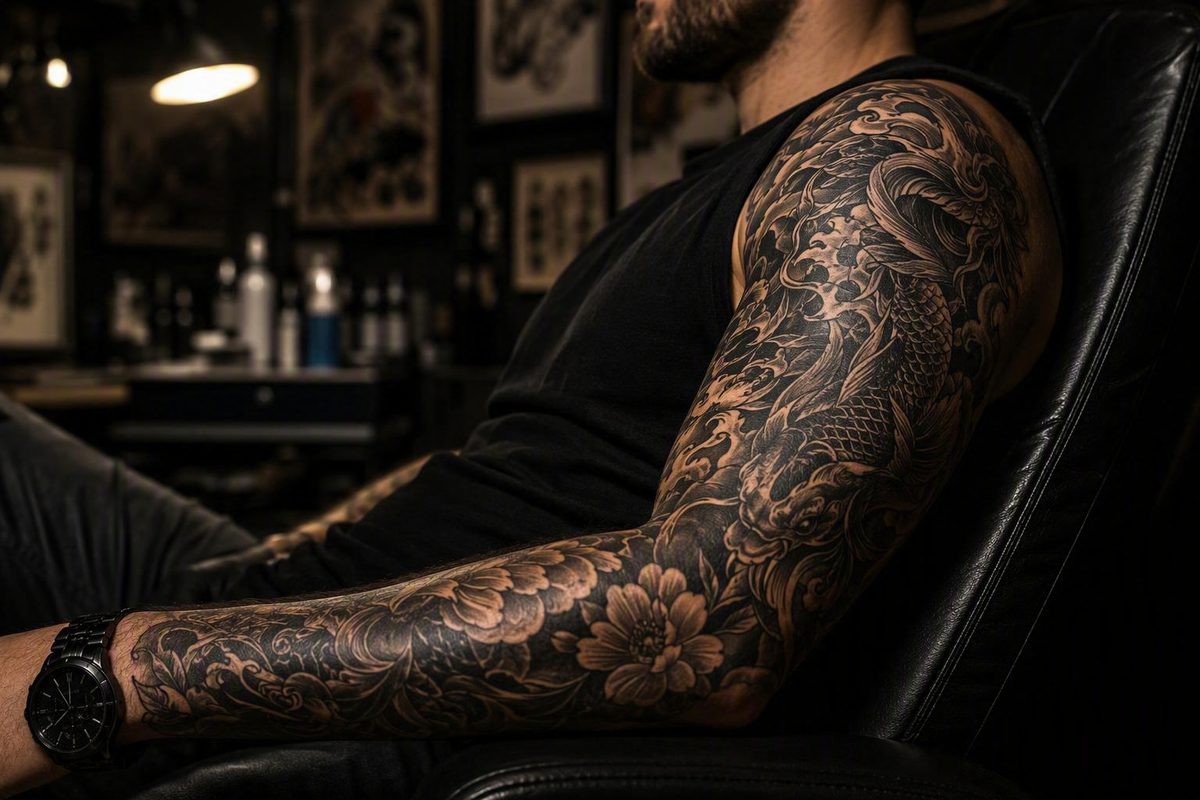
The short answer: plan for roughly $1,000–$3,000, then price your design
For planning purposes, roughly $1,000–$3,000 is a useful starting budget for many half-sleeve tattoos in the United States. This is not a guaranteed price or a statistically established national average. A design may cost less if it uses limited detail, substantial negative space, or narrower coverage. Dense realism, intricate geometry, extensive color or shading, premium markets, and sought-after artists can push the price above $3,000.
Published estimates do not align neatly. Neebol’s commercial tattoo-supply guide estimates approximately $1,000–$3,000 for a U.S. half sleeve and notes that premium artists may charge more. The guide does not disclose a representative national survey method, so its range is best treated as planning guidance rather than a measured market average. See Neebol’s 2026 sleeve-tattoo pricing guide.
Tattoo Studio Pro gives a lower $500–$1,500 headline estimate, but its more detailed scenarios begin around $800 and reach $2,500 or more, depending on detail, color, and artist level. That internal spread illustrates why a headline range may not describe a connected, wraparound design with dense coverage. Compare Tattoo Studio Pro’s headline range and detailed scenarios.
Removery also publishes a $500–$1,500 half-sleeve estimate. Its wider discussion of sleeve pricing is less consistent, however, and it does not explain how the estimate was calculated. The lower band may be achievable, but it should not be assumed to cover every half sleeve. Review Removery’s tattoo-price estimates and cost factors.
The cited ranges can be reconciled as design scenarios, rather than as one universal average:
| Planning scenario | Approximate tattoo fee | What might fit |
|---|---|---|
| Simpler or lighter-coverage work | $800–$1,500 | Bold shapes, limited detail, open skin, narrower coverage, or a lower artist rate |
| Moderately detailed work | $1,200–$2,500 | A connected composition with meaningful shading, color, background work, or broader wraparound coverage |
| Intricate or premium work | $2,500–$5,000+ | Dense realism, portraits, elaborate geometry, extensive color or shading, cover-up constraints, premium markets, or an in-demand specialist |
These are synthesized planning tiers, not statistically established national averages. They overlap because the variables overlap. A simple design by a high-demand specialist can cost more than a detailed design by an artist with a lower rate. A moderate concept can also move into the premium tier if it requires substantially more working time than expected.
It is much less dependable for a dense composition that connects and wraps around half the arm.
At the other end, published premium rates and longer time estimates show how a project can reach or exceed $5,000. For example, 15 hours at $350 per hour equals $5,250. That arithmetic does not establish $5,250 as a standard price; it demonstrates how time and rate interact.
The answer to “how much is a half sleeve tattoo?” therefore has two parts:
- Use $1,000–$3,000 as an initial U.S. planning range for many projects.
- Replace that range with a design-specific written estimate from your chosen artist.
The artist’s estimate can account for your arm, exact boundaries, intended detail, existing tattoos, references, and the artist’s own workflow and billing model.
What counts as a half sleeve?
A half sleeve generally means a connected tattoo composition covering roughly half the arm. The two common placements are:
- Upper-arm half sleeve: approximately shoulder to elbow
- Forearm half sleeve: approximately elbow to wrist
Removery likewise describes half sleeves as covering either the bicep or forearm. In conventional use, the composition wraps around the arm and reads as a unified project rather than as one isolated image. See Removery’s description of half-sleeve placement.
An outer-bicep portrait or large forearm emblem may occupy substantial space without requiring the work associated with a connected sleeve. Consider two projects that both extend from shoulder to elbow:
- One has a central image on the outer arm, several small supporting elements, and open skin between them.
- The other wraps fully around the arm, with a background connecting every element and shading filling most gaps.
The dimensions may be similar, but the second project can require more composition work, stencil placement, tattooing, and refinement.
There is no supported rule that an upper-arm half sleeve is categorically cheaper or more expensive than a forearm half sleeve. Placement can affect layout, anatomical transitions, and working time, but the upper-versus-lower label does not determine the price by itself.
When requesting a quote, describe the project rather than writing only “half sleeve.” Include:
- Whether it is on the upper arm or forearm
- Approximate start and end points
- Arm measurements or approximate dimensions
- Whether the design covers only the visible outer arm or wraps fully
- How much open skin you want to retain
- Existing tattoos that must be incorporated, avoided, or covered
- Whether the design must connect to future shoulder, chest, wrist, or full-sleeve work
The term half sleeve establishes the general scale. Coverage density, technical demands, artist rate, and working time establish the price.
Calculate the tattoo fee from hours and the artist’s rate
The simplest preliminary formula is:
Estimated tattooing hours × artist’s hourly rate = estimated tattoo fee
This is a planning calculation, not necessarily the artist’s final billing method. Some artists charge by the session or day, while others provide a fixed quote for the complete project. Expected labor, complexity, and coverage can still inform those prices.
Published U.S. guidance places many general tattoo rates around $100–$300 or more per hour, with some premium categories reaching approximately $350–$400 or more. Neebol lists approximately $100–$150 for beginner or apprentice categories, $150–$250 for experienced professionals, and $250–$400 or more for top-tier artists. These are commercial guide figures, not standardized national rates. See Neebol’s published hourly-rate categories.
The following table is illustrative arithmetic using hour and rate inputs found within the broad published guidance:
| Hourly rate | 6 hours | 9 hours | 12 hours | 15 hours |
|---|---|---|---|---|
| $100/hour | $600 | $900 | $1,200 | $1,500 |
| $175/hour | $1,050 | $1,575 | $2,100 | $2,625 |
| $250/hour | $1,500 | $2,250 | $3,000 | $3,750 |
| $350/hour | $2,100 | $3,150 | $4,200 | $5,250 |
Four examples show how quickly the result changes:
- 6 hours × $100 = $600
- 9 hours × $175 = $1,575
- 12 hours × $250 = $3,000
- 15 hours × $350 = $5,250
The $600 result is a possible limited-detail, lower-rate scenario—not a promise that a typical connected half sleeve can be completed for $600. It requires both a low rate and a short estimate. If either input rises, the price rises with it.
Los Angeles pricing should be treated separately from general U.S. guidance. Art Collector Tattoo Studio lists local rates of $50–$130 per hour for junior artists, $150–$300 for experienced artists, and $300–$500 for pro or famous artists. Its large 12-by-7-inch upper-arm example reaches $3,000–$5,000 at the pro level, but the studio does not identify that example as a complete half sleeve. Review Art Collector Tattoo Studio’s Los Angeles rates and size examples.
Before applying the formula, establish what the quoted “hours” include. Ask whether the artist charges for:
- Active tattooing only
- Stencil placement or repositioning
- Setup and breakdown
- Consultation
- Drawing or digital composition
- Requested revisions
- Breaks during the appointment
A nine-hour estimate can lead to different bills if one artist charges only for tattooing while another includes design or setup time. Defining chargeable time matters as much as multiplying the numbers.
If the artist charges by the session or project, ask for the likely complete total. A $900 session price does not resolve your budget if you do not know whether the design will require two sessions or four.
Why two half sleeves can have very different prices
- How much chargeable time the project requires
- How much the selected artist charges for that time or project
Several design and market factors influence those variables.
Artist experience and demand. A specialist with a long waiting list may charge a higher hourly, session, day, or project rate. Demand is separate from speed: an experienced artist may work efficiently while still commanding a premium.
Local market. Rates vary among cities, regions, studios, and artists. An expensive market can produce higher quotes, but premium Los Angeles pricing should not be generalized to every U.S. city.
Design complexity. Bold forms, uncomplicated fills, and open compositions may take less time than portraits, realism, delicate transitions, repeated patterns, or intricate geometry. The relevant difference is not just the number of elements; it is the precision and number of passes required to execute them.
Coverage density and negative space. A design that leaves deliberate areas of untattooed skin may require less tattooing than one with solid backgrounds and dense connective material. Negative space does not create a fixed discount, however. Its effect depends on how it changes the composition and workload.
Color and shading. Color is not automatically more expensive than black-and-grey. A detailed black-and-grey portrait with smooth tonal transitions may take longer than a simpler color design. Conversely, a color project requiring extensive layering, saturation, and transitions may demand more time than a bold black design. Think Tank Tattoo similarly treats color, complexity, coverage, revisions, and artist demand as interacting variables rather than as automatic surcharges. Read Think Tank Tattoo’s discussion of sleeve-pricing factors.
Placement and anatomy. Wrapping a coherent image around an arm can involve more layout work than placing one flat image on the outer arm. Elbows, inner arms, wrist transitions, and connections to existing pieces can affect placement and execution. Placement matters through its effect on the specific project—not through a universal forearm surcharge or upper-arm discount.
Existing work and cover-ups. Incorporating an existing tattoo can constrain the composition. A cover-up may require additional design work or denser imagery, but the evidence does not support a universal percentage surcharge. The artist must assess the existing tattoo and proposed result.
Revisions and changing scope. A quote based on one central figure and an open background may no longer apply if the concept becomes a fully filled composition. Additional revision rounds, major stencil changes, or expanded boundaries can add working time.
Actual tattooing time. A preliminary estimate can change once work begins. The design may evolve or require more time than anticipated. Unless the artist has provided a fixed project price with a clearly defined scope, the initial estimate may not be the final invoice.
Do not divide a full-sleeve estimate in half and treat the result as a half-sleeve quote. Full sleeves have different total areas, transitions, composition requirements, and schedules. Price the actual project instead.
How many hours and sessions should you expect?
A practical planning span is approximately 6–15 tattooing hours. Neebol estimates 6–12 hours, while Tattoo Studio Pro estimates 8–15 hours. Both describe completion across approximately two to four sessions, but neither source provides a representative national sample, and neither schedule should be treated as mandatory. Compare Tattoo Studio Pro’s time and session estimates.
The wide span reflects substantial differences among projects. A shorter design might use bold forms, open skin, and limited wraparound coverage. A longer project might include fine detail, dense backgrounds, portraits, repeated geometry, or multiple tonal transitions.
Session count does not determine the total cost by itself. Consider two hypothetical schedules:
- Nine tattooing hours completed in three three-hour appointments
- Nine tattooing hours completed in two appointments of four and five hours
If the artist charges the same hourly rate and does not add separate session charges, the tattoo fee can be identical. The schedule changes when you pay, but not necessarily how much you pay.
The number and length of appointments can be affected by:
- Design complexity and coverage
- The artist’s normal workflow
- The client’s tolerance and ability to remain still
- How outlining, shading, backgrounds, and color are divided
- Healing between stages
- Design changes after the first appointment
- The amount of working time booked on each date
Although published guides commonly describe two to four appointments, that is guidance rather than a rule.
Multi-session booking can make cash flow easier because payments may be spread across several dates. It does not inherently reduce the complete project price. Ask for both:
- The expected number of sessions
- The likely complete fee or fee range
A per-session price without an expected session count leaves the budget unresolved.
Build an all-in budget beyond the artist’s quote
The artist’s tattoo fee and your complete cash budget may not be the same. Depending on the studio’s written terms and your circumstances, you may also need to plan for:
- Optional gratuity where locally customary
- Aftercare supplies
- Travel, parking, lodging, or meals
- A separately billed design charge
- Paid touch-ups
- Additional working time beyond the original estimate
- Any other charges disclosed by the studio
Neebol publishes an aftercare estimate of approximately $20–$50 and reports gratuity figures of 15%–30%. Tattoo Studio Pro recommends 15%–20% and approximately $20–$40 for aftercare. These gratuity figures are commercial-guide recommendations, not universal obligations; local customs and individual policies vary.
For a narrow illustration, suppose the tattoo fee is $1,500, a gratuity of 15%–20% is customary in your situation, and aftercare costs approximately $20–$50:
- Tattoo fee: $1,500
- Optional gratuity: $225–$300
- Aftercare: approximately $20–$50
- Illustrative total: $1,745–$1,850
The arithmetic reflects the ranges reported by the cited guides. It excludes travel, separately billed design work, paid touch-ups, additional tattooing time, and any other disclosed studio charges.
A practical budget has three separate lines:
- Expected tattoo fee: Estimated hours multiplied by the rate, or the quoted project price.
- Contingency: Money reserved for additional working time or an approved change in scope.
- Optional and incidental expenses: Aftercare, travel, parking, optional gratuity, and separately billed services.
Do not assume that consultation, drawing, revisions, setup, aftercare, or touch-ups are included merely because no separate charge appeared in an initial message. Ask for a written list of inclusions and exclusions.
If touch-ups are included under certain conditions, confirm the eligibility period, what qualifies, and whether missed appointments or changes to the original design affect the policy.
Also distinguish between a cost and a payment-timing issue. A deposit credited toward the tattoo is part of the tattoo fee rather than an additional expense. Travel and aftercare generally sit outside the artist’s quoted tattoo price.
Understand deposits, payment timing, and overruns
Commercial tattoo-pricing guides commonly mention deposits around $100–$300, but an individual artist may require a different amount or use a percentage. A deposit often reserves calendar time and is credited toward the tattoo balance. It should not automatically be added on top of the quoted total.
For example, if the quoted tattoo fee is $2,000 and you pay a $200 credited deposit, the remaining tattoo balance is $1,800. The calculation changes if the artist identifies a separate, noncredited booking or design charge, which is why the written terms control.
Obtain written information covering:
- Whether the deposit is credited to the project
- Whether it is applied at the first or final session
- Whether it is refundable
- Whether it can be transferred to another date or design
- How much notice is required to reschedule
- What happens after a late arrival, cancellation, or missed appointment
- Whether a new deposit is required after a policy violation
Large projects may use a phased structure: a reservation deposit followed by payment after individual appointments. Think Tank Tattoo describes this approach while distinguishing hourly pricing from project-based pricing. See Think Tank Tattoo’s discussion of deposits, sessions, and pricing models.
No single billing model is universally preferable.
Hourly pricing can be transparent when the scope may evolve, but the total is less certain if the project takes longer than estimated. Ask for an expected range of hours, what counts as billable time, and how overruns will be communicated.
Per-session pricing makes the amount due at each appointment clear, but it can obscure the complete cost unless the artist also provides an expected session count. Confirm the scheduled session length and how interrupted or shortened appointments are handled.
Fixed-project pricing can provide greater certainty when the design and boundaries are settled. Confirm whether the price includes drawing, setup, requested revisions, stencil changes, all necessary sessions, and any eligible touch-up.
For any model, request the likely complete total. If the artist offers one, you can also ask for a maximum planning estimate or a point at which work will pause for a budget discussion. Not every artist will agree to a price cap, particularly if the design is still evolving.
A sound arrangement answers three questions before work starts:
- What is included?
- When is each payment due?
- What happens if the project takes longer or changes?
How to request and compare half-sleeve quotes
A useful quote begins with a useful brief. “How much for a half sleeve?” does not give an artist enough information to estimate the work accurately.
Include the following in your request:
- Upper arm or forearm
- Left or right arm
- Approximate dimensions and start/end points
- Outer-arm coverage only or a full wrap
- Preferred style
- Color, black-and-grey, or a mixture
- Desired level of detail and coverage density
- Amount of negative space
- Clear reference images, with notes about what you like in each
- Photographs of the arm in good light
- Existing tattoos or other relevant features
- Whether the project involves a cover-up
- Whether it should connect to future work
Ask the artist to explain the pricing structure:
- Is the project hourly, per session, per day, or fixed price?
- What rate applies?
- How many tattooing hours are expected?
- How many appointments are likely?
- What deposit is required?
- Is the deposit credited to the tattoo fee?
- When are the remaining payments due?
Ask what the quote includes:
- Consultation
- Drawing and design time
- A stated number of revisions
- Stencil changes
- Setup
- Aftercare products
- Touch-ups
- Any other studio charges
Finally, ask how changes are handled:
- What happens if the design becomes larger or denser?
- How will you be told if more time is required?
- Is approval required before exceeding the estimated range?
- What happens if you or the artist must move an appointment?
- Does a substantial concept change require a new quote or deposit?
When comparing an hourly estimate with a fixed quote, convert both into a likely total and compare their scope. Suppose one artist estimates 10–12 hours at an hourly rate while another gives one fixed figure. The fixed quote is not automatically cheaper or more expensive. It may include drawing and revisions that sit outside the hourly estimate—or exclude changes the hourly artist would accommodate.
Do not choose solely on the lowest number. Compare:
- Portfolio fit for the exact style
- Experience with wraparound arm compositions
- Relevant healed work where available
- Understanding of the proposed coverage
- Clarity of the quote and payment terms
- What is and is not included
- How potential overruns will be communicated
Art Collector Tattoo Studio describes tattoo pricing as the hourly rate multiplied by required time, with possible adjustments for complexity, color, or placement, while emphasizing that individual projects require individual quotes. That framework illustrates why a detailed brief matters even when public rates are available. See the studio’s tattoo-price calculation framework.
Use this worksheet before booking:
| Budget item | Your figure |
|---|---|
| Estimated hours | _____ |
| Hourly rate, if applicable | $_____ |
| Hours × rate | $_____ |
| Quoted tattoo fee | $_____ |
| Deposit credited toward fee | − $_____ |
| Remaining tattoo payments | $_____ |
| Contingency for additional time | $_____ |
| Aftercare | $_____ |
| Travel and parking | $_____ |
| Optional gratuity | $_____ |
| Other disclosed charges | $_____ |
| Estimated all-in cash budget | $_____ |
A broad $1,000–$3,000 budget remains a useful starting point for many U.S. half sleeves, but it is not a fixed market price. Translate the design into expected working hours, account for the artist’s rate or project fee, reserve a contingency, and add incidental expenses. The final written estimate from an artist who has reviewed your arm and concept is the best available answer for your individual project.
Frequently asked questions
Is $500 enough for a half-sleeve tattoo?
Possibly, but it is not a dependable budget for every half sleeve. Around $500 is more plausible for limited detail, narrower coverage, substantial negative space, or a comparatively low rate. A connected composition with broad wraparound coverage, shading, backgrounds, or intricate detail is likely to require a larger budget. Ask an artist to price the actual concept before assuming $500 will cover it.
Does an upper-arm half sleeve cost more than a forearm half sleeve?
Not categorically. Artists consider dimensions, wraparound coverage, placement challenges, detail, and expected working time. Either placement can cost more depending on the project. Provide photographs, measurements, exact boundaries, and an explanation of how fully the design should wrap.
Is a color half sleeve always more expensive than black-and-grey?
No. Color may require additional layering or saturation in some designs, but detailed black-and-grey realism, portraits, smooth shading, or intricate textures can take as much time or more. Compare the expected hours and technical demands of the specific designs rather than treating color as an automatic surcharge.
Can I pay for a half sleeve one session at a time?
Often, yes. Large projects may be paid in stages, with a deposit followed by payment after each appointment. The artist may instead use a fixed-project, day-rate, or other arrangement. Paying by session spreads the expense over time but does not necessarily reduce the complete cost. Confirm the likely number of sessions, the amount due at each one, and the projected total.
Is the tattoo deposit included in the final price?
It is often credited toward the tattoo balance, but the artist’s written policy controls. Do not assume the deposit is either an extra charge or refundable. Confirm how it is applied and review the cancellation, rescheduling, transfer, and missed-appointment terms before paying.