
What the Kat Von D Tattoo Case Actually Proves
Kat Von D’s traced Miles Davis tattoo defeated an infringement claim before a jury and appellate panel, but the pending rehearing limits that precedent.
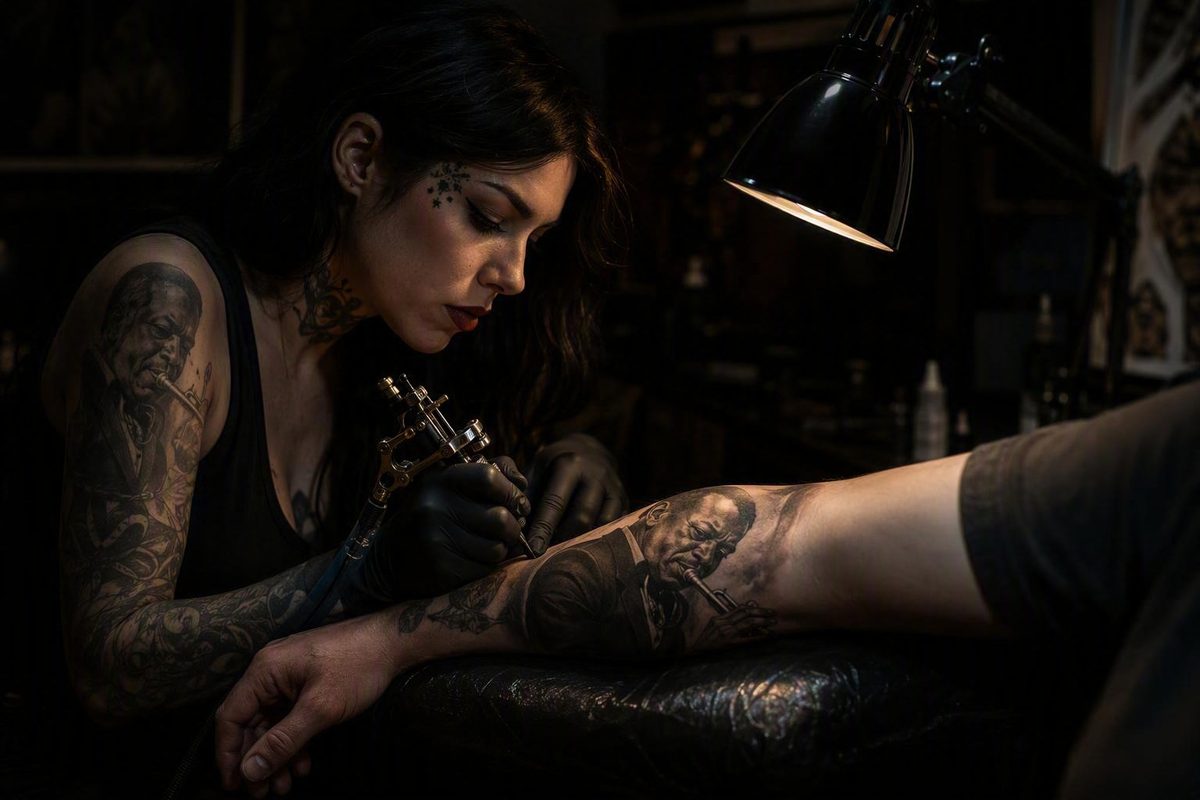
A tattoo traced directly from a copyrighted photograph has now cleared an infringement claim twice: first before a jury, then before a unanimous three-judge Ninth Circuit panel. Kat Von D projected Jeffrey Sedlik’s Miles Davis portrait on a light box, traced it, made a stencil, and tattooed with the photograph beside her, yet the jury found the tattoo was not substantially similar to Sedlik’s protected expression. The appellate panel affirmed before its opinion was vacated for en banc rehearing (PetaPixel’s account of the case and rehearing).
That does not make copying a photo for a tattoo automatically lawful. A photo-based tattoo can infringe when it reproduces protected creative expression without permission and no defense applies. The narrower verdict is that tracing, stencil transfer, and obvious reference use do not establish infringement by themselves.
This is general information about U.S. copyright law, not legal advice for a particular tattoo. Ownership, permission, the source and finished images, planned publication, governing jurisdiction, and subsequent court rulings can change the analysis.
The Consensus View Identifies a Real Risk
Coverage of the rare full-court rehearing has understandably treated the case as a possible threat to tattoo artists and clients who bring them reference photographs. Tattooing has no categorical copyright exemption. Moving an image from a photograph onto skin does not erase the photographer’s rights, and the client’s possession of a screenshot or print does not establish permission.
That warning is correct within limits. A faithful transfer can preserve a photographer’s composition, pose, lighting, crop, expression, styling, and arrangement. Charging for the tattoo or publishing the process may introduce additional facts rather than curing the problem.
The coverage becomes misleading only when the rehearing is presented as the first serious legal test of photo-to-skin copying. The most direct, well-documented example already survived two rounds of scrutiny. The en banc court is reconsidering the Ninth Circuit’s similarity methodology, particularly its subjective “intrinsic test,” rather than announcing a tattoo-specific crackdown. Granting rehearing neither establishes infringement nor predicts the final result.
Choose the source, copying method, and publication plan; the walkthrough separates the recorded Sedlik result from practical clearance risk.
The default selections reproduce the documented Sedlik facts. Change any selection to see which practical side wins: proceeding on the current record or obtaining clearance first.
These defaults match the documented light-box trace, stencil transfer, use of a stranger’s copyrighted Miles Davis photograph, and public process images. The jury found the tattoo and sketch not substantially similar; four social posts separately received fair-use findings. The panel opinion was later vacated for en banc rehearing.
How Each Fact Changes the Analysis
Reference Scenarios From the Article
| Scenario | Copying Evidence | Recorded or Practical Status | Takeaway |
|---|---|---|---|
| Sedlik facts: projected trace, stencil, public process posts | Direct and publicly documented | Jury win and panel affirmance; panel later vacated | No substantial similarity for tattoo and sketch; separate fair use for four posts |
| Exact trace without permission | Strong | Fact-dependent | Tracing proves use more readily than infringement |
| Close recreation retaining the central composition | Strong | Higher practical risk | Minor changes may preserve protected expression |
| Loose reference with new pose, lighting, and crop | Present but more distant | Lower, fact-dependent risk | More expressive choices come from the tattoo artist |
| Independent depiction of the same person | Source not used | Lower practical risk | Shared subject matter alone does not prove copying |
| Use licensed for the tattoo and planned posts | May be direct | Lower within license scope | Read the terms; one use may not cover another |
| Verified public-domain photograph | May be direct | Lower copyright risk | Verification matters; online availability is not public-domain status |
| Paid advertising or merchandise | Depends on design | Separate review warranted | Downstream uses should not be collapsed into the tattoo itself |
This walkthrough sorts practical clearance factors; it cannot predict a court result. No percentage or number of edits guarantees that a design is sufficiently different.
Sources: Sedlik v. Von Drachenberg reporting and case summaries cited in the article. Status shown through August 31, 2026; no en banc merits decision appears in the supplied sources.
Sedlik Involved Direct Tracing, Not Loose Inspiration
Photographer Jeffrey Sedlik created the Miles Davis portrait in 1989. According to a case summary, Sedlik positioned Davis’s fingers, adjusted his hair, selected his wardrobe and jewelry, and directed his facial expression. Those decisions matter because copyright protects the photographer’s particular treatment, not the general idea of portraying Miles Davis making a quiet gesture (Loeb & Loeb’s case summary).
Von D’s process was unusually easy to document. She projected the photograph on a light box, traced it, prepared a stencil, and used the photograph as a reference while tattooing. Images of the process appeared on Instagram. If a plaintiff wanted a fact pattern demonstrating actual use of a photograph, this was a strong one.
The jury nevertheless separated proof of copying from actionable infringement. In January 2024, it found the tattoo and related sketch were not substantially similar to Sedlik’s protected photograph. It therefore found no infringement as to those works.
The jury did not find that the tattoo itself was fair use. It separately found fair use for four social-media images documenting the tattoo process. That distinction matters: the tattoo and sketch prevailed at the substantial-similarity stage, while the posts prevailed under a separate defense.
A three-judge Ninth Circuit panel affirmed the result in January 2026. Two judges criticized the circuit’s intrinsic test while applying the existing framework. The Ninth Circuit then granted en banc rehearing on June 9, 2026, vacating the panel opinion so a larger court could reconsider the case.
As of the August 31, 2026 reporting cutoff used here, the supplied sources identified no en banc merits decision. An August 28 report said argument was scheduled for the week of September 28, although that report also contains older procedural passages inconsistent with its updated introduction. Anyone relying on the present status should check the Ninth Circuit docket rather than treating secondary coverage as final (LawFold’s case update).
Two Victories Do Not Create a Tattoo Exemption
The jury verdict remains a fact-specific decision about the works, evidence, instructions, and claims presented. The vacated panel opinion no longer supplies binding appellate precedent. The en banc court could alter the legal test, order further proceedings, or otherwise change the case’s significance.
Even so, the procedural history defeats the claim that direct tracing is automatically infringement. Von D did not merely study Davis’s face before producing a new pose. Her documented process involved projection, tracing, stencil preparation, close reference, and public posting. The tattoo still cleared the jury’s substantial-similarity analysis, and that result initially survived appellate review.
The proper scope is narrow:
- Tracing is strong evidence that the source was used, but use is not the complete infringement test.
- The tattoo verdict rested on lack of substantial similarity, not an automatic fair-use rule for skin.
- The four social-media images received distinct fair-use findings.
- The panel victory occurred, but its opinion was vacated when rehearing was granted.
- No supplied source reports a final en banc merits decision by the stated cutoff.
The case therefore supplies neither a permission slip nor a zero-tolerance rule. It shows why courts distinguish access and copying from the legal question of whether protected expression was taken to an actionable degree.
Copyright Protects the Photograph’s Treatment, Not Its Subject
A photographer cannot use copyright to control every depiction of the person, animal, building, object, or gesture appearing in a photograph. Protection concerns the original expressive choices embodied in that particular image.
For a portrait, those choices can include composition, pose, expression, lighting, shadows, camera angle, distance, crop, wardrobe, jewelry, props, background, and selection of the captured moment. Sedlik’s direction of Davis is relevant because it identifies choices attributable to the photographer rather than the bare subject of Miles Davis.
Two tattoos of the same person can therefore present different issues. An independently composed portrait with a new viewpoint, expression, lighting scheme, wardrobe, and background may share only the subject. A tattoo retaining one photograph’s distinctive pose, crop, shadows, expression, styling, and arrangement presents a closer comparison.
There is no sourced percentage, required number of edits, or universal recipe that guarantees sufficient difference. Changing the medium, removing a background, converting tones to linework, adding ornament, or changing colors may create differences without necessarily replacing the source’s expressive core.
Permission, Copying, and Similarity Are Separate Questions
A practical analysis begins with the source photograph and its owner. The photographer may own the copyright, but rights can be transferred or affected by an employment arrangement. Approval from the person depicted is not necessarily permission from the photographer. A client who sends a file likewise cannot license rights the client does not possess.
The next question is authorization. A written license may cover tattooing, preparatory drawings, stencils, portfolio photography, process footage, social posts, advertising, or merchandise. Permission for one use should not be assumed to cover all of them. Labels such as “stock,” “royalty-free,” or “open license” do not replace the actual terms.
Evidence of copying comes next. Projection, tracing, design files, messages, process videos, and photographs showing the source beside the stencil can all demonstrate use. Indirect proof may combine access with similarities.
Only then does the comparison focus on protected expression. The court or jury asks whether the challenged work reproduces enough protectable material to satisfy the governing similarity standard. That is where Von D prevailed, despite unusually strong evidence that she had used Sedlik’s photograph.
The applicable doctrine can vary by jurisdiction. The current Sedlik dispute specifically implicates the Ninth Circuit’s division between extrinsic and intrinsic similarity analysis. Artists should not assume that a result under that framework determines litigation elsewhere.
Moving the Image to Skin Is Not Automatically Fair Use
Fair use is a separate defense, not a rule that every change of medium is transformative. U.S. analysis generally considers the purpose and character of the use, the nature of the copyrighted work, the amount and importance taken, and effects on relevant potential markets. The factors are assessed together (Tucker Ellis on tattoos and fair use).
A paid tattoo is not automatically infringing, and a free tattoo is not automatically fair use. Personal significance, permanence, craftsmanship, and artistic quality may form part of the context, but none independently eliminates the photographer’s rights.
Attribution does not replace authorization either. Crediting the photographer may be ethically appropriate or required by a license, but “inspired by” is not a universal defense.
The Sedlik verdict demonstrates why similarity and fair use should remain distinct. The jury found no actionable similarity in the tattoo and sketch, so those works did not need a tattoo-specific fair-use exemption. It separately applied fair use to four social posts.
Publishing the Process Creates Another Rights Question
Creating a tattoo and publishing it are different acts. A healed-tattoo photograph, process reel, sponsored post, studio advertisement, convention banner, book, print, shirt, or licensed promotional image can involve separate reproductions and purposes.
The distinction does not mean every photograph showing a tattoo infringes. News coverage, documentaries, incidental appearances, games, portfolio displays, advertising, and merchandise can involve different facts, permissions, amounts, and defenses. It means that clearance for the tattoo should not silently be treated as clearance for every downstream use.
For a planned close copy, written permission can identify the photograph and state whether it covers one tattoo, drawings and stencils, portfolio images, process video, organic social posts, paid advertising, editorial use, prints, or merchandise. The needed terms depend on the project; there is no universal license language.
The source photograph, original additions made by the tattoo artist, and the depicted person’s likeness can also involve different rights. A tattoo may contain protectable original artwork if it satisfies copyright requirements, but protection for added lettering, shading, or ornament does not erase rights in borrowed material. Publicity, privacy, and contractual rights involving the depicted person are separate from the photograph’s copyright (Copyright Alliance’s tattoo copyright overview).
Close Copies Deserve Clearance Before the Stencil
For a recognizable recreation, identify where the image originated and who controls it. A search result, repost, mood board, wallpaper site, screenshot, or client-supplied print usually establishes only where a copy was found.
Review any stated license rather than relying on its label. Confirm whether it permits the intended tattoo, alterations, commercial work, attribution, portfolio publication, advertising, and other planned uses. Preserve the source link, displayed terms, correspondence, final permission, invoices, drafts, and publication approvals.
If permission is unavailable, the practical alternatives are to commission an original reference photograph with documented rights, license another suitable image, use a verified public-domain source, or develop a genuinely new composition. Drafts using multiple lawful references can help document the artist’s own choices, although records do not guarantee that a claim will fail.
A client sourcing form can preserve what the client represented, but it is not armor against the actual owner. High-profile portraits, disputed ownership, close reproductions, merchandise, substantial advertising, cross-border publication, or an existing complaint warrant advice from a copyright lawyer in the relevant jurisdiction before tattooing or publication.
The Working Rule Is Distance or Permission
The closer a tattoo remains to one photograph’s recognizable creative choices, the stronger the practical reason to obtain written permission. An original composition, verified public-domain source, or appropriate license covering both tattooing and intended promotion reduces uncertainty.
Sedlik v. Von Drachenberg does not abolish that rule. It establishes something more precise: even a publicly documented light-box trace can fail to infringe when the fact-finder concludes that the finished tattoo is not substantially similar to the photograph’s protected expression. That happened before a jury and initially before a unanimous appellate panel, while the legal test itself remains under en banc review.