
Tattoo Meanings: Symbols, Stories and Cultural Context
Explore tattoo meanings through anchors, swallows, lotuses, dragons and semicolons—and learn how personal stories and cultural context change the reading.
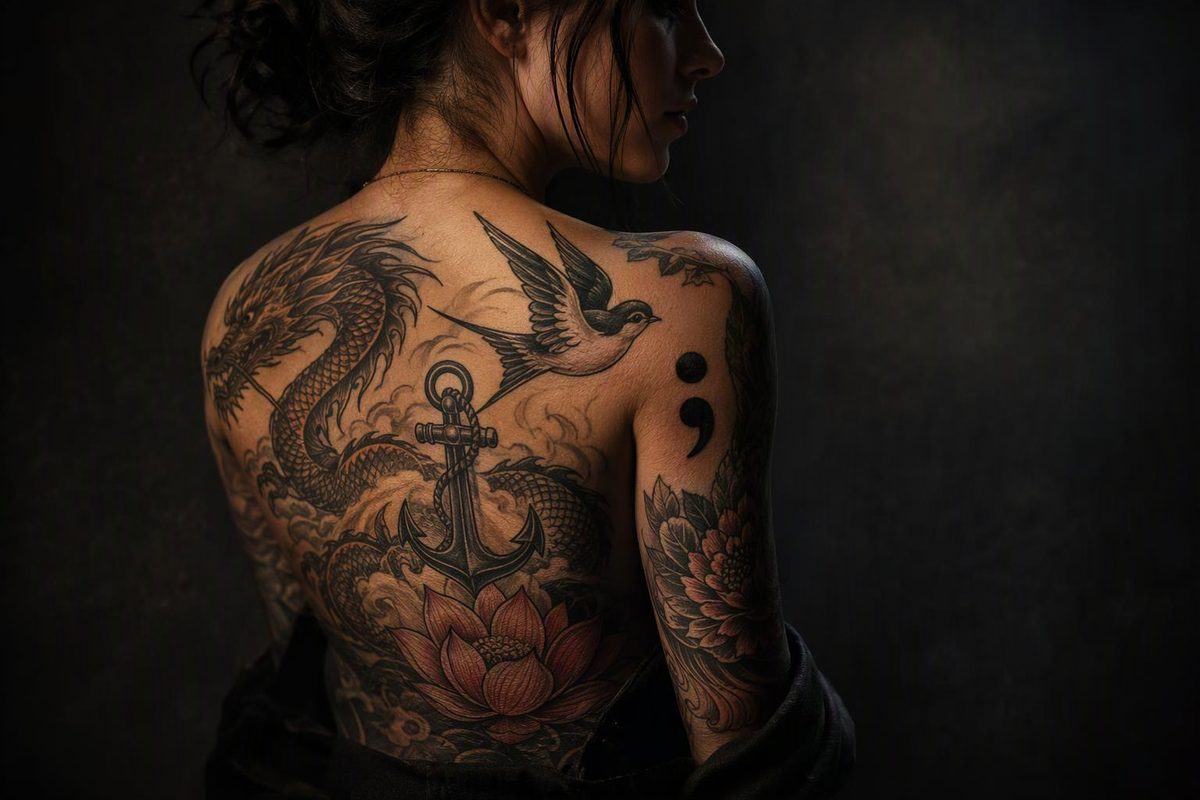
An anchor can mark a sea crossing, stand for someone who keeps you grounded, or simply be a design you like. Tattoo meanings are not a single code: a motif’s history, its surrounding details and the wearer’s intention can point in different directions.
The useful question is not just “What does this symbol mean?” It is “Where does that interpretation come from—and does it fit this particular tattoo?”
Five tattoo meanings worth understanding
These examples have identifiable sources behind them. They are starting points for interpretation, not rules for reading strangers’ bodies.
Anchor: a voyage or a grounding influence
The Historic Dockyard Chatham describes an anchor tattoo as a sign of a successful Atlantic crossing in sailor tradition. It also identifies the anchor with stability, and an anchor with a name in a banner as a tribute to someone who keeps the wearer grounded. Those are related but distinct readings: one records a voyage; another describes a relationship.
A wearer’s account can add another meaning. In the National Museum of the American Sailor’s exhibition, HM2 Tracy Blackmond-Mills describes an anchor tattoo as a reminder to stay grounded, steady and ready, and of an obligation to the country.
For your own design, a name, date or ship can make the intended story more specific. An anchor alone does not prove that its wearer has crossed an ocean.
Swallow: sailing experience, homecoming or remembrance
Chatham’s account associates each swallow with 5,000 nautical miles in a sailor’s career, and also connects the bird’s migration with finding the way home. Add a dagger and the museum describes a memorial to a comrade lost at sea.
That small addition changes the reading substantially. Identify the whole composition, not just the bird.
Lotus: purity, awakening and transformation
The Rubin Museum of Himalayan Art identifies the lotus with purity, awakening, transformation and compassion in Buddhist and Hindu traditions. Its growth from murky water to a bloom above the surface also supplies a metaphor for resilience. The museum shows how lotuses appear as thrones and attributes of particular sacred figures—not merely as standalone flowers.
A wearer might choose a lotus for personal renewal, but a lotus beneath a deity has a more specific religious context. Our guide to lotus tattoo symbolism explores that distinction.
Dragon: the tradition changes the message
Even “dragon” is too broad to decode by itself. In Chatham’s sailor-tattoo account, a dragon records travel to Asia, while a golden dragon marks crossing the international date line.
In a different setting, the Metropolitan Museum of Art explains how five-clawed dragons and their arrangement on an eighteenth-century Chinese court robe identify an imperial-family wearer. That is evidence about a particular historical garment, not a rule that every five-clawed dragon tattoo claims royal status.
Start by identifying the reference tradition. Our dragon tattoo meaning guide separates Chinese, Japanese and European contexts.
Semicolon: continuation and solidarity
Project Semicolon, the mental-health and suicide-prevention organization, presents the semicolon as a declaration that a person’s story is not over. It explicitly says the tattoo is not exclusive to participants in the project and has no official placement.
That association can help explain a design, but it does not disclose the wearer’s medical history. Nor does it entitle anyone to ask for that history.
Cultural context is more than a meaning label
A list that translates every line or spiral into a personality trait can miss how a tattoo tradition actually works.
Te Papa describes tāmoko as an interplay of aesthetics, identity and role, while noting uncertainty around some historical interpretations of status and genealogy. As one contemporary studio’s approach, Ōtautahi Tattoo distinguishes tā moko primarily for people of Māori descent from kirituhi for non-Māori clients, and describes consultation and individually drawn designs.
The practical lesson is to consult a practitioner within the relevant tradition rather than copying another person’s markings or relying on a generic symbol chart. Personal intent matters, but it is not a substitute for cultural context.
Turn the meaning into an artist brief
Before choosing a reference, write down:
- Your intention: “I want this to remember my brother,” rather than only “I want a bird.”
- The source: a family photograph, a named artwork, a tradition or a motif you simply enjoy.
- The important details: names, companion symbols, colors or features you want preserved—and associations you want to avoid.
Then discuss how the artist can express that intention at the proposed size and placement. Browse different tattoo styles for visual approaches, or tattoo ideas if you are still choosing a subject.
Liking the image is also a valid reason. You do not need to invent a profound meaning to justify a tattoo.