
Use AI References Without Handing Over the Design
Learn when an AI tattoo reference helps, what artists may reject, and how to turn size, placement, text, detail, and cultural concerns into a brief.
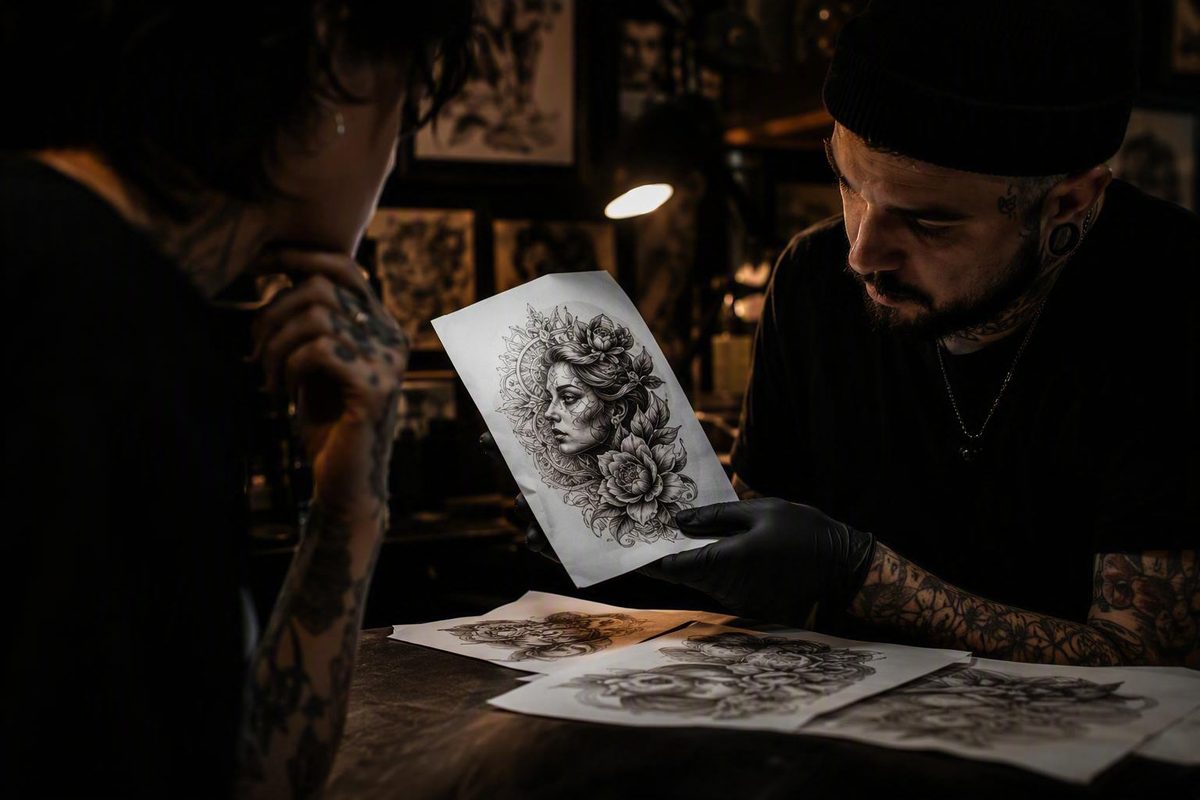
Yes—bring an AI-generated image if it communicates your idea, but present it as a reference that the tattoo artist may substantially redraw. Do not expect an exact copy. If the artist rejects AI references, the image contains culturally governed motifs, or you will not accept changes for size and placement, describe the concept instead.
A useful way to introduce it is:
“This captures the general concept I want. I’m open to you redrawing it so it works for the placement and in your style.”
Policies differ. Artists interviewed by RNZ ranged from using AI to clarify concepts to refusing AI references because they conflict with the artist’s process. These are individual accounts, not an industry-wide survey. RNZ’s interviews show the range of professional approaches.
ABC reporting found Australian studio estimates ranging from roughly one in four to three in four inquiries involving AI references. Artists also reported generated images with excessive detail, misspelled text, and extra fingers. ABC News examined how studios are handling these requests.
Grade your reference, then copy the generated consultation brief.
AI Tattoo Reference Readiness Check
Choose the answers that match your image. The result identifies whether to bring it, revise the brief, or pause for the artist or an appropriate cultural practitioner.
Your Expectations
Image Risk Flags
Readiness: 6 of 8 checks cleared
Ask the artist's AI policy and placement advice, but the default reference has no declared text, anatomy, density, or cultural flags.
Brief to Hand the Artist
Decision Path
- Bring the image when it clarifies the subject or mood, the artist accepts AI references, and you permit a redraw.
- Bring it with explicit warnings when text, dense detail, anatomy, dimensions, or placement still need assessment.
- Describe the idea without the image when the artist declines AI references.
- Pause and consult an appropriate practitioner when culturally governed imagery, identity, genealogy, or protocol may be involved.
- Resolve permissions separately before merchandise, branding, advertising, or other commercial reproduction.
| Check | Lower-Concern State | Flag | Consultation Response |
|---|---|---|---|
| Exactness | Open to redraw | Exact copy required | Ask what can realistically be preserved |
| Dimensions | Flexible | Fixed or small | Ask for the minimum workable size |
| Placement | Named body area | Undecided | Request placement and flow guidance |
| Density | Clear focal point | Tiny or crowded detail | Enlarge or remove secondary detail |
| Text | Absent or verified | Unverified | Confirm every character independently |
| Anatomy | No known defect | Extra, missing, or merged forms | Identify errors and invite a redraw |
| Culture | No governed motif identified | Yes or unsure | Consult a practitioner within the tradition |
| Artist Policy | Artist accepts references | No or unknown | Ask before booking or use words instead |
Source note: Decision factors reflect the artist interviews and examples reported by ABC News and RNZ, including detail, text, anatomy, placement, artist policy, and culturally grounded practice. No universal minimum tattoo size is available.
Ask About the Artist’s AI Policy Before Booking
Do not assume that an artist accepts AI references because a booking form permits image attachments. Ask before paying a deposit or committing studio time.
A concise message is enough:
“I generated this image to communicate the concept, not as a design that must be copied. Do you accept AI references, and would you be interested in redrawing it in your style?”
This discloses the image’s origin, recognizes the artist’s creative role, and gives them an uncomplicated opportunity to decline. The available evidence does not establish a universal legal duty to disclose AI use, but transparency avoids a preventable disagreement about process, originality, or permissions.
Study the artist’s portfolio before making contact. Look beyond a broad style label and examine healed work, recurring subjects, composition, line treatment, color, and the scale at which the artist usually works. An artist known for What Defines an American Traditional Tattoo? 5 Rules should not be expected to reproduce a generated realism image, and a realism specialist may not be the right choice for delicate ornamental work.
Choose someone because you want that person’s interpretation. Asking an unrelated specialist to imitate the generated result turns a communication aid into a constraint on the artist’s strongest work.
Before confirming the project, ask whether the artist will develop an original drawing, when you can review it, how revisions are handled, and whether redesign or placement testing affects the quote or schedule. Deposit, pricing, approval, and revision policies vary by studio; the available reporting does not provide a universal figure or rule.
An artist may refuse even when the picture appears tattooable. AI may conflict with their creative process, standards on originality, ethical position, or cultural practice. That refusal defines how they work; it is not necessarily a judgment of your subject matter.
AI Images Often Conceal Problems That Skin Will Expose
A polished image on a flat, illuminated screen is not evidence that the same composition will work on a curved, moving body. The artist must account for dimensions, placement, contours, line density, spacing, shading, color structure, and the number of focal elements.
AI can create the impression of resolved complexity while leaving individual parts incoherent. ABC’s interviewees identified extra fingers, misspelled text, excessive detail, placement, healing, bodily change, color change, and long-term legibility among the issues that arise when generated pictures are translated to skin.
RNZ reported one realism artist’s example of a generated request showing six finely detailed Greek gods on a neck. The example does not prove that every multi-figure neck tattoo is impossible. It illustrates a mismatch between subject density, fine detail, available space, and placement.
Every face, letter, feather, scale, leaf, and ornamental line needs enough visual separation to be read. No general formula can guarantee how a particular tattoo will heal or age. The usual trade-off is either to increase the dimensions to preserve detail or keep the dimensions and remove detail.
A generated mockup of a finished tattoo deserves particular skepticism. Software can place a design on an invented arm, neck, back, or leg without proving that the depicted scale is accurate, the anatomy is coherent, or the tattoo has ever been executed successfully.
Different Styles Create Different Reference Problems
| Style Or Practice | What AI May Communicate | What Needs Scrutiny |
|---|---|---|
| Realism | Pose, lighting, mood | Anatomy, tiny faces, dense texture |
| Illustrative or blackwork | Silhouette, movement, contrast | Crowding, weak negative space |
| Fine-line | Delicate direction, small motifs | Hair-thin detail and tight spacing |
| Traditional | Subject and broad composition | Fit with the artist’s established language |
| Tā moko or cultural work | It may not be an appropriate starting point | Authority, genealogy, protocol, relationship |
For realism, inspect hands, faces, joints, reflections, repeated objects, and transitions between foreground and background. A convincing overall scene may contain local anatomical failures that become obvious when the artist tries to draw them coherently.
Illustrative and blackwork references are often most useful for silhouette, movement, and areas of contrast. Expect the artist to open negative space, establish one focal point, and remove decorative material that competes with the subject.
Fine-line imagery can look effortless on a bright screen because the generator is not constrained by the physical process of tattooing. Treat hair-thin borders, miniature lettering, tiny jewelry, and tightly nested patterns as questions for the artist rather than guaranteed features.
With traditional styles, use the image to identify the subject or arrangement you like, not to override the artist’s visual language. The artist may change proportions, line weight, palette, and framing so the result belongs to the style evident in their portfolio.
Culturally specific work requires a separate conversation. It cannot be assessed only by whether the motif looks attractive or technically executable.
Audit Text, Anatomy, and Density Before the Consultation
You do not need to make the reference tattoo-ready. You should identify obvious errors so the artist can distinguish your intention from the generator’s inventions.
Inspect words letter by letter. Confirm names, quotations, dates, punctuation, and unfamiliar languages independently. Generated lettering may retain the silhouette of writing while substituting malformed characters or gibberish. Treat all lettering in the image as a placeholder unless you have verified it.
Check hands, feet, limbs, teeth, eyes, petals, and repeated ornaments. Look for merged objects, impossible joints, broken symmetry, patterns that change halfway through, geometric forms that fail to align, and disconnected lines that only seem meaningful from a distance.
Then view the picture at approximately the dimensions you want. This is not a simulation of tattooing, but it can reveal whether the subject depends on screen enlargement. Note whether small faces disappear, pale details vanish, dark areas collapse together, or overlapping objects become indistinguishable.
Mark accidental features directly or list them in a note:
- “I want three flowers; the fourth shape is accidental.”
- “The expression matters, but the jewelry does not.”
- “The asymmetry in the wings is a generator error.”
- “The symbol behind the head has no intended meaning.”
- “The lettering is only a placeholder.”
This prevents the artist from spending time interpreting a detail you never wanted.
Turn the Image Into a Three-Level Design Brief
A single generated picture makes the artist guess whether you value its subject, mood, pose, palette, symbolism, or exact arrangement. Separate those decisions before the consultation.
Essential Elements Carry the Meaning
Essential elements are the reason for the tattoo: a particular animal, memorial date, flower species, family object, direction of movement, or relationship between figures. Keep this category short. If everything is essential, the artist has no room to solve technical problems.
Preferred Elements Define the Direction
Preferred elements can be expressed in several ways. These might include a solemn mood, high contrast, warm colors, open composition, delicate foliage, dramatic movement, or a circular silhouette.
Optional Elements Can Be Removed
Optional details are generator additions with no personal significance: filler smoke, stray jewelry, background sparkles, arbitrary symbols, extra moons, or excessive texture. Explicit permission to remove them makes redesign easier.
Add the proposed placement, approximate dimensions, and black-and-grey or color preference. If the dimensions are not settled, say so plainly and ask the artist to recommend the minimum size needed for the essential features.
Bring separate references for anatomy, composition, mood, or palette when they explain the idea better than the AI picture. Annotate what each one contributes. “I like the upward movement and open space around the wings, not this rendering style” is more useful than “use this.”
A workable handover might read:
“The owl silhouette and moon are essential. The quiet mood and upward shape are preferred. The small ornaments and exact shading are optional. I want this on my forearm, but I’m open to changing the dimensions and having you redraw it in your style.”
Expect the Artist to Change the Composition
The artist may reorganize the picture rather than merely trace it. Placement can require a different flow, especially around joints or strongly curved areas. A forearm composition may not transfer cleanly to a shoulder blade, neck, or calf.
Likely changes include thicker or more varied line weight, wider spacing, more negative space, simplified shading, fewer secondary subjects, enlarged faces or flowers, repositioned limbs or lettering, and a silhouette reshaped to follow the body.
Ask two direct questions during the consultation:
“What is the minimum size you recommend for the essential elements?”
“Which details are most likely to become unclear at my preferred size?”
If the design contains several faces, flowers, a date, a landscape, and a decorative frame, preserving all of them may require more area. If placement and dimensions cannot change, decide which element carries the concept and which can be removed. The draft evidence supplies no universal minimum dimensions because feasibility depends on the design, body area, technique, and artist.
A substantial redraw does not mean the artist ignored the reference. It may be the work needed to turn an impressive screen image into a coherent tattoo. Ask how each major change responds to placement, anatomy, spacing, or the artist’s technique.
Cultural Motifs Require the Appropriate Practitioner
Do not treat culturally governed forms as ordinary decoration because a generator made them visually available. Identity, genealogy, relationship, eligibility, placement, and protocol may be part of the design process.
RNZ interviewed tā moko practitioner Tristan Marler, who described developing work organically through kōrero rather than using reference images in his freehand, relationship-based process. His account does not establish one rule for every tā moko practitioner or every cultural tradition. It shows why a generated picture may be the wrong entry point.
If the image contains tā moko or another culturally specific form, pause and consult a practitioner working within that tradition. Show the image only if the practitioner welcomes it. Be prepared to discard it and begin with conversation instead.
Originality and Ownership Are Separate Questions
Avoid asking an artist to imitate a living tattoo artist’s recognizable style. If someone’s work prompted the idea, approach that artist where appropriate or choose another artist whose own portfolio naturally shares the broad qualities you want.
A reverse-image search may uncover an obvious duplicate or close resemblance. It cannot prove originality, resolve questions about training data, or clear every third-party right.
Ownership has no universal answer. It may depend on jurisdiction, the generator’s terms, human creative input, the tattoo artist’s adaptation, and your agreement with the artist. Ask separately whether the final drawing is exclusive, whether you receive a design file, whether the artist may photograph or post the tattoo, and whether either party may reuse the composition.
If the design will appear on merchandise, clothing, branding, or advertising, check the generator’s current terms and put permissions with the artist in writing. Payment for a tattoo should not be assumed to transfer every possible reproduction right. Higher-stakes commercial use may require jurisdiction-specific legal advice.
If the Artist Refuses, Preserve the Idea Rather Than the Image
First determine whether the objection is to AI itself or to the generated composition. An artist may reject all AI references. Another may accept the underlying idea but reject crowded detail, confused anatomy, unsuitable placement, or a request for exact duplication.
If AI conflicts with the artist’s policy, describe the subject, meaning, mood, placement, and essential features without showing the picture. Supply non-AI references if the artist accepts them, or let the artist develop the concept through conversation, sketching, custom drawing, or freehand work.
If the problem is feasibility, use the criticism. A recommendation to enlarge, simplify, or move the design may apply regardless of how the reference was made.
Find another qualified artist only when their portfolio and stated process genuinely fit the project. Shopping for someone who will promise an exact copy does not resolve problems with anatomy, density, cultural authority, or long-term legibility.
Proceed when you and the artist agree on the concept, placement, approximate dimensions, and freedom to adapt. Pause when exact reproduction is non-negotiable, the artist’s policy is unresolved, text remains unverified, or cultural questions have not been taken to an appropriate practitioner.