
Choose Tattoo Placement by Shape, Visibility and Daily Life
Choose tattoo placement by design shape, size, visibility and healing needs, then check the stencil in motion before committing.
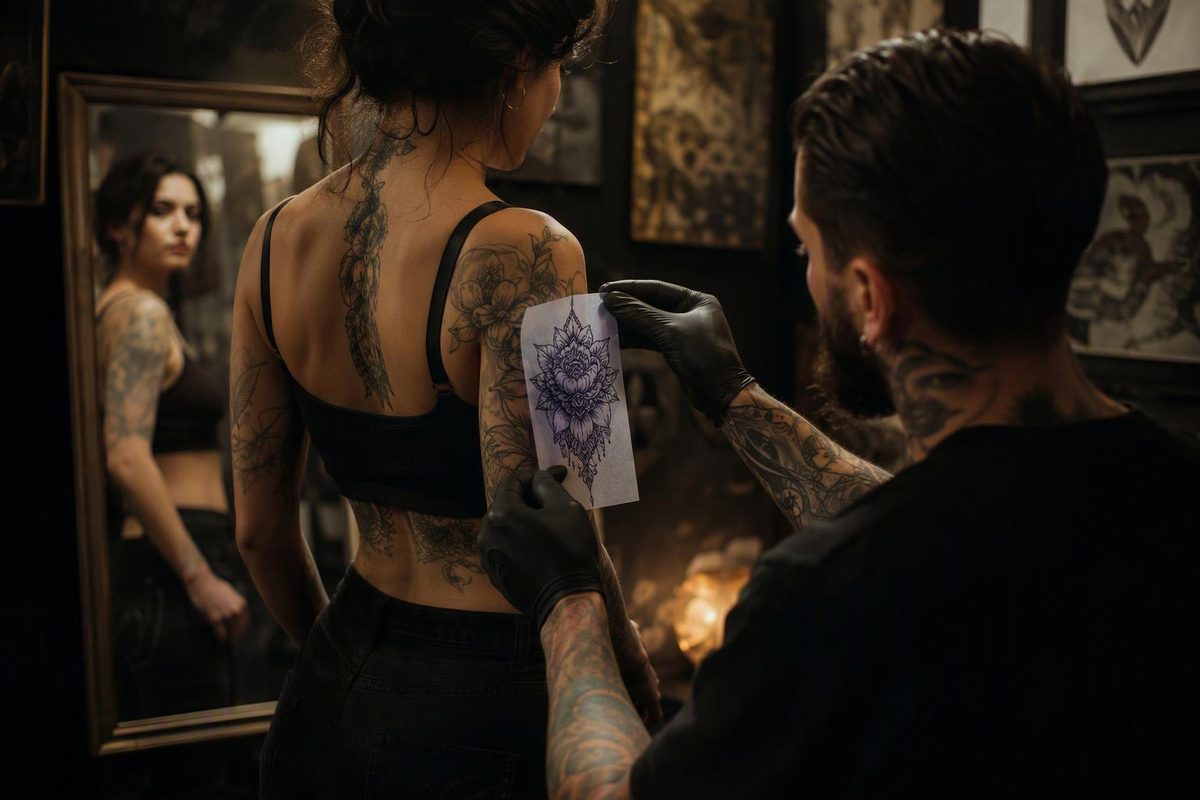
A tattoo can look right on paper and feel wrong on the body. A flower might need more room than the wrist allows; a long snake might work better following a limb than squeezed into a square patch of skin.
Choose placement and size together—not as separate decisions. Start with how visible you want the tattoo to be, then let the design’s shape and detail narrow the options. Use the stencil to settle the exact position.
Decide who gets to see it
There are two different questions here: do you want to see the tattoo yourself, and do you want other people to see it?
A forearm tattoo is easy to glance at. A back tattoo offers a different relationship to the image: you may need a mirror to see the whole piece. Neither is better, but that distinction matters if the tattoo is meant as a daily reminder.
For concealment, test your actual clothes rather than trusting a placement label. A shoulder tattoo may show beneath a sleeveless uniform; a thigh piece may appear below shorts. Hands, neck and face offer fewer everyday covering options. If work requires covered tattoos, check the policy before booking.
Use this as a shortlist, not a ranking:
| Placement | Reason to consider it | Check before committing |
|---|---|---|
| Upper arm | You want to alternate between showing and covering it | Where your usual sleeve ends |
| Forearm | You want to see the piece frequently | Orientation with your arm relaxed and turned |
| Thigh | You want room for a larger composition | Shorts, sitting position and clothing contact |
| Back | You want to explore a broad composition | Whether you’re comfortable rarely seeing it directly |
| Ribs or torso | You prefer a usually covered piece | Clothing seams and comfort during the session |
| Hand or fingers | Visibility is part of the intention | Healed examples, design limits and touch-up policy |
Match the shape before fixing the size
Think about the design’s silhouette. A narrow branch, dagger or snake gives you different options from a round mandala or a wide scene. Ask the artist to show how it could follow the body’s contours, wrap around a limb, or sit within one visible surface.
In its placement and design guide, Mud True Art Tattoo advises considering body curves and warns that small areas such as fingers and wrists may not provide enough space for intricate details.
If the drawing only fits after every element is shrunk, ask what can be simplified—or whether another placement would serve it better. Bring dimensions in inches or centimetres rather than asking for something “small.”
Also tell the artist about future plans. If you might eventually want a sleeve or back piece, ask whether this tattoo should stand alone, join a larger composition, or leave particular areas open. You don’t need to plan your entire body, but you should mention the next piece you already have in mind.
Consider the spot after appointment day
Hands and fingers deserve a specific consultation. Tattoo artist Brian Parrillo, writing about his practice at Ethereal Tattoo Gallery, reports inconsistent healing and fading in these placements, particularly with fine-line work. He may recommend bolder lines, more spacing or another location. That is an artist’s practice-based assessment, not a measured failure rate for every hand tattoo. Ask to see healed work in the exact area you’re considering.
For any placement, discuss clothing and equipment that will touch it: waistbands, shoes, gloves or backpack straps. Inked & Adorned’s appointment guidance recommends loose clothing that won’t rub the tattoo. If your routine makes that difficult, resolve the practical problem before choosing the date.
Sun exposure matters too. The American Academy of Dermatology says UV light can fade some inks and recommends broad-spectrum, water-resistant SPF 30 or higher for tattooed skin. Save sunscreen for after the tattoo has fully healed; Skinzophrenic Tattoos’ aftercare guide advises keeping it covered during healing. The AAD also advises choosing skin free of moles, because tattoos can obscure early signs of skin cancer.
Pain belongs in the decision, but don’t make it the only criterion. Discuss session length and breaks with the artist; our tattoo pain guide explores sensitive placements without making your personal tolerance predictable.
Check the stencil on your body
Before approving it:
- Look in a mirror from close up and from farther away.
- Stand naturally, then sit and move the relevant limb.
- Check lettering and faces in the orientation you’ll usually show them.
- Compare the edges with nearby tattoos and clothing lines.
- Ask for a repositioning if it feels too high, low, crowded or small.
For wrist or forearm lettering, explicitly discuss whether you want it readable to you or to someone facing you. Don’t leave that choice implicit.
A useful brief is specific: “I want a narrow botanical piece on my outer upper arm, covered by this shirt sleeve, with room for another tattoo below it. Please show me two sizes.” That gives the artist something concrete to solve—and gives you a clearer basis for saying yes.