
The Patch Dissolves, but the Ink May Not
See what dissolving microneedles leave behind, how long evidence tracks the ink, and how patches compare with machine and hand-poked tattoos.
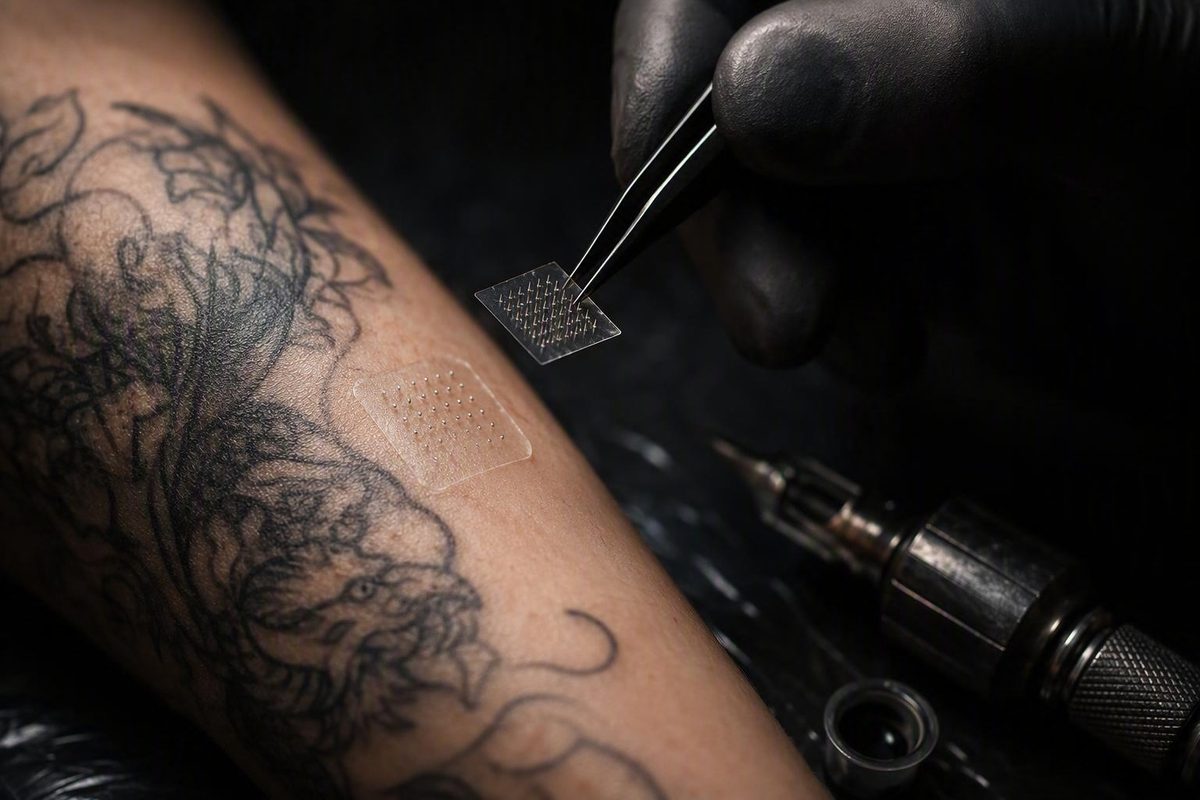
Microneedle patch tattoos can be permanent, and a patch containing permanent pigment should be treated as permanent before it touches your skin. The dissolving part is the delivery system, not the finished mark. However, lifelong permanence in humans has not yet been independently demonstrated.
The strongest peer-reviewed longevity evidence followed microneedle-delivered tattoos in rats for at least one year. CipherX, the first consumer-facing version, describes its tattoos as permanent, but there is not yet multi-year human evidence showing how sharply they age or whether they last as long as machine and hand-poked tattoos.
Three claims need separating: intended to be permanent, observed to remain for a defined period, and proven to last for life. Permanent-pigment microneedle tattoos meet the first description. Limited research supports the second. Current evidence does not establish the third.
Choose what matters most to you; the picker compares all three methods and changes its verdict.
Best suited to someone prioritizing the marketed low-sensation experience, a roughly 15-minute application and a small preset design.
Microneedle Patch
~15 minutesBlack only at launch13 CipherX designsStrongest fit for a compact preset image. CipherX costs £50, measures about 15 mm and excludes wrists and hands.
Machine Tattoo
Custom workColour variesTime variesStrongest fit when design freedom, scale, colour choice or placement flexibility matters more than a fixed rapid transfer.
Hand-Poked Tattoo
Manual processCustom workTime variesStrongest fit for someone specifically seeking point-by-point manual tattooing rather than a manufactured patch or machine.
| Factor | Microneedle Patch | Machine | Hand-Poke |
|---|---|---|---|
| Pain evidence | Marketed as painless; no comparative human trial supplied | Repeated needle passes; no comparative score supplied | Repeated manual punctures; no comparative score supplied |
| Depth | CipherX reported at under 1 mm | Varies; no comparable figure supplied | Varies; no comparable figure supplied |
| Permanence | Permanent pigment is intended to stay; at least one year shown in rats | Intended as permanent; no direct longevity comparator supplied | Intended as permanent; no direct longevity comparator supplied |
| Design freedom | CipherX offers 13 stock designs | Custom work is not confined to a manufactured array | Built manually point by point |
| Colour | CipherX launch designs are black; research patches have used colour and UV-visible ink | Varies by artist and ink | Varies by artist and ink |
| Placement | Relatively flat areas; CipherX excludes wrists and hands | Varies by artist, design and anatomy | Varies by artist, design and anatomy |
| Cost | £50 for CipherX | — | — |
| Application time | Approximately 15 minutes for CipherX | —; depends on the work | —; depends on the work |
| Aftercare | Reports conflict between no aftercare and tattoo-like care; product guidance is required | No direct protocol comparison supplied | No direct protocol comparison supplied |
Sources: 2022 iScience microneedle study; Cornell Chronicle, New Atlas and Time Out reporting on CipherX. Unknown figures are marked —. Fit points express matching priorities, not measured superiority.
CipherX Tattoos Are Intended to Stay
CipherX’s commercial patch places a preset pattern of ink-coated polymer microneedles against the skin. Moisture dissolves the structures, releasing pigment beneath the surface. The company’s application takes approximately 15 minutes, and coverage reports that the needles reach a depth of less than 1 millimeter.
That does not mean the image lasts for only 15 minutes. The carrier disappears after depositing ink, just as a dissolving capsule can release material that remains after the capsule itself is gone. Ink formulation determines whether the resulting mark is intended to be temporary or permanent.
The broader research platform can carry permanent, temporary or ultraviolet-visible inks. An American Society of Mechanical Engineers account describes permanent and temporary formulations within the same platform. “Microneedle tattoo” therefore describes a delivery method, not one guaranteed lifespan.
CipherX launched its commercial service in London in late July 2026. By mid-August, it had applied approximately 500 tattoos, was booked through September and was planning expansion into the United States, according to the Cornell Chronicle.
The initial offering is narrow. Reports describe 13 stock designs, all black, each approximately 15 millimeters across. The price is £50. The patches need relatively flat skin, and wrists and hands are not offered placements. Those restrictions reflect a prefabricated transfer system rather than an artist adapting a design while working.
One-Year Animal Results Do Not Prove Lifetime Wear
A 2022 paper in iScience tested single-use microneedle patches carrying tattoo ink. The researchers produced letters, numbers, symbols, QR-code-like patterns, colored images and marks visible under ultraviolet illumination. Colored and ultraviolet-visible tattoos remained visible for at least one year during the reported experiments (full study).
The one-year observations were made in rats, not in long-term human participants. A red heart and blue star retained their color and general appearance. The red heart showed some distortion by the end of the observation period, although it remained recognizable.
Researchers identified changes in body shape, skin aging, and rats’ rapid growth and metabolism as possible influences on the distortion. The experiment did not establish one specific cause. The study also tested patches on porcine skin outside a living animal.
These results demonstrate that pigment delivered by dissolving microneedles can remain embedded in living skin for a substantial period. They do not establish that a commercial patch will remain for a person’s lifetime, age like a conventional tattoo or produce identical results with every pigment.
“One year” is an observation window, not an expiration date. The images had not necessarily reached the end of their lifespan when observation stopped. Equally, visibility at one year cannot be extended into proof of lifetime permanence.
A reliable human lifespan would require multi-year follow-up, defined pigment and patch specifications, standardized images or measurements, reporting of incomplete transfers and adverse reactions, and direct comparisons with conventional tattoos. No such comparative evidence is supplied here.
Commercial Claims Go Beyond Independent Follow-Up
CipherX is presented in current coverage as a permanent tattoo product. That description establishes the product’s intention, not a lifetime result.
New Atlas calls the result permanent and reports that the image may darken over the first 24 to 48 hours. It also describes black designs approximately 15 millimeters across, intended for relatively flat body areas. Its product details come from CipherX rather than an independent long-term durability trial.
The Cornell Chronicle explains the polymer microneedles, application and company launch but does not independently establish how the tattoos look after many years. Time Out similarly describes dissolvable ink-carrying microneedles while repeating company claims about pain and aftercare without supplying fading or clinical follow-up data.
CipherX’s product and the Georgia Tech research system should not be treated as identical. They share the idea of a predefined microneedle array depositing pigment, but that does not prove identical materials, needle geometry, pigment dose, image resolution, safety or durability.
The defensible verdict is that CipherX tattoos are intended and marketed as permanent and should be approached as potentially permanent. Their lifetime performance in human skin remains unproven.
Patch Tattoos Trade Artistic Freedom for Speed
A patch encodes its image into the microneedle array before application. Each ink-bearing point acts like a pixel, and the points collectively transfer a fixed design. Machine tattooing and hand-poking instead build an image through repeated punctures directed by the tattooer.
| Difference | Patch | Machine | Hand-Poke |
|---|---|---|---|
| Design | Preset microdot pattern | Built during the session | Built point by point |
| Current color | CipherX is black only | Varies by artist and ink | Varies by artist and ink |
| Timing | About 15 minutes for CipherX | Varies | Varies |
| Human longevity evidence here | No multi-year data | No direct comparison supplied | No direct comparison supplied |
The current CipherX choice is limited to 13 small stock designs rather than custom work. Its approximately 15-millimeter format suits a compact symbol, not a large composition. Machine tattooing is not bound to a manufactured patch shape, while hand-poking allows the tattooer to make individual marks and adjust the work as it develops.
Research patches have demonstrated more visual variety than CipherX currently sells, including colored shapes, ultraviolet-visible marks and QR-code-like images. Those experiments show that the platform can carry different formulations and patterns. They do not establish unrestricted artistic scale or commercial availability.
Lead researcher Mark Prausnitz did not present microneedle patches as a replacement for large, intricate tattoo work. Their clearest advantage is repeatable transfer of a small preset image without the repeated passes associated with conventional tattooing.
The depth comparison also needs care. Commercial coverage places CipherX’s needles at less than 1 millimeter. The supplied evidence does not provide directly comparable depth measurements for machine or hand-poked tattoos, so a precise three-way numerical comparison cannot be made.
Fading and Distortion Remain Unpredictable
No supplied evidence establishes a human fading curve for permanent-pigment microneedle tattoos. It is not possible to state responsibly that they fade faster, more slowly or at the same rate as machine or hand-poked work.
The animal research offers two bounded findings. The tattoos remained visible for at least one year, demonstrating durable pigment retention. One image also distorted while preserving its color and recognizable form, showing that retained pigment does not guarantee an unchanged design.
Placement may matter to the initial transfer. Skin curves, flexes and moves, while the patch must place its array consistently enough to reproduce the complete pattern. CipherX’s exclusion of wrists and hands and its preference for relatively flat areas reflect that practical limitation. An incomplete transfer says nothing by itself about the lifespan of pigment that was deposited successfully.
Early darkening should not be mistaken for evidence about long-term fading. Reports say a CipherX image can initially appear pale and become darker over the next 24 to 48 hours as the microdot pattern becomes more visually unified. Evidence tracking what happens over many years is not yet available.
In this setting, permanent means that the pigment is intended to remain rather than wash away or disappear on a planned schedule. It does not promise that edges, density, shape and contrast will remain visually identical forever.
Pain-Free Claims Lack Comparative Human Trials
Research descriptions call the microneedle process rapid, painless and bloodless, while commercial coverage repeatedly uses “painless” or “pain-free.” The supplied evidence does not include a comparative human trial measuring sensation across microneedle patches, tattoo machines and hand-poking.
The tested rats tolerated the research procedure without observed adverse skin reactions under the study conditions. That is not a long-term human safety record and does not establish complication rates for consumer products, different pigments, repeated applications or real-world hygiene conditions.
Aftercare reporting is inconsistent. Some CipherX coverage says the tattoos heal like conventional tattoos and require similar care. Other reporting repeats no-aftercare messaging. Product guidance reported elsewhere mentions petroleum jelly and avoiding prolonged water exposure for the first 48 hours.
There is therefore no evidence-based universal aftercare protocol covering every microneedle patch. Anyone receiving one should obtain written instructions for that exact product and provider. Persistent, worsening or otherwise concerning skin reactions warrant assessment by a qualified medical professional.
The available sources do not supply rates for allergic reactions, infection, inflammation, scarring or incomplete transfer. An absence of figures does not establish that these outcomes are common, but it also cannot prove that the process is risk-free.
Permanent Ink Requires a Permanent Decision
Before application, the provider should identify whether the pigment is permanent or temporary, the product being used, the design’s finished dimensions and the expected placement. For CipherX, the relevant constraints are particularly concrete: black ink, 13 stock designs, approximately 15 millimeters, £50, a roughly 15-minute patch time and no wrists or hands.
Ask what evidence supports any permanence claim. Manufacturer intention, one-year retention in rats and multi-year observation in human recipients are three different standards. Current evidence reaches the first two only in their respective contexts.
Removal is another unresolved point. The supplied research does not establish whether conventional laser removal performs identically on microneedle patch tattoos. Pigment formulation, concentration and distribution may be relevant, but their practical effects have not been determined. A mark that is quick to apply should not be assumed to be quick to remove.
Home application should not be assumed safe or currently supported either. Research coverage has discussed self-administration as a possibility, and commercial reporting describes home use as a future aim. That does not establish that current products are intended for unsupervised application.
If a patch contains permanent pigment, the sound decision is to treat the resulting image like any other permanent body modification. The microneedles dissolve within minutes; available evidence gives no reliable date by which the deposited mark will disappear.