
Choose Geometry That Works With Your Body
Compare line-led, patterned and ornamental geometric tattoos through three artists’ approaches, with guidance on symbolism, placement and healed work.
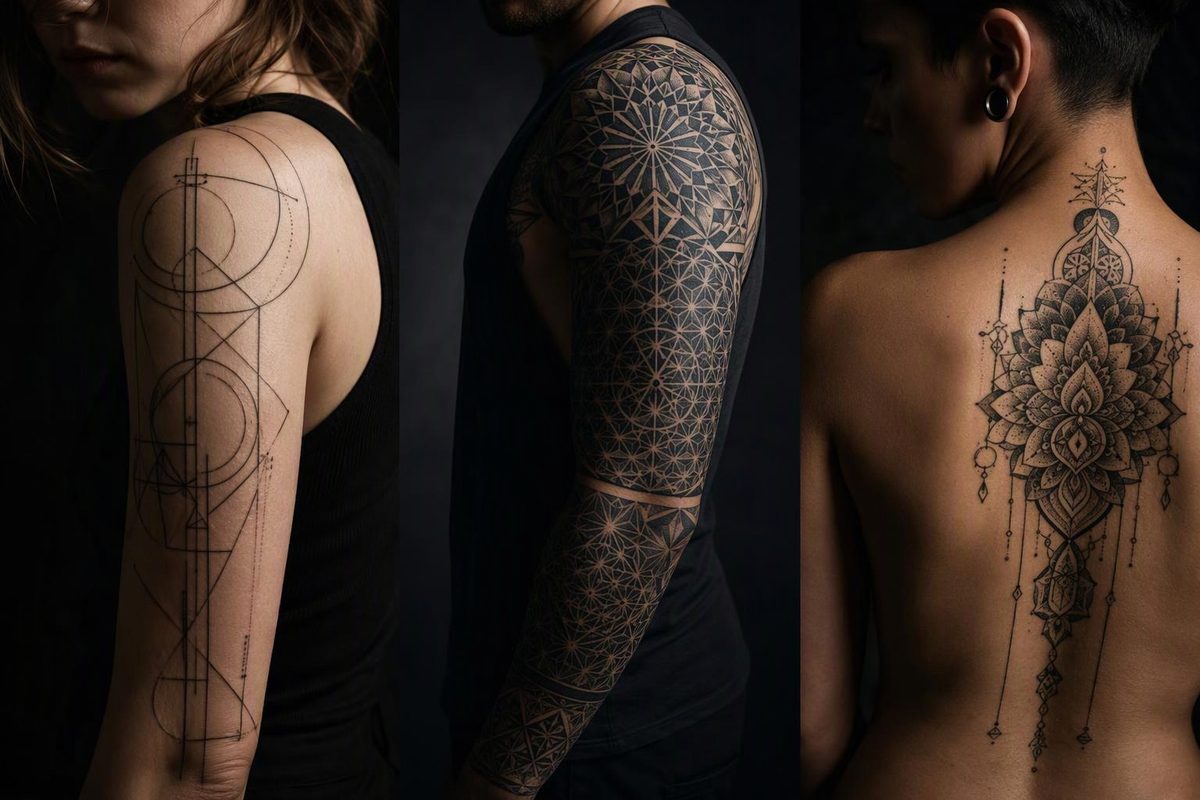
Geometric tattoos use shapes, repetition and spatial relationships to build a design, whether that means a single circle, repeating hexagons or parallel lines wrapping around a shoulder. Choose the pattern for how it works on your body, not just how it looks on paper. Its meaning can be personal, but geometry has no universal symbolic code; a specific religious image needs its own context.
Choose a design direction and reference type; use the result to shape your artist brief.
Build Your Design Brief
Brief: Body-Led Lines
Ask for open skin and flowing contours. Review how the lines turn around your chosen placement, not only how they look in a flat drawing.
Bring references for movement and ask to see healed linework at a comparable scale.
Describe any personal meaning in your own words. Shapes do not carry one universal meaning.
Source: the article’s design guidance, artist interviews and the Met’s context for Tibetan Buddhist mandalas; this is a consultation brief, not a finished design.
Geometry Describes Structure, Not One Technique
Geometry can supply the whole design or organize another image. You might choose an abstract arrangement of triangles, a flower built from repeated shapes, or an animal broken into angular planes.
The term describes the design’s structure, not one exclusive technique. Blackwork uses black ink rather than color; dotwork builds marks or shading from dots; geometric describes the arrangement of shapes and lines. These approaches can overlap. For a wider comparison, see our guide to different tattoo styles.
Within that broad category, identify the visual effect you want:
| Direction | Defining Features |
|---|---|
| Line-led | Open skin, parallel contours, intersections and movement |
| Pattern-led | Repeated shapes, dark–light contrast and fields of ornament |
| Radial | Elements arranged around a center, such as a decorative rosette |
| Figurative | A recognizable subject reconstructed through geometric forms |
These are useful design directions, not rigid categories. An artist might combine flowing lines with a repeated pattern, or use radial ornament within a larger blackwork composition.
Three Artists Show Different Ways To Fit Geometry
Chaim Machlev Builds Lines Around The Body
Chaim Machlev, known as DotsToLines, distinguishes between placing a figure on someone and using their body as the form around which a tattoo is built. In a Tattoo Life interview reproduced on his own website, he described working on photographs of clients and sometimes freehand. He disliked designs that seemed “stuck” onto the body—even when they appeared perfect. Read Machlev’s account of his process.
For a line-led tattoo, that distinction matters: a beautiful flat drawing is only part of the proposal. Ask how its lines will turn around your arm, torso or leg. A reference photograph can show the kind of movement you like without supplying a design to copy.
Roxx Uses Repetition And Bold Contrast
Roxx’s work offers a different reference point: broad black areas and repeated pattern. In her interview with Sophie Breitsameter for Baku, she described her interest in repetition and the order found in nature. The accompanying work includes a “Black & Hex” leg piece for client Maria. Roxx explained that she usually drew directly onto skin to fit the wearer’s form, using digital renderings and stencils for particularly complicated pieces. See the interview and credited work.
If this direction appeals, consider the balance between solid black, small pattern and untouched skin—not just the individual hexagon or triangle. Those areas together determine the composition you are asking the artist to build.
Thomas Hooper Develops Geometry Into Ornament
In his Hypebeast interview, Thomas Hooper named a wide range of influences, including architecture, William Morris, Christopher Dresser, medieval ornament and Tibetan Buddhist art. He explained how repeating and refining ideas produces a personal visual language; he also described digitally altering and repeating drawings to generate new patterns. Read Hooper’s interview.
His account is a reminder that geometric work need not be minimalist. It can be dense, decorative and layered with references. If ornament is what attracts you, show the artist which aspects matter: the repetition, the density or the relationship between the pattern and its surrounding space.
Personal Symbolism Is Not A Universal Shape Dictionary
You can choose geometry to express balance, connection, order or change, but those are possible intentions—not fixed meanings. A triangle does not automatically communicate the same thing on every wearer. Tell your artist whether the meaning is essential or whether you primarily want a particular visual rhythm.
Be more specific when a reference is religious. “Geometric” and “sacred geometry” are not interchangeable labels. A Tibetan Buddhist mandala, for example, is not simply a circular pattern: the Metropolitan Museum of Art describes it as a diagram of the universe used to conceptualize a path to enlightenment. The Met’s mandala exhibition explains that context.
If you want decorative radial symmetry rather than a religious diagram, say so. If you want a particular sacred image, identify its tradition and purpose before treating it as ornament. The Met’s description concerns Tibetan Buddhist mandalas; it is not a definition of every circular tattoo.
Approve The Design On Skin, Not Just On Screen
Bring a short brief with placement, approximate size, desired density, and two or three examples showing what you like. Name the feature—flowing lines, repeated cells, strong black contrast—rather than asking for a copy of someone else’s tattoo. Explain whether the design must accommodate existing tattoos or future additions.
Ask to see healed examples, ideally of comparable linework and scale. Review the stencil or drawing from several angles, not only the view used for a photograph. Check it with the body relaxed and in ordinary movement. Ask which gaps or details need more space, and what would change if you made it smaller.
Keep your expectations human. In his Scene360 interview, Machlev emphasized that tattoos change over time and that handmade lines cannot behave like printer output; he said small irregularities were particularly noticeable in his work. Read his discussion of tattoo imperfections.
Choose an artist whose healed work you like, not just a drawing whose geometry looks flawless on a screen.