
How to Tell Different Tattoo Styles Apart
Compare traditional, realism, fine-line, blackwork and other tattoo styles by their visual features, with artist examples and cultural context.
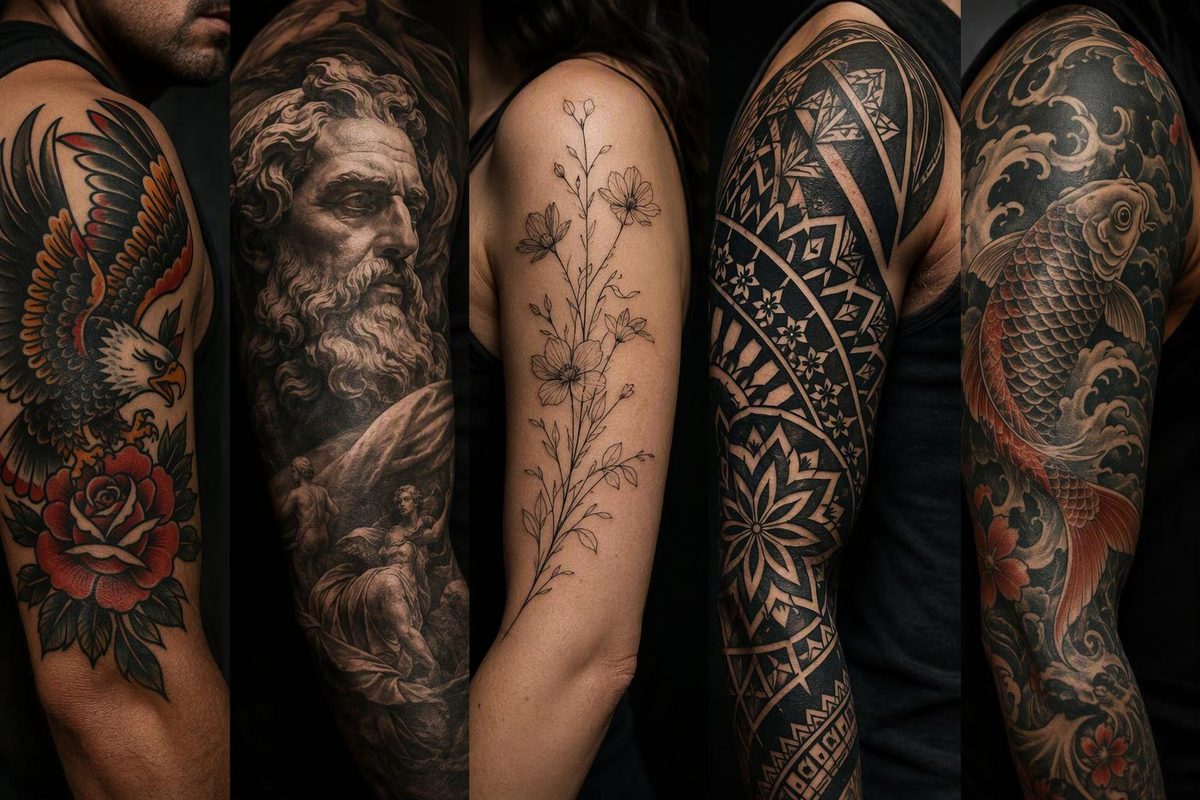
A rose can be a flat red emblem, a lifelike rendering of a flower, or a cluster of thin botanical lines. The subject stays the same; the tattoo style changes.
To distinguish different tattoo styles, look at line weight, shading, color and composition before the motif. The labels overlap: “black and grey” describes a palette, “fine line” describes an approach to linework, and “Japanese traditional” names a tradition with its own visual conventions.
American traditional, neo-traditional and new school
These three can all use strong outlines and color, but they handle shape and detail differently:
- American traditional: Bold black outlines, relatively flat shapes and a restrained palette. Roses, anchors, eagles and daggers are familiar subjects. Think of a rose reduced to clearly separated petals and leaves rather than rendered petal by petal. Traditional Ink’s studio guide describes these graphic conventions.
- Neo-traditional: Keeps pronounced outlines but expands the palette, detail and sense of depth. Decorative borders, elaborate animals and lush florals are common; Art Nouveau and Art Deco are important influences.
- New school: Leans into cartoons and caricature—exaggerated proportions, animated expressions and deliberately distorted figures. Its defining feature is the exaggeration, not simply bright ink.
The latter distinctions follow Tattoodo’s overview of contemporary styles. For a closer look at the first style, see our guide to American traditional tattoo design.
Neo-traditional is not just “traditional with more colors.” Its ornament and varied line weights matter too. Tattoodo identifies references to Mucha and Klimt in Hannah Flowers’s portrait work, offering a specific example of that decorative approach.
Realism and illustrative tattoos
Realism aims for a lifelike image: recognizable faces, convincing textures, light and shadow. It can be color or black and grey. A realistic rose is modeled through tonal changes rather than primarily through a heavy contour. Tattoodo’s style overview includes both portraiture and natural subjects within realism.
Illustrative work deliberately looks drawn. Hatching, cross-hatching and stippling can recall book illustrations, engraving or a sketchbook. The distinction is not “detailed versus simple”: both realism and illustrative work can be intricate. It is whether the rendering looks photographic or visibly drawn, as Traditional Ink’s studio guide explains.
Fine line and minimalism
Fine-line tattoos use thin, delicate linework. They are not necessarily tiny, simple or unshaded: the approach can appear in botanical illustration, lettering, Chicano work and micro-realism.
Minimalism concerns how much a design leaves out. A few lines can suggest a face or flower without describing every feature. A minimalist tattoo may use fine lines, but the two terms are not interchangeable. Tattoodo’s fine-line guide makes this useful distinction between application and artistic style.
Blackwork, geometric and ornamental work
Blackwork uses black pigment to build the image, often with solid areas contrasted against untattooed skin. It can be graphic, abstract, illustrative or lettering-based; it does not name one particular subject. Unlike black-and-grey work, which uses grey tonal shading, blackwork relies on black ink, lines, dots and open skin. Tattoodo’s blackwork guide emphasizes both the all-black palette and the category’s breadth.
Geometric and ornamental tattoos organize shapes into patterns, symmetry or decorative structures. Geometric work emphasizes forms such as circles and repeating grids; ornamental work can also suggest lace or flowing decoration. Dotwork describes the use of dots to construct shading or pattern—not a requirement for either category. These approaches frequently overlap, as shown in Tattoodo’s ornamental guide.
Watercolor
Watercolor tattoos imitate painterly washes, brushstrokes, splashes and soft transitions. The name describes the effect, not the use of watercolor paint in skin.
A useful artist reference is Amanda Wachob. MCA Denver’s account of her 2019 exhibition describes her use of brushstrokes, washes, splatters and spills, an approach she began developing in 2008. Her work shows that watercolor tattooing can be abstract, not just a flower surrounded by colored splashes.
Japanese traditional
Japanese traditional tattooing is recognizable through its large-scale pictorial compositions, not merely the presence of a koi or dragon. Figures, flowers and backgrounds work together across the body.
The Asian Art Museum traces this densely composed style to nineteenth-century Japan and its relationship with woodblock prints. Utagawa Kuniyoshi’s Water Margin heroes provide concrete historical examples. For tattoo work, the Japanese American National Museum’s Perseverance exhibition features artists including Horitomo, Shige and Junii, with life-sized photographs of full-body compositions.
Chicano
Chicano tattooing commonly combines smooth black-and-grey shading, fine lines, elaborate lettering, portraits, roses and religious imagery. It is a cultural tradition, not a synonym for every monochrome tattoo. Tattoodo’s Chicano guide places these visual conventions within Mexican American cultural expression.
Mister Cartoon offers a specific artist reference: CONTROL Gallery’s account of his work connects his tattooing with Los Angeles car culture, graffiti, sign painting and music.
Labels to use carefully
“Tribal” is too broad to identify a single tradition. Name the specific practice where possible, and seek guidance from practitioners rather than treating cultural designs as interchangeable pattern sheets. Te Papa describes Māori tāmoko as a visual language involving artistic excellence, identity and role—not simply decoration.
Likewise, handpoke describes a non-electric application method, rather than one mandatory appearance, as Tattoodo’s handpoke guide explains.
Turn a style preference into an artist brief
Save a few references and identify what attracts you: thick contours, soft shading, open space, exaggerated shapes or dense pattern. Then look for an artist who repeatedly demonstrates those qualities.
Ask to see healed examples, including work at a similar scale and on a similar skin tone. Think Tank Tattoo’s portfolio guide recommends reviewing healed work, placement and skin-tone representation rather than relying only on fresh close-ups.
Bring your intended size and placement, and ask which details need simplifying. A useful brief is more precise than a label: “A rose with bold outlines, limited color and open space between the petals” gives an artist more to work with than “something traditional.”