
Famous Tattoo Artists: Six Names and the Work Behind Them
Meet six famous tattoo artists through their work, from Sailor Jerry’s flash and Ed Hardy’s custom designs to Whang-Od’s living Kalinga tradition.
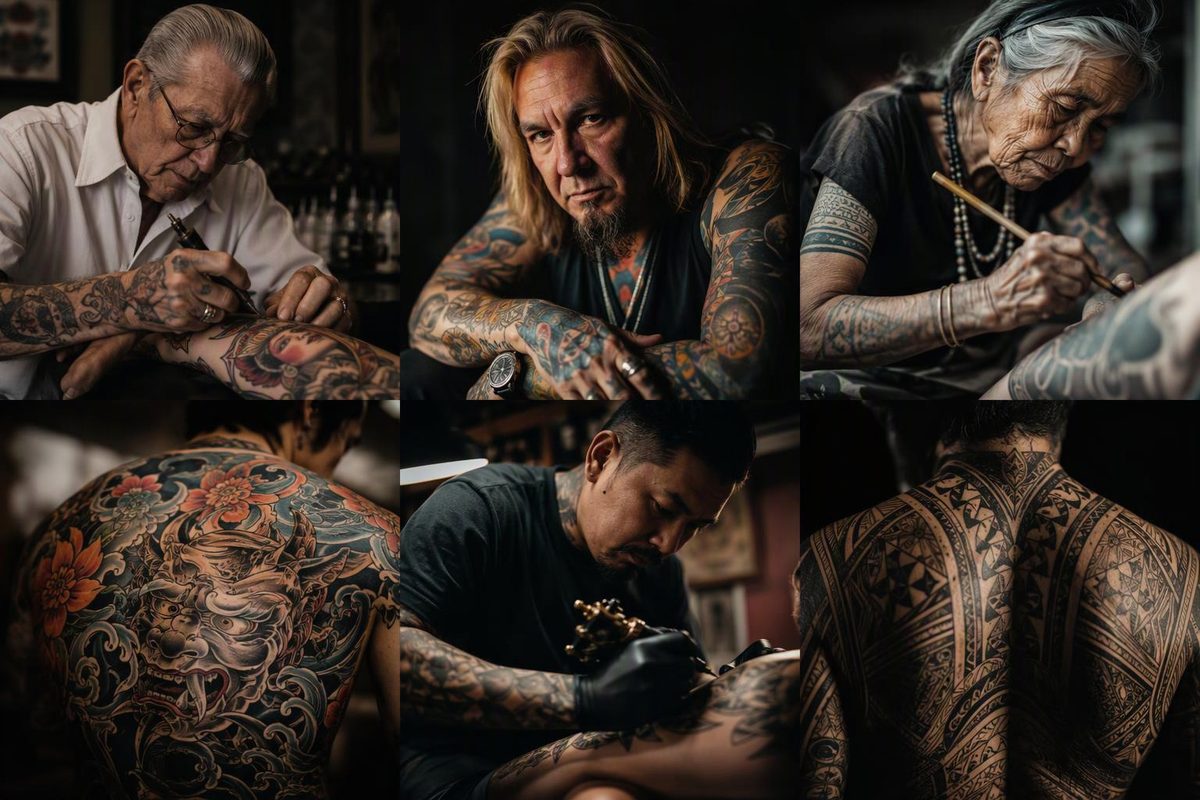
Sailor Jerry, Ed Hardy, Horiyoshi III, Apo Whang-Od, Kat Von D and Dr. Woo are useful starting points for exploring famous tattoo artists—but for different reasons. Some are central to tattoo history; others reached audiences through television, fashion or celebrity clients. This is a selected guide, not a ranking of the world’s “best”: each name offers a different way into the work.
Sailor Jerry: a Honolulu legacy in flash
Norman “Sailor Jerry” Collins belongs in the conversation about American traditional tattooing. His influence also extended through other artists: the Fine Arts Museums of San Francisco identifies him as Ed Hardy’s Honolulu mentor, who introduced Hardy to Japanese subject matter. It is one documented example of exchange between American and Japanese tattooing. The museum’s Hardy retrospective traces that connection.
For a concrete entry point, look at his flash—sample tattoo designs—and the designs preserved at his former Honolulu shop. In a 2025 interview, Old Ironside Tattoo owner Harry Seda described a wall arranged in Jerry’s memory and identified the hula girl as one of the shop’s most requested images. His legacy is still encountered through working tattoo designs, not just a famous name on merchandise. KHON2’s shop profile records that continuity.
Ed Hardy: beyond the clothing label
Before the fashion line, Don Ed Hardy was a printmaker and tattoo artist. He graduated from the San Francisco Art Institute in 1967, chose professional tattooing over a Yale graduate fellowship, and opened Realistic Tattoo in San Francisco in 1974. The private studio made unique commissions tailored to clients, including back, chest and full-body designs. The Fine Arts Museums’ retrospective traces that career.
The work to seek out is his preparatory tattoo drawing and early flash—not only the imagery licensed for clothing. The museum describes designs combining Western imagery with Japanese subject matter. Hardy is a useful artist to study when you want to understand how an individual drawing becomes part of a larger composition on the body.
Horiyoshi III: the body as the setting
Horiyoshi III is known for full-body Japanese tattooing. A 2007 Japan Times profile also noted his books of artwork on paper and skin, including the drawing collection 36 Ghosts.
His own explanation is more revealing than a superlative. “The creatures I draw only come alive on somebody’s skin,” he told interviewer Judit Kawaguchi. He also described feeling responsible for keeping the classical repertoire of Japanese designs alive. Kawaguchi’s retained interview gives those statements in context.
Use that distinction when looking at his work: a dragon drawing is one thing; a dragon placed on a living body is another. Study the whole tattoo rather than treating its central creature as an isolated emblem.
Apo Whang-Od: a living Kalinga tradition
Apo Whang-Od, also known as Maria Oggay, is a traditional tattoo practitioner from Buscalan in Kalinga, Philippines. Her work belongs to batok, a hand-tapped practice—not simply a visual category to file beside machine-made tattoo styles.
Vogue Philippines’ April 2023 profile describes her tapping a thorn-tipped bamboo tool with another stick. Just as importantly, it documents her teaching and the work of Grace Palicas and Elyang Wigan. The profile identifies the three dots she tattooed at that time with Apo, Grace and Elyang.
Calling her the “last tattoo artist” misses that continuation. Her significance includes the knowledge carried forward by younger practitioners. Read the work through its Butbut and Kalinga context, rather than assuming its motifs are interchangeable decorative symbols.
Kat Von D: tattooing on television
Kat Von D became widely recognizable through Miami Ink and then LA Ink, which ran from 2007 to 2011. That television history explains a different kind of fame from a museum retrospective or a teaching lineage. The Los Angeles Times’ 2024 reporting documents her rise through both programs.
A specific work discussed in that report is her Miles Davis portrait tattoo, based on Jeffrey Sedlik’s 1989 photograph. It offers a concrete subject to examine beyond the television persona: how a photographed face, gesture and lighting are translated into a tattoo. Keep the source photographer’s attribution attached when discussing the reference.
Dr. Woo: fine-line work and celebrity visibility
Dr. Woo’s official biography credits his start under Mark Mahoney at Shamrock Social Club and identifies single-needle tattooing as the style for which he is known. His biography makes the training connection explicit.
For a recognizable example, his work for Emilia Clarke included three flying baby dragons on her wrist in 2018. In an interview with Discover Los Angeles, Woo described developing his intricate fine-line approach through trial and error rather than following a predetermined plan. The interview connects the celebrity work with his account of learning the style.
His name is a useful starting point for exploring fine-line imagery, not evidence that one artist invented the broader tradition.
Turn a famous name into a better reference
If you are researching your own tattoo, separate what you admire from whom you recognize. Is it the line weight, the portrait shading, the scale, or the way a design fits the body?
Bring credited examples and explain those features to your artist, rather than asking for a duplicate of someone else’s custom tattoo. Ask to see healed work and discuss what suits your intended size and placement. Our guide to different tattoo styles can help name the visual qualities; how to look at tattoo art takes that comparison beyond the motif.