
From Shop-Wall Designs to Collectible Art: A Field Guide to Old-School Flash
Today the label can mean an original painted sheet, historical production flash, a book page, a later reprint or a new vector that merely looks old.
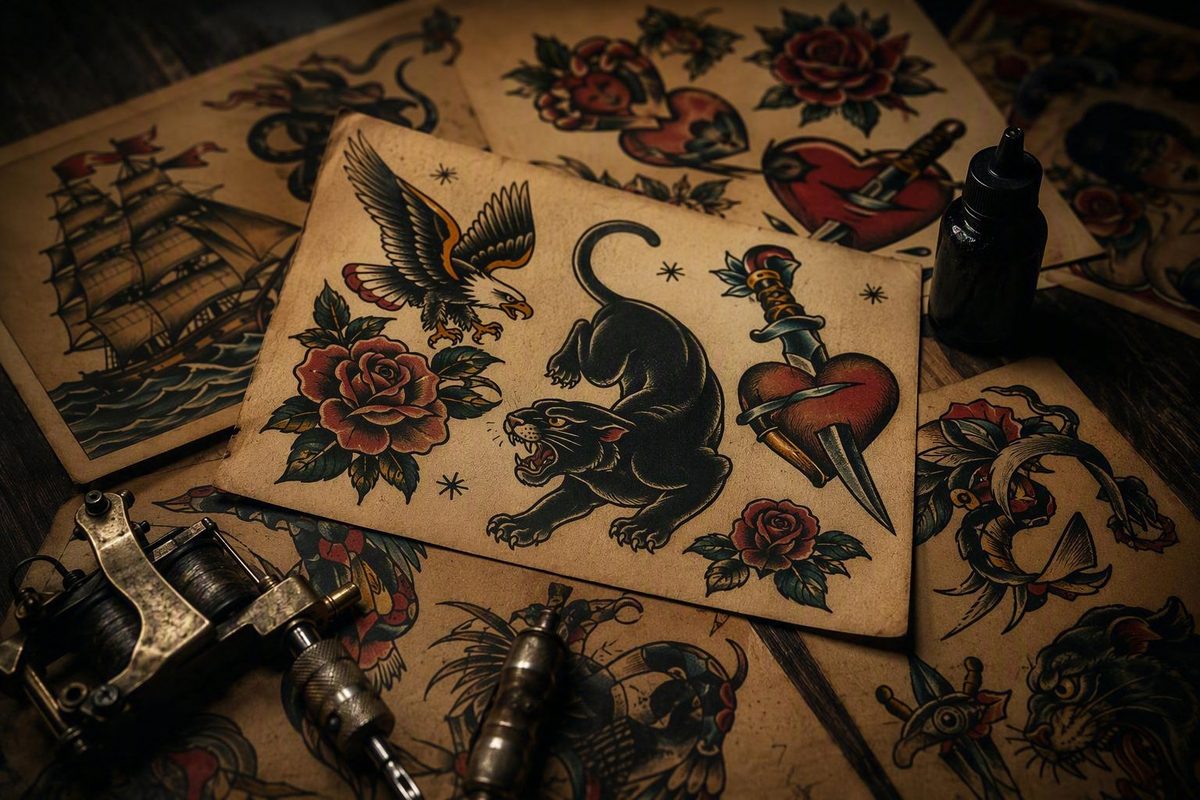
Vintage tattoo flash is easy to recognize and surprisingly difficult to define. Bold eagles, pierced hearts, clipper ships, panthers, roses, banners, and pin-ups immediately suggest an old-school tattoo shop. Yet appearance tells only part of the story.
Historically, flash served as working material: prepared artwork displayed for customers and, according to surviving industry accounts, transported, exchanged, copied, repainted, commercially distributed, and repeatedly tattooed. Today, the same phrase may describe an original painted sheet, historical production flash, a page in a modern reference book, a later reprint, or a newly created vector that merely looks old.
That distinction matters whether you want a tattoo, study design history, collect paper artifacts, or buy reference material. An old-fashioned aesthetic describes how something looks. A vintage claim concerns what the object is, when it was made, who made it, and how it reached its present owner.
What vintage tattoo flash is—and why the label causes confusion
Tattoo flash is artwork prepared before a particular customer selects it. Traditionally, designs were grouped on sheets and displayed on shop walls, racks, or other visible surfaces. A customer could browse the available images, point to one, and have it tattooed without commissioning an entirely new composition.
A flash sheet usually contains several separate designs, often arranged around a shared style or theme. One page might combine a rose, dagger, eagle, heart, and swallow; another might concentrate on military insignia or nautical subjects. The sheet therefore differs from a single bespoke drawing developed for one client, although contemporary tattooists may adapt flash or limit how often they use a design.
The available evidence does not establish an accepted date at which tattoo flash becomes “vintage.” Nor does it establish consistent boundaries between vintage, antique, old, and historic. Those words may function as approximate descriptions, sales language, or category labels rather than verified dates.
It helps to treat classification as a set of overlapping axes rather than a row of mutually exclusive boxes. One label may describe an object’s date, another its physical format, another its production method, and another its relationship to an earlier source. An object could therefore be both historical and commercially produced, or both a tracing and a period working artifact.
A provisional working vocabulary includes:
- Original period sheet: A physical sheet made during the historical period assigned to it. “Original” may describe the physical object without proving that a particular named artist created it.
- Historical production flash: Material made for distribution or repeated shop use. A production sheet may be old and historically important even if it is printed rather than uniquely painted.
- Reprint or facsimile: A later reproduction of an earlier sheet. Facsimile generally implies an effort to follow the source closely; reprint can cover a broader range of later editions.
- Stencil: Material associated with transferring a design for tattooing rather than necessarily serving as a finished display composition.
- Tracing: A line-based copy that may relate to transfer, copying, or preservation.
- Acetate: A transparent or translucent object associated in commercial collections with working or reproductive material. Its exact use should be established object by object.
- Reference-book reproduction: A printed image of historical flash in a later publication. The artwork depicted may be old, but the book page is a modern reference object.
- Contemporary vintage-inspired design: New artwork that borrows old-school motifs, line weights, palettes, or sheet layouts without being a period artifact.
These descriptions are practical editorial terms, not a universally accepted technical classification system. A commercial archive, for example, separates “vintage,” “old,” “original,” and “production” flash from tracings and acetates. That demonstrates that the market recognizes materially different categories, but the archive does not publish enough authentication information to validate every label it applies (see Tattoo Collection’s flash categories).
Several adjacent terms also need separating:
- Flash describes prepared tattoo artwork and its function.
- American traditional names a recognizable tattoo style, not every kind of flash.
- Old school commonly refers to established visual conventions, but its chronological boundaries vary.
- Vintage may assert historical age or merely describe an appearance.
- Retro generally signals a deliberate evocation of an earlier look and need not imply age.
The overlap is real. Much historical American flash uses what is now called American traditional grammar, and much contemporary flash deliberately works within that grammar. But flash can be produced in many styles, while American traditional designs can also be custom-drawn.
The quickest diagnostic question is therefore not “Does this look vintage?” but “What kind of object am I looking at?” Bold lines, faded colors, familiar motifs, and yellowed paper can create an old-school impression. They do not independently establish when a sheet was produced, how its appearance developed, or whether the named artist handled it.
How flash worked in the historical tattoo shop
In a working shop, flash operated as a menu. Instead of describing an idea and waiting for a custom composition, a customer could choose from designs already prepared for tattooing. The system made selection direct and allowed a tattooist to organize a broad vocabulary of images in a form customers could understand at a glance.
The display also communicated what the tattooist offered. A wall of military emblems, ships, romantic banners, animals, and religious images advertised both subject matter and visual approach. Flash could serve at once as inventory, sales display, portfolio, and working reference.
The Motor City Tattoo Museum reports that early shops commonly displayed roughly 30 to 40 sheets. It also describes traveling tattooists connecting sheets vertically so they could be folded into an accordion-like arrangement for transport (read the museum’s account of vintage tattoo flash). These details should be understood as the museum’s account, not as a documented rule followed by every shop or traveling artist.
Flash was not necessarily a fixed collection of images belonging permanently to one maker. The same museum account says tattooists shared designs through correspondence, producing variations on common compositions. Two sheets might share a central image while differing in lettering, faces, proportions, colors, shading, or surrounding ornaments. Within this reported system, repetition was part of circulation rather than automatically evidence of a modern counterfeit.
The publisher of Jonathan Shaw’s collection similarly describes sheets as moving among makers and shops through repainting, exchange, sale, unauthorized taking, and reuse. Its book presents more than 300 pieces spanning settings from the 1900s Bowery through mid-century Texas and the Pike to 1970s Los Angeles (see powerHouse Books’ collection description). Because this is promotional copy for a commercial book, it supports what the publisher says about the collection but does not independently prove every element of the broader history.
Commercial distribution reportedly widened that circulation. Tattoodo’s industry style guide attributes the exchange of flash and its distribution with tattoo supplies through mail-order catalogs to the late 19th and early 20th centuries. The same guide credits Lew Alberts with selling commercial flash by 1905, but that date and priority remain the guide’s claims rather than independently established findings in the available evidence (see Tattoodo’s traditional style history).
These accounts complicate modern expectations about originality. A composition can be historically significant without being unique. A production sheet may document what working tattooists could obtain. A repaint may show how an image changed in circulation. A tracing or stencil may preserve a working version that differs from a polished wall display.
They also help explain why identical or closely related designs may appear under different names. Possible explanations include commercial production, direct copying, correspondence, memory, repainting, or later reproduction. Similarity by itself does not reveal which process occurred.
Even the origin of the word flash remains unsettled in the available material. Industry accounts propose circus or carnival language, portable “flash racks,” quick selection, quick tattooing, or the displays’ visual impact. Aloha Monkey Tattoo, for example, connects the term to speed and flashiness, while other shop and museum accounts favor circus-display explanations (read Aloha Monkey’s account of flash terminology). These are competing narratives, not a documented etymology that can safely be reduced to one proven origin.
The visual grammar: line, color, contrast, and composition
Historical American traditional flash is commonly associated with a compact visual vocabulary:
- Bold black outlines
- Solid fields of color
- Strong light-dark contrast
- Clear silhouettes
- Limited internal detail
- Relatively restrained shading
- Compact compositions
They also allow a composition to communicate as a tattoo design rather than as an open-ended illustration. An anchor entwined with rope, for example, can be reduced to a decisive outline, a few internal divisions, and a small number of color areas without losing its identity.
Traditional palettes are repeatedly described in the supplied industry sources as emphasizing red, yellow, green, and black, with blue appearing in some accounts. That list is a useful orientation, not a universal historical formula. Artists, suppliers, periods, locations, and surviving objects varied. The presence of another color does not automatically make a sheet inauthentic, and a restricted palette does not prove age.
Commercial and studio histories connect this visual economy to the pigments and tattooing tools available to earlier practitioners, the need to repeat established designs, and the goal of preserving clarity when transferring an image from paper to skin. Those explanations are plausible within the industry literature, but the available evidence does not provide a technical archival study that applies them uniformly to every historical sheet.
Nor does the visual vocabulary justify a guarantee that every traditional tattoo will retain its appearance better than every tattoo in another style. Results vary, and the supplied studio material itself cautions that execution, placement, aftercare, skin, and aging can affect the outcome (see Big Cat Tattoo’s overview of flash). A stylistic tendency should not be converted into an individual medical or durability promise.
Broad comparisons sometimes characterize American flash as bolder and early English or European work as more intricate. Black Hat Tattoo likewise contrasts thick outlines and limited bright color in American traditional tattooing with more decorative detail and complex shading in European traditions (see its American and European traditional comparison). This can be a useful introductory tendency, but it is not a rigid regional divide. Europe contains many traditions, American artists differed from one another, and designs crossed borders.
Most importantly, design traits and authentication evidence answer different questions. Bold outlines, compact forms, hard shading, and restricted color may help identify a visual tradition. They cannot prove that a particular sheet is old. A contemporary painter, printer, vector designer, or image generator can reproduce those surface characteristics.
For more context on the style itself, see our guide to American traditional tattooing. It is related editorial coverage, not independent authentication evidence for any historical object discussed here.
A motif map: the subjects that filled the sheets
A long list of anchors, skulls, roses, eagles, and daggers can make vintage tattoo flash seem like a static symbol dictionary. It is more useful to organize the imagery around the settings, customers, and emotional themes that kept particular subjects in circulation.
Carol Clerk’s sourcebook offers a useful precedent. Its cataloged chapter subjects include nautical and patriotic traditions; girls, hearts, and banners; superstition; and the natural world. The catalog also identifies chapters on the decline of a “golden era” and a later vintage revival (view the catalog record for Carol Clerk’s sourcebook).
Nautical life and travel
Ships, anchors, swallows, mermaids, nautical stars, ropes, lighthouses, and related seafaring images form one of the most recognizable clusters. Museum, publisher, and studio accounts associate early flash with port shops and maritime customers, although the available sources do not establish one universal interpretation for every design.
A ship might refer to travel, work, adventure, separation, or simply an image admired by the wearer. An anchor might be chosen for occupational association, stability, graphic impact, or no stated symbolism at all. Later symbolism guides often assign fixed meanings to such motifs, but the evidence here does not support applying one meaning across every wearer, region, or period.
The designs also have clear graphic uses. An anchor creates a strong symmetrical structure. A clipper ship provides sails, waves, flags, and a dramatic silhouette. A swallow can occupy a small area while retaining a recognizable directional form. Their persistence can therefore be considered in terms of composition as well as symbolism.
Military service and patriotism
Eagles, flags, weapons, shields, military insignia, service emblems, and patriotic banners form another major group. The Motor City Tattoo Museum identifies sailors and soldiers as important historical customers and says military imagery served that clientele.
Such designs could express affiliation, remembrance, pride, unit identity, grief, or protection, but their significance depended on the wearer and context. They also changed across national settings and periods. An eagle on one sheet may belong to a patriotic arrangement; on another, it may function primarily as an animal emblem or as a central form above a banner.
Weapons require similar caution. A dagger, rifle, cannon, or sword may appear in military, memorial, romantic, or simply dramatic compositions. Surrounding text, insignia, dates, flags, and companion motifs can narrow an interpretation, but they do not always provide a complete answer.
Love, memory, loss, and risk
Hearts, roses, banners, women, pin-ups, daggers, and skulls gave artists a flexible language for affection and danger. A banner could carry a name, place, family role, unit, promise, or brief declaration. The surrounding composition could be prepared in advance while leaving space for personalized lettering.
Hearts might appear intact, pierced, burning, winged, crowned, or combined with flowers. Roses could soften a weapon, frame a portrait, fill an awkward space, or become the main subject. Women and pin-ups could represent an individual, an idealized figure, a stock character, or a fantasy of glamour.
Daggers and skulls increased visual tension. They may suggest mortality, violence, courage, betrayal, or risk, but none of those meanings should be assigned automatically. Different customers could select the same composition for different reasons.
Animals and the natural world
Panthers, wolves, snakes, dragons, birds, tigers, and flowers offered dynamic silhouettes and adaptable shapes. A crawling panther produces a long diagonal composition. A coiled snake can wrap around a dagger or occupy an irregular space. A wolf or big-cat head creates a frontal emblem with strong symmetry and contrast.
Dragons also demonstrate how porous stylistic categories can be. Their presence in American flash does not make every dragon American in origin or influence. The industry histories in the evidence pack describe tattooists encountering and adapting imagery through travel, correspondence, commercial products, and wider cultural exchange.
Flowers were equally versatile. They could frame lettering, soften harsher subjects, connect separate elements, or stand alone. “The natural world” was therefore not merely a decorative category; it supplied artists with forms that could balance and reshape compositions.
Religion, superstition, protection, and popular culture
Crosses, sacred hearts, praying figures, protective images, lucky symbols, horseshoes, and dice appear alongside secular themes in traditional-flash accounts. These motifs can be discussed in relation to religion, chance, danger, or personal belief, but no fixed interpretation applies to every use.
Period cartoon characters also entered flash. The publisher’s description of Jonathan Shaw’s collection lists crosses and popular cartoon figures alongside ships, women, roses, daggers, dragons, wolves, panthers, and skulls. That mixture is a reminder that historical shop walls did not necessarily follow the tidy categories later researchers use.
Anyone planning to reproduce, publish, merchandise, or substantially adapt a historical or popular-cultural image should seek qualified rights guidance for the particular work and intended use. This article does not determine permissions or provide legal clearance.
Modern stock libraries continue to apply overlapping terms such as vintage, old school, retro, American traditional, and flash to roses, skulls, daggers, hearts, swallows, eagles, anchors, snakes, panthers, and banners. Those tags demonstrate current visual association, not historical authenticity.
Artists and lineages to know
No short list can establish a complete lineage of tattoo flash. Records are uneven, work circulated without full documentation, and the artists grouped under “traditional” or “vintage” did not all work in one place, period, or uniform style. The names below are best treated as a research index: starting points for locating documented sheets, collection books, museum records, supplier material, and artist-estate information.
Sailor Jerry, or Norman Collins, is the most consistently recurring figure across the available historical-style guides, studio accounts, books, and commercial collections. His prominence in current discussion does not mean that he invented flash or represents every branch of traditional tattooing. It does make him an important reference point for examining how artist reputation, surviving designs, later publication, and commercial reproduction intersect.
Other repeatedly encountered names include:
- Bert Grimm
- Don Ed Hardy
- Amund Dietzel
- George Burchett
- Christian Warlich
- Pinky Yun
These artists span different periods, locations, professional relationships, and visual approaches. Placing them together in an introductory guide should not erase those distinctions.
Less frequently covered figures can be equally useful in showing the field’s breadth. Bob Shaw, Zeke Owens, Harry V. Lawson, Earl Brown, Joseph Hartley, and Dusty Rhodes appear in collection descriptions or attribution discussions in the supplied material.
Jonathan Shaw’s collection book includes work attributed to or associated with Bob Shaw, Zeke Owens, Holt + Rowe, Ted Inman, Ace Harlyn, Ed Smith, Colonel Todd, and the Moskowitz brothers. The publisher presents the volume as a visual history drawn from one collection, not as a complete genealogy or ranking of influence.
A retailer’s traditional and vintage-art category illustrates the range of modern reference products associated with this history. Its listings include books or sets connected with Don Ed Hardy, Christian Warlich, Ralph Ashwell, Spider Webb, Pinky Yun, Sailor Jerry, and others (browse Belzel Books’ traditional and vintage collection). Inclusion in a retail category shows availability and market positioning; it does not make every product an original historical artifact.
Tattoodo also credits Lew Alberts with selling commercial tattoo flash by 1905. That claim is a useful research lead, but the supplied evidence does not independently verify the date or establish that Alberts was the first person to make or sell commercial flash.
When researching an artist, consider the following as an editorial checklist rather than an accepted authentication standard:
- Look for museum or institutional records tied to a specific object.
- Check artist-estate material and its stated chain of custody.
- Ask whether a signature is supported by provenance rather than merely visible.
- Consult cataloged collections and documented monographs.
- Search for supplier catalogs, dated correspondence, photographs, and shop records.
- Compare the object with examples that have stronger documentation.
- Record what collectors or prior owners say, while distinguishing recollection from documentation.
- Treat marketplace titles, search tags, and unsupported seller descriptions as leads, not proof.
No position on that list automatically confirms an attribution. Institutional records can retain uncertainty, published books can contain errors, and marketplace listings can occasionally reproduce useful documents. The central question is always what supports the name—not how often the name has been repeated.
Original sheet, production flash, or modern reproduction?
Classification should begin before artist attribution, but it should not force an object into one exclusive category. A useful description may combine date, format, production method, and function: for example, “historical commercially printed production sheet” or “modern facsimile of an attributed period painting.”
An original period sheet is a physical object made during the period assigned to it. Confirming that status requires more than stains, fading, or a handwritten name. The available evidence does not provide a validated technical dating procedure, so questions about paper, media, printing, construction, inscriptions, repairs, and provenance should be taken to an appropriate specialist when the stakes are significant.
Production flash was intended for wider distribution or repeated use. It may have been commercially printed or supplied as part of a set. “Production” does not necessarily mean recent, inexpensive, or historically unimportant. A production object may document what designs were available to working tattooists and how imagery circulated.
They can also be historical objects in their own right. Their precise purpose should be established from the individual object and its documentation rather than assumed from the material alone.
Books create another layer. A modern publication can reproduce an authentic historical sheet in great detail, but the page in the book remains a modern printed reproduction. Removing and framing that page does not change when the page itself was manufactured.
Other image types include:
- Faithful facsimile: A reproduction intended to follow a known source closely and ideally labeled as such.
- Later reprint: A subsequent printing that may differ in paper, size, color, cropping, or captions.
- Modern homage: New art that deliberately refers to a historical artist, composition, or style.
- Digital recreation or vector: Artwork redrawn or converted into a scalable digital form.
- AI-generated imitation: A synthetic image made to resemble vintage flash rather than a documented scan of a historical object.
Contemporary stock results combine vectors, templates, PNG elements, stock illustrations, and explicitly generative-AI images under overlapping traditional and vintage-flash labels (see Adobe Stock’s traditional tattoo flash results). That is evidence of current market language, not proof that the images reproduce genuine period artifacts.
| Object type | Likely role | What to request from a seller | What the label does not prove |
|---|---|---|---|
| Original period sheet | Historical shop, working, or presentation object | Ownership history, dimensions, front-and-back images, marks, stated medium, condition information | That a named artist made it |
| Historical production flash | Distribution or repeated shop use | Supplier or printer marks, set information, paper details, comparable examples | Uniqueness or hand painting |
| Reprint or facsimile | Study, display, publication, or resale | Publication date, publisher, source image, edition, reproduction method | That the physical copy is as old as the image depicted |
| Stencil | Design-transfer material | Associated sheet, material description, markings, provenance | That it was used for a completed tattoo |
| Tracing | Line-based working or copying material | Source design, inscriptions, paper description, ownership history | That the original designer made the tracing |
| Acetate | Working or reproductive object | Material identification, dimensions, associated supplier or shop, markings | That it is a finished wall sheet |
| Reference-book page | Visual study and documentation | Book title, edition, publication data, complete caption | That the page is original period flash |
| Modern homage | Contemporary interpretation | Artist, creation date, edition, statement of influence | Historical age or authorship by the referenced artist |
| Digital vector or stock asset | Digital design, layout, or licensed use | Creator, file format, creation date, stated license | A physical historical source |
| AI-generated imitation | Synthetic vintage-style image | Generation disclosure, platform information, editing history | Historical accuracy, provenance, or period origin |
Common “signs of age” require caution. Familiar imagery can be redrawn indefinitely.
Whenever an article, catalog, listing, or social post shows an example, its caption should identify the object as precisely as the documentation allows: original, attributed original, historical production sheet, reproduction, restored image, digitally recreated design, or AI-generated illustration. A useful caption should also state the basis for the date and attribution. If the status is unknown, the caption should say so.
How attribution works—and where certainty ends
Attribution is an argument built from evidence, not a visual hunch converted into fact. The following confidence ladder is an editorial organizing tool, not a validated authentication protocol:
- Confirmed: Strong documentation supports the stated maker, although the basis should still be identified.
- Probable: Several details point toward one maker, but part of the evidentiary chain remains incomplete.
- Possible: The attribution fits some features or circumstances, while credible alternatives remain.
- Speculative: The name rests mainly on resemblance, hearsay, seller language, or an undocumented story.
Even then, the signature may require corroboration: it could be copied as part of a reproduction, added later, misread, or unrelated to the person who created the underlying design.
Collector case studies in the supplied material compare lettering, women’s faces and shoes, snake anatomy, decorative dots, repeated compositions, and characteristic shading. Those features can help investigators identify patterns, but the method is not presented as a standardized scientific procedure. Shared conventions and direct copying can make work by different hands look related.
Non-destructive digital color inversion may help make faint or erased writing easier to inspect in a photograph. The technique changes the displayed image rather than the physical object. Any enhanced view should therefore be preserved and labeled as an altered image, not presented as an untouched photograph.
In one collector discussion, an early sheet was considered “most likely” the work of Harry V. Lawson. The argument combined a penciled May 20, 1930 date, an erased block-letter name made easier to see through digital inversion, and feathered shadows compared with examples attributed to Lawson. The same site attributes a board found in Dusty Rhodes’s studio to Joseph Hartley by comparing lettering, snakes, decorative dots, faces, shoes, and a reported business relationship (review the collector attribution case studies).
Neither case should be elevated beyond the evidence supplied. The Lawson conclusion was explicitly framed as “most likely.” The Hartley argument depends partly on visual comparison and a reported relationship rather than independent technical verification. Both are useful examples of attribution reasoning, not conclusive findings established by this article.
Provenance stories also vary in strength. “Found in an old studio” may be relevant, but it does not identify the painter by itself. An auctioneer’s story repeated by a later owner remains secondhand unless supported by records. A seller-provided date may reproduce a genuine inscription, an informed estimate, or an unsupported claim.
Researchers should preserve uncertainty rather than smooth it away. Useful catalog language includes:
- “Signed and documented as…”
- “Attributed to…”
- “Probably by…”
- “Possibly associated with…”
- “Formerly attributed to…”
- “Artist unknown”
- “Date inscribed, but not independently verified”
Specialist or institutional review may still be necessary, particularly when value, publication, conservation, or disputed authorship is involved. This article is not an authentication service, and informal comparison should not be mistaken for definitive technical analysis.
Researching or buying flash without mistaking price for proof
Different sources answer different questions. Begin by deciding whether you need historical context, visual references, a tattooable design, a collectible object, or a contemporary digital asset.
Museums and archives can provide historical context, catalog records, documented objects, and comparison material. Their labels may still preserve uncertainty, but they are generally stronger starting points than anonymous marketplace metadata.
Documented collection books provide concentrated visual study. Their usefulness depends on image quality, captions, attribution standards, provenance information, and bibliography. A well-produced book may be invaluable as a reference while still reflecting one collector’s holdings and editorial decisions.
Specialist dealers may offer focused knowledge and material not widely available elsewhere. Ask how each object was dated and attributed, what the seller guarantees, and what documentation accompanies the sale.
General marketplaces offer breadth and opportunities to compare formats, descriptions, and asking prices. They also place originals, production reprints, books, lots, and modern items under overlapping category labels.
Stock libraries are appropriate for finding contemporary visual assets under stated platform terms. They are not reliable places to authenticate historical material, even when contributors use words such as vintage or traditional.
For an introductory reference, Carol Clerk’s Vintage Tattoos: A Sourcebook for Old-School Designs and Tattoo Artists is cataloged as a 2008 Carlton publication of 255 pages, with bibliographical references on pages 252–253 and an index. The displayed Internet Archive record offers borrowing or waitlist access rather than an unrestricted download (see the catalog record).
The Jonathan Shaw collection is another substantial visual reference. Its publisher describes the hardcover as a 256-page volume containing more than 300 pieces and covering settings from the 1900s Bowery through Texas in the 1950s, the Pike in the 1960s, and Los Angeles in the 1970s (see the publisher’s specifications). Those figures describe the modern book and its stated scope, not the age of a loose page or detached image later offered for sale.
Retail catalogs show how varied the reference market has become. Books and sets associated with Don Ed Hardy, Christian Warlich, Ralph Ashwell, Spider Webb, Pinky Yun, and Sailor Jerry appear alongside museum collections, rediscovered-flash volumes, stencil books, and broader tattoo histories. Displayed prices and availability are temporary retail snapshots; they do not establish appraisal or investment value.
Before buying a sheet or set, request:
- Ownership history and previous-sale information
- Evidence supporting the proposed date
- Clear photographs of signatures, inscriptions, stamps, and artist marks
- Complete front-and-back images
- The seller’s description of the medium and support
- Exact dimensions
- The stated printing, drawing, or painting method
- Edition or set information
- A condition report
- Details of fading, staining, tears, trimming, mounting, or adhesive
- Known repair or restoration history
- Supplier labels, envelopes, invoices, correspondence, or related documents
- A written explanation of whether the seller means original, production, reprint, or reproduction
A captured eBay category mixed flash sheets, production reprints, sets, lots, and books. Its visible listings also combined seller-attributed names and dates with active bids, fixed prices, and separate shipping charges (view eBay’s vintage tattoo flash category). That mixture demonstrates why a category heading cannot substitute for object-level review.
Price context
- Retail price is the amount a shop currently requests for a product or object.
- Asking price is what a seller hopes to receive.
- Active bid is a temporary figure in an unfinished auction.
- Shipping charge is a transaction cost listed separately from the item price.
- Verified completed-sale price records a transaction but still requires context, including condition, provenance, attribution, dimensions, fees, and whether the transaction was completed.
None of these figures, by itself, authenticates an object or establishes appraisal, investment, or fair-market value.
Pause when a seller relies heavily on words such as rare, museum quality, important, or from an old shop without providing supporting records. Be equally cautious when an attribution depends on familiar motifs, distressed-looking paper, a reproduced signature, or resemblance to online images.
If a paper object appears fragile or altered, refer handling and treatment questions to a qualified paper conservator or appropriate archival professional. This article does not provide conservation procedures.
Questions about reproduction, publication, merchandise, adaptation, permissions, estate interests, or culturally sensitive material likewise require qualified, situation-specific guidance. This article does not provide legal clearance.
FAQ about vintage tattoo flash
Is vintage tattoo flash the same as American traditional tattoo flash?
No. American traditional is a major style associated with historical flash, particularly bold outlines, compact compositions, solid colors, and familiar nautical, military, romantic, and animal motifs. But flash describes prepared tattoo artwork and its function, while American traditional describes a style.
Historical flash also includes other regional and stylistic traditions. Conversely, a contemporary artist can make new American traditional flash that is not vintage. The terms overlap, but neither fully contains the other.
How old does tattoo flash have to be before it is considered vintage?
The available evidence does not establish an accepted age threshold. Sellers, collectors, writers, and tattooists may use vintage differently—sometimes to indicate actual age and sometimes to describe an old-school appearance.
A specific date or period is more useful than the label alone. Prefer “dated 1978 by an inscription that has not been independently verified” or “modern reproduction of a sheet attributed to the 1930s” over an unsupported description such as “true vintage flash.”
Were historical flash designs intended to be tattooed more than once?
Often, according to the museum, publisher, and studio accounts used here. Traditional flash commonly operated as reusable shop material, allowing customers to choose established designs. Sheets and compositions could also circulate, be repainted, or appear in variations.
That does not mean every historical design was tattooed repeatedly, nor that every modern flash design is unlimited. Contemporary artists may offer a design once, a few times, or repeatedly according to their own practice. Clients should ask the artist whether a design is repeatable, limited, or reserved.
Can a signature or erased name prove who painted a flash sheet?
Not by itself. A signature is important evidence, but it should be considered alongside provenance, the physical object, documented comparison, and the possibility that the name was copied, added later, misread, or reproduced mechanically.
An erased name made more visible through digital enhancement may support an attribution without confirming it. In the Harry V. Lawson case, the collector site combined an erased block-letter name with a penciled 1930 date and similarities in shading, yet still described the conclusion as “most likely.”
Do online asking prices show what original vintage tattoo flash is worth?
No. Asking prices show what sellers request, not necessarily what buyers have paid. Active bids can change, shipping may be listed separately, and marketplace categories can combine original sheets with reprints, books, lots, and production material.
Even verified completed sales need object-specific comparison by attributed artist, date, condition, medium, provenance, dimensions, rarity, and confidence in the description. An online listing price is neither authentication nor an appraisal.
The central distinction remains simple: bold outlines, familiar motifs, and aged-looking paper may identify an old-school visual language, but they do not establish date, maker, or originality. Vintage tattoo flash is best understood both as working tattoo material and as historical evidence. Precise object labels, documented collections, and openly stated uncertainty preserve that history better than confident guesses.
This guide can help readers classify what they see, identify gaps in a description, and ask better questions. It cannot authenticate, appraise, conserve, restore, or provide legal clearance for an object.