
What the Protective Hand Can Represent in a Tattoo
Even without an eye, the open hand can retain protection and blessing symbolism while emphasizing heritage, ornament, family or personal meaning.
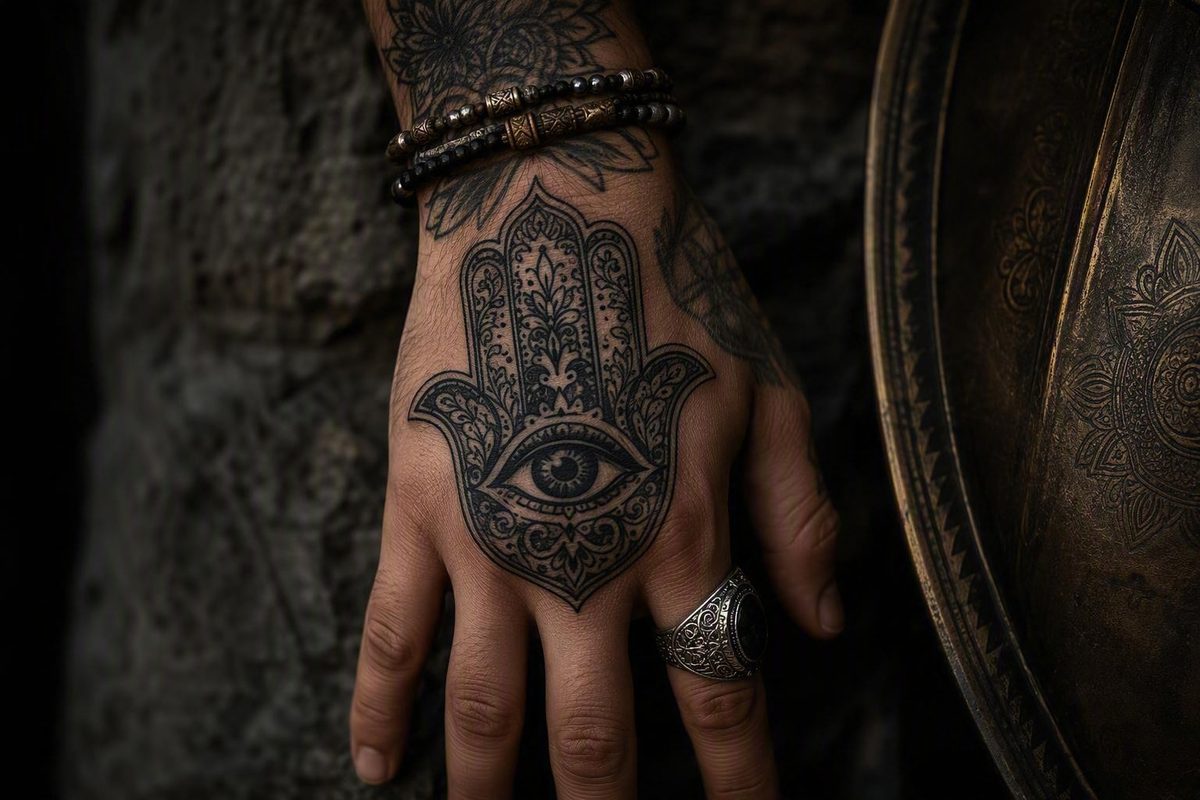
The clearest meaning of a Hamsa tattoo
A Hamsa tattoo most consistently represents symbolic protection. In particular, it is traditionally associated with protection from the evil eye, envy, harm, and other unwanted influences.
That is the clearest answer, but it is not the only one. A Hamsa tattoo may also represent blessing, luck, strength, guidance, peace, harmony, prosperity, or spiritual and cultural identity. These are common secondary associations, not parts of one fixed definition that applies to every design.
A tattoo can carry several layers of meaning at once:
- Inherited cultural meaning: Connection to North African, Middle Eastern, Sephardi, Mizrahi, Jewish, Muslim, Christian, regional, or family traditions.
- Religious meaning: A context-specific association with Miriam, Fatima, Mary, or a religious interpretation of the hand’s five fingers.
- Amulet symbolism: Protection from harm and especially from the evil eye.
- Personal meaning: Resilience, boundaries, awareness, peace, hope, or another intention chosen by the wearer.
- Tattoo-specific meaning: An interpretation shaped by orientation, composition, placement, style, and accompanying imagery.
The evil eye refers here to the belief that an envious or hostile gaze can bring misfortune. The Hamsa is commonly used as a symbolic defense against that gaze, which is why protection is more consistently associated with it than any promise of wealth, health, fertility, or success. The open palm, its role as an amulet, and its prominence in North Africa and the Middle East are outlined in this overview of the Hamsa.
Moving the symbol onto skin can preserve an inherited meaning, reinterpret it personally, or do both. One wearer may choose a Hamsa because it resembles an object kept in their family. Another may understand it through a Jewish, Islamic, Christian, or regional context. Someone else may use the hand as a personal reminder to resist envy, maintain boundaries, or remain open to good experiences.
Claims that a Hamsa protects its wearer, attracts fortune, improves health, increases fertility, or brings blessings belong to spiritual belief and symbolism. A tattoo can express faith, hope, identity, or intention, but it does not demonstrate or guarantee a supernatural, medical, financial, or reproductive result.
Hamsa tattoo meaning at a glance
| Level of interpretation | What the tattoo may represent | How broadly it applies |
|---|---|---|
| Core meaning | Protection from the evil eye, envy, harm, or negative influence | The most widely shared interpretation |
| Common secondary meanings | Blessing, luck, strength, guidance, peace, harmony, or prosperity | Common, but not present in every design |
| Cultural or religious meaning | Heritage, family identity, the Hand of Miriam, Hand of Fatima, or Hand of Mary | Depends on the wearer and community |
| Design-specific meaning | Vigilance through the eye; defense or receptivity through orientation | Variable conventions rather than fixed rules |
| Personal meaning | Boundaries, resilience, awareness, hope, or a significant life experience | Defined by the wearer |
| Claimed spiritual effects | Protection, fertility, fortune, health, or answered prayer | Matters of belief, not proven outcomes |
The best interpretation begins with protection but does not stop there. Consider who is wearing the tattoo, which cultural context informs it, what appears inside the hand, and how the wearer explains the design. No single reading covers every Hamsa tattoo.
Reading the design: hand, eye, fingers, and symmetry
A Hamsa is recognizable first as an open palm. Some versions resemble an anatomical hand, with one thumb and one little finger. Others are deliberately symmetrical, with a central group of fingers and two thumb-like forms curving away from the palm.
The open hand is commonly associated with protection and blessing. As a matter of visual interpretation, it can resemble a raised barrier, shield, offered palm, or welcoming gesture. These visual impressions can help a tattoo communicate a particular mood, but they should not be confused with fixed cultural rules.
Tattoo style changes the presentation rather than automatically changing the inherited symbolism. Heavy blackwork may make the design appear forceful, while fine-line or ornamental work may feel quieter or more devotional. Those are aesthetic effects, not established religious meanings.
The Hamsa and the evil eye are related, not identical
A Hamsa is the hand-shaped symbol. The evil eye is the harmful or envious gaze against which the hand is traditionally used, although eye-shaped talismans may themselves serve as symbolic defenses against that gaze. Because an eye often appears inside the palm, the terms are sometimes blurred in tattoo descriptions. They are not interchangeable.
In a Hamsa tattoo, a central eye commonly reinforces the protective theme. It may suggest watching for envy, hostility, or harmful attention. Contemporary tattoo interpretations also connect it with awareness, understanding, intuition, vigilance, or inner vision.
A Hamsa does not have to contain an eye. An eye-free design can retain the open hand’s protective and blessing-related associations while emphasizing heritage, ornament, family, or personal meaning.
The main possibilities are:
- Hand with an eye: Protection against the evil eye, vigilance, awareness, or discernment.
- Hand without an eye: Protection through the palm itself, blessing, heritage, or a less literal personal meaning.
- Eye as the dominant feature: Greater emphasis on watching, being watched, envy, or resisting harmful attention.
- Ornament as the dominant feature: A decorative treatment whose meaning still depends on the underlying hand and the wearer’s intention.
Do the fingers change the meaning?
Finger position is sometimes assigned a symbolic code. Spread fingers are commonly said to ward off harm, while joined or closed fingers are said to welcome luck, receive blessings, or keep good fortune close.
They appear frequently in modern jewelry, lifestyle, and tattoo explanations and should be treated as variable conventions rather than universal laws.
Finger position also affects composition. Separated fingers create a wider silhouette and may make the hand appear more active. Joined fingers produce a compact, amulet-like form and leave more continuous space for patterning. A choice made primarily for visual balance can still acquire personal significance, but it does not have to carry a traditional meaning.
To interpret a design accurately:
- Identify whether the image is a Hamsa hand.
- Look for a central eye and note how prominent it is.
- Determine whether the hand is anatomical or symmetrical.
- Observe its direction and finger position.
- Consider inscriptions, religious references, flowers, geometry, or other motifs.
- Ask how the wearer understands the complete composition.
No isolated detail settles the meaning. The eye, fingers, direction, ornament, and placement modify the whole; they do not override context.
Hamsa facing up or down: a useful convention, not a universal rule
| Orientation | Common emphasis | Possible personal message |
|---|---|---|
| Fingers pointing upward | Defense, resistance to negativity, protection from envy or the evil eye | “I stand against harmful influence.” |
| Fingers pointing downward | Receptivity to blessings, grace, abundance, friendship, prosperity, good fortune, or fertility | “I remain open to what is good.” |
With the fingers pointing upward, the palm may resemble a raised barrier. This orientation is often chosen to emphasize protection, boundaries, resilience, or resistance to an envious gaze. An eye in the palm can strengthen that reading.
With the fingers pointing downward, the hand is often interpreted as receptive. It may represent openness to blessing, kindness, friendship, abundance, prosperity, or good fortune. Fertility and answered prayer also appear in spiritual explanations of this orientation, but they are traditional beliefs rather than results a tattoo can produce or promise.
Tattoo and spirituality sources commonly describe upward-facing Hamsas as protective and downward-facing examples as receptive to blessings or abundance, while acknowledging that orientation varies by culture and personal intention.
That qualification matters. Sources, families, regions, and individual wearers do not necessarily assign direction the same meaning. Some people recognize the up-versus-down distinction immediately; others understand protection and blessing as qualities of the Hamsa in either orientation. Neither direction is universally correct.
A tattoo has no permanently fixed “up” on a moving body
Orientation is more complicated on skin than on a pendant or wall hanging. A forearm rotates, a wrist bends, and a thigh changes position when the wearer sits.
There are at least three possible reference points:
- The wearer’s viewpoint: The tattoo appears upright when the wearer looks down at it.
- The observer’s viewpoint: It appears upright to someone facing the wearer in a neutral pose.
- The body’s anatomical direction: The fingers follow the limb toward or away from the extremity.
None is automatically correct. The wearer must decide which view matters most and in which posture the tattoo should communicate its primary message. A forearm Hamsa oriented toward the wearer may look inverted to an observer when the arm hangs naturally. A design oriented for an observer may look upside down when the wearer raises the wrist to examine it.
Before tattooing, test the full stencil:
- Stand naturally with the limb relaxed.
- Look at the stencil from your own viewpoint.
- Use a mirror or straight-on photograph to check the observer’s view.
- Sit, bend the limb, and rotate the wrist or forearm.
- Check its relationship to nearby tattoos.
- Decide which posture is the design’s primary presentation.
Define the intended message before choosing direction. If the central idea is repelling harm, an upward-facing hand may reinforce it. If the idea is receiving blessings, a downward-facing hand may communicate that more readily. If the tattoo honors heritage or reproduces a family object, that reference may matter more than a generic orientation guide.
Direction should support the meaning, not carry it alone. The eye, inscription, ornament, placement, and wearer’s explanation all affect how the tattoo will be read.
Why it is called Hamsa, Hand of Miriam, Hand of Fatima, or Hand of Mary
Hamsa or khamsa is associated with the number five, referring most directly to the hand’s five fingers. The symbol has longstanding cultural prominence in North Africa and the Middle East and has acquired different names and interpretations among Jewish, Muslim, Christian, regional, and family communities.
These names are context-specific. “Hamsa” or “khamsa” can serve as a broad term for the hand-shaped amulet, while Hand of Miriam, Hand of Fatima, and Hand of Mary identify more particular cultural or religious settings. They should not be treated as interchangeable labels in every community.
Hand of Miriam in Jewish contexts
In Jewish contexts, especially those associated with Sephardi and Mizrahi communities, the symbol may be called the Hand of Miriam. Miriam is the sister of Moses and Aaron in the Hebrew Bible. Some Jewish interpretations connect the hand’s five fingers with the five books of the Torah.
That association can make a tattoo an expression of Jewish identity, family continuity, heritage, or protection. It does not mean that every Jewish person uses the symbol, calls it the Hand of Miriam, or accepts the same interpretation of the fingers.
A careful personal description might be:
“My design draws on the Hand of Miriam and a Jewish interpretation connecting the five fingers with the Torah’s five books.”
That is more accurate than claiming that the design has one uniform meaning throughout Judaism.
Hand of Fatima in Islamic contexts
In Islamic and related regional contexts, the symbol is commonly called the Hand of Fatima, referring to Fatima al-Zahra, daughter of the Prophet Muhammad. The supplied evidence supports the name’s present-day use but does not establish one uncontested account of how old or universal the label is.
The five fingers may also receive denomination-specific interpretations. Some Sunni explanations connect them with the Five Pillars of Islam. Some Shia explanations connect them with the Five People of the Cloak: Muhammad, Fatima, Ali, Hasan, and Husayn. These Jewish, Sunni, and Shia five-part interpretations should be attributed to particular traditions rather than presented as unanimous doctrine.
That distinction matters when designing a tattoo. An ornamental Hamsa is less specific than a composition containing Fatima’s name, Arabic writing, or imagery intended to express a Sunni or Shia concept. Explicit religious details require careful research and language verification.
Hand of Mary in some Christian contexts
Some Levantine Christians use the name Hand of Mary. In that setting, the hand may be associated with Mary and understood through a Christian cultural context. The name should not be applied automatically to every Hamsa worn by a Christian or to every hand symbol found in Christian art.
The most careful usage is contextual:
- Use Hand of Miriam when a design intentionally draws on the relevant Jewish context.
- Use Hand of Fatima when its Islamic, regional, denominational, or family context makes that name appropriate.
- Use Hand of Mary when referring to the Levantine Christian interpretation.
- Use Hamsa or khamsa when discussing the broader amulet without claiming a denomination-specific identity.
The Hamsa is therefore not adequately described as belonging exclusively to one religion, but neither should it be flattened into generic modern spirituality. Its cultural, familial, regional, and religious meanings overlap without being identical.
What can—and cannot—be said about the Hamsa’s history
Accounts of the Hamsa’s origin often combine three different questions:
- When open-hand motifs were used to represent protection, power, or ritual ideas.
- How the recognizable Hamsa or khamsa developed and circulated as an amulet.
- How contemporary tattooing adapted the amulet form for the body.
Keeping those questions separate prevents a visual resemblance from being turned into an unsupported claim of direct descent.
Ancient hands are not automatically modern Hamsas
Open-hand motifs are attested in the ancient Near East, and modern accounts propose connections with Mesopotamian, Egyptian, Phoenician, Carthaginian, or Iron Age imagery. The precise relationship between those ancient images and the later Hamsa remains uncertain.
Similar appearance does not prove that it carried the Hamsa name, served the same amuletic purpose, or belonged to an uninterrupted symbolic tradition.
The safest summary is:
Protective open-hand motifs are attested in antiquity, and some have been proposed as precedents or relatives of the later Hamsa. The symbol’s single birthplace and exact line of development have not been conclusively established.
It is not responsible to claim that one named civilization definitively invented the Hamsa or that the symbol has retained exactly the same meaning ever since. Reports of a Hamsa-like hand in a particular archaeological setting do not by themselves establish the later amulet’s name, function, or complete symbolism.
The amulet belongs centrally to North African and Middle Eastern history
Whatever its possible ancient antecedents, the Hamsa or khamsa is culturally prominent in North Africa and the Middle East. It appears in forms such as jewelry, wall hangings, textiles, ceramics, and domestic or religious decoration. Jewish, Muslim, and some Christian communities have developed distinct names and interpretations around the open-hand form.
That regional history should remain central. Describing the Hamsa primarily as a wellness accessory, yoga-studio image, or tattoo trend detaches it from communities in which it has long functioned as an amulet. One North African-focused cultural account emphasizes its continued regional importance while criticizing the way fashion and tattoo use can strip the khamsa of context.
This does not mean that every Hamsa object has one religious meaning. A hand-shaped amulet can be domestic, decorative, familial, devotional, and protective at the same time. Nor does shared use prove that Jewish, Islamic, and Christian interpretations descend from one identical theology.
Tattooing is a contemporary medium for an established amulet form
The Hamsa is documented as an amulet used in jewelry, wall hangings, and other objects. A Hamsa tattoo adapts that recognizable form to skin.
Tattooing changes how the symbol is encountered. A pendant can be removed or turned around. A wall hanging remains in one location. A tattoo stays attached to a moving body and may be visible in social, religious, professional, or family settings the wearer did not initially anticipate.
Tattooing also invites contemporary composition. The hand can be combined with flowers, geometric patterns, lettering, dates, animals, or other personal imagery. The resulting tattoo is not an untouched historical amulet, but neither is it disconnected from the meanings associated with that amulet.
Measured descriptions include:
- “The tattoo draws on a North African and Middle Eastern amulet.”
- “Protective open-hand motifs have ancient precedents, although the exact lineage is debated.”
- “The design has regional, religious, familial, and personal interpretations.”
- “My tattoo uses a contemporary composition rather than reproducing one historical object.”
This language acknowledges cultural depth without claiming certainty that the available evidence cannot support.
Building a personal design without inventing a traditional meaning
A thoughtful Hamsa tattoo can be highly personal. The key is to distinguish inherited symbolism from tradition-specific interpretation, modern tattoo convention, and individual intention.
1. Inherited amulet symbolism
Begin with the broadest established association: the open hand as a protective sign, especially against the evil eye, envy, or harmful influence. Decide whether protection is the tattoo’s central meaning, a secondary layer, or simply part of the symbol’s background.
If the design is intended to reproduce a family pendant, wall hanging, textile, or ceramic object, bring a clear photograph to the artist. Identify which details belong to the original and which may be adapted. A family reference may be more meaningful than a generic design found online.
2. Tradition-specific interpretation
Determine whether the tattoo intentionally draws on a Jewish, Islamic, Christian, North African, Middle Eastern, or particular regional setting.
This is where names, sacred references, and inscriptions matter. A Hand of Miriam design may express Jewish identity or a five-part Torah interpretation. A Hand of Fatima tattoo may refer to an Islamic, Sunni, Shia, regional, or family context. A Hand of Mary may belong to a Levantine Christian setting.
Do not mix these labels merely because they refer to visually related hand forms. If the tattoo combines references from more than one tradition, understand why each element is present and avoid implying that the underlying beliefs are interchangeable.
3. Modern tattoo convention
Orientation and finger position belong partly to the modern visual vocabulary of tattoo culture, jewelry, retail explanations, and spirituality media.
An upward-facing hand with a central eye can express resistance to envy or harmful influence. A downward-facing hand can express openness to blessing or good fortune. Spread fingers can make the silhouette feel active, while joined fingers create a more compact form.
Use these conventions deliberately, but do not present them as fixed ancient rules. “I chose an upward Hamsa to emphasize protection” is more defensible than “Upward has always meant protection in every tradition.”
4. Personal intent
Finally, define what the design means to you. Protection might refer to spiritual belief, emotional boundaries, resilience after a difficult experience, loyalty to family, or a commitment to remain aware of envy without being governed by it.
Personal symbolism does not need to be presented as ancient tradition. It needs accurate labeling. For example:
“In my tattoo, the downward hand represents being open to blessings; I know other traditions may read it differently.”
That sentence gives the design a clear meaning without turning one wearer’s interpretation into a universal cultural claim.
Choosing the eye
Include an eye when the tattoo should foreground protection from the evil eye, vigilance, awareness, insight, or inner vision. It should be large enough for the iris, outline, and surrounding ornament to remain visually distinct at the chosen scale.
Omit it when the palm, heritage, blessing, family reference, or another motif should dominate. An eye-free Hamsa remains recognizable and does not lose its broad protective association.
If an eye is included, decide whether it should be realistic, amulet-like, or geometric. That choice changes the mood, not necessarily the core protective theme.
Adding flowers, mandalas, and other motifs
Lotus flowers and mandalas appear in contemporary Hamsa tattoo compositions.
These additions should not be described as universal or ancient parts of Hamsa tradition. They may come from different cultural histories or from contemporary global tattoo aesthetics. A careful explanation would be:
“I paired the Hamsa with a lotus because the two images represent protection and growth to me.”
The same caution applies to chakras, mudras, sacred geometry, manifestation imagery, and deity figures. Visual compatibility does not establish shared historical origin.
A design brief to take to the artist
Write down the following before the consultation:
- Primary meaning: Protection, blessing, heritage, awareness, resilience, or another idea.
- Cultural reference: Broad Hamsa imagery, a family object, Hand of Miriam, Hand of Fatima, Hand of Mary, or a particular regional design.
- Direction: Fingers pointing up or down, including which viewing angle defines “up.”
- Finger position: Spread, joined, anatomical, or symmetrical.
- Central eye: Included or omitted; realistic, geometric, or amulet-like if included.
- Additional motifs: Flowers, geometry, dates, initials, animals, or other imagery, with each identified as inherited or personal.
- Inscriptions: Exact language, spelling, reading direction, calligraphy, and method of verification.
- Placement: Body area, limb movement, visibility, and relationship to existing tattoos.
- Style: Blackwork, fine line, dotwork, ornamental, illustrative, an American traditional tattoo style, or another visual approach.
- Scale: Enough room for the eye, ornament, and negative space to remain distinct.
- Explanation: One or two sentences describing the tattoo without claiming that its interpretation is universal.
A tattoo artist can solve compositional and placement problems, but the client should arrive prepared to discuss the symbol’s cultural references. When sacred names, unfamiliar languages, or denomination-specific imagery are involved, verification should happen before the appointment.
Cultural appreciation, appropriation, and choosing respectfully
There is no universal ruling on whether someone outside the cultures associated with the Hamsa may get it tattooed. Some commentators regard informed use as acceptable because the symbol has circulated among several communities. Others argue that purely aesthetic use can erase or trivialize its North African, Middle Eastern, Jewish, Muslim, or Christian contexts.
No writer, retailer, tattoo artist, or individual wearer can speak for every community. Research also does not create universal permission.
A more useful question than “Am I allowed?” is: “What relationship am I creating with this symbol?” Someone who learns its context, identifies the tradition informing the design, verifies its details, and speaks modestly about personal meaning is making a different choice from someone who treats it only as an exotic or mystical image.
A practical respect checklist
Learn the relevant context. Do not stop at “It means protection.” Understand the evil-eye belief, the amulet’s regional prominence, and the communities associated with the particular name or design you plan to use.
Identify tradition-specific details. A broadly ornamental hand is different from a Hand of Miriam with Hebrew text, a Hand of Fatima with Arabic calligraphy, or a design invoking the Five People of the Cloak. Greater specificity requires greater care.
Verify every inscription. Do not rely only on image search, automatic translation, or a decorative font the artist cannot read. Confirm spelling, grammar, reading direction, religious appropriateness, and letterforms with a knowledgeable reader.
Avoid blending distinct religious claims carelessly. A composition can combine traditions for a considered personal reason, but visual convenience is not enough. Do not present Jewish, Sunni, Shia, and Christian associations as versions of one identical doctrine.
Use names accurately. Call the design Hand of Miriam, Hand of Fatima, or Hand of Mary only when that context is genuinely relevant. “Hamsa” or “khamsa” is usually more appropriate for general discussion.
Consult knowledgeable people when needed. If a tattoo contains explicit Jewish, Sunni, Shia, Christian, Arabic, Hebrew, Amazigh, or other regional details, speak with someone who understands that context. A skilled tattooer may still need help from a language expert, religious educator, family member, historian, or cultural practitioner.
Describe your meaning without speaking for everyone. Say, “For me, the hand represents protection and awareness,” rather than, “This symbol means the same thing to all Middle Eastern people.”
Expect more than one response. Thoughtful research cannot guarantee approval. Some observers may welcome the design; others may regard permanent use by an outsider as appropriation. Private intent does not erase the symbol’s public and cultural meanings.
One commercial cultural guide argues that informed outsider use can amount to appreciation while acknowledging that treating the Hamsa as mere fashion may be disrespectful. That position represents one side of the debate over cultural significance and outsider use.
A contrasting cultural critique warns that fashion and tattooing can detach the symbol from North African and Middle Eastern histories. Together, these positions demonstrate why there is no single community-wide answer.
The final pre-tattoo review
Before tattooing, confirm six things:
- Intended meaning: Can you explain what the tattoo represents to you in plain language?
- Cultural references: Do you know which details are inherited, tradition-specific, modern, or personal?
- Orientation: Have you decided whose viewpoint matters and what “up” means on that body part?
- Visual elements: Are the eye, fingers, symmetry, inscriptions, and added motifs intentional?
- Artist discussion: Has the artist reviewed the complete brief and raised any concerns about scale or placement?
- Stencil inspection: Have you checked the design while standing, sitting, moving, and viewing it from more than one angle?
Frequently asked questions
Is a Hamsa tattoo the same as an evil-eye tattoo?
No. A Hamsa is an open-hand symbol associated with protection. The evil eye is the harmful or envious gaze against which the hand is traditionally used; the term may also refer to an eye-shaped talisman intended to defend against that gaze.
The symbols are closely related because a Hamsa often contains an eye in its palm. A Hamsa can exist without an eye, and an eye-shaped protective tattoo does not automatically become a Hamsa.
Should a Hamsa tattoo face up or down?
Either orientation can be appropriate. Fingers pointing upward commonly emphasize defense, boundaries, and protection from negativity or the evil eye. Fingers pointing downward commonly emphasize receptivity to blessings, grace, abundance, prosperity, good fortune, or fertility.
These are conventions rather than universal rules. Choose the direction that supports your intention, then test the stencil in natural postures so you understand how it appears to you and to an observer. Fertility and prosperity remain symbolic or spiritual associations, not promised outcomes.
What do spread or closed fingers mean in a Hamsa tattoo?
Spread fingers are sometimes interpreted as warding off harm. Joined or closed fingers are sometimes associated with welcoming luck, receiving blessings, or keeping good fortune close.
These meanings are less firmly established than the Hamsa’s general association with protection. Finger position may also be chosen for balance, available space, or readability, so it is best described as a convention or personal interpretation.
What does the number five represent in the Hamsa?
The name Hamsa or khamsa is associated with five, referring most directly to the hand’s five fingers.
Some communities give those fingers additional meanings. Jewish interpretations may connect them with the five books of the Torah. Some Sunni interpretations associate them with the Five Pillars of Islam, while some Shia interpretations associate them with the Five People of the Cloak. These are tradition-specific explanations, not one universal theology.
Is it disrespectful to get a Hamsa tattoo if it is not part of your heritage?
Views differ. Some people consider informed use acceptable because the Hamsa has circulated among several cultural and religious communities. Others believe outsider use—especially when it is purely aesthetic—can trivialize or erase those communities’ relationships with the symbol.
If you proceed, learn the relevant context, use tradition-specific names accurately, verify inscriptions, avoid careless religious combinations, and describe the design as your interpretation rather than everyone’s. Those steps cannot guarantee approval, but they make the decision more informed and respectful.
Protection remains the clearest shared Hamsa tattoo meaning. Direction, the central eye, finger position, religious names, and added motifs create more specific but variable readings. Choose those details deliberately, describe spiritual effects as beliefs rather than facts, acknowledge the symbol’s living North African, Middle Eastern, Jewish, Islamic, and Christian contexts, and approve the final design only after checking both its cultural references and its physical orientation with the tattoo artist.