
A Cerberus Tattoo Guards the Boundary Between Worlds
Cerberus tattoos can suggest guardianship, mortality, duty or surviving a severe trial. Heracles, gates, chains and snakes change the reading.
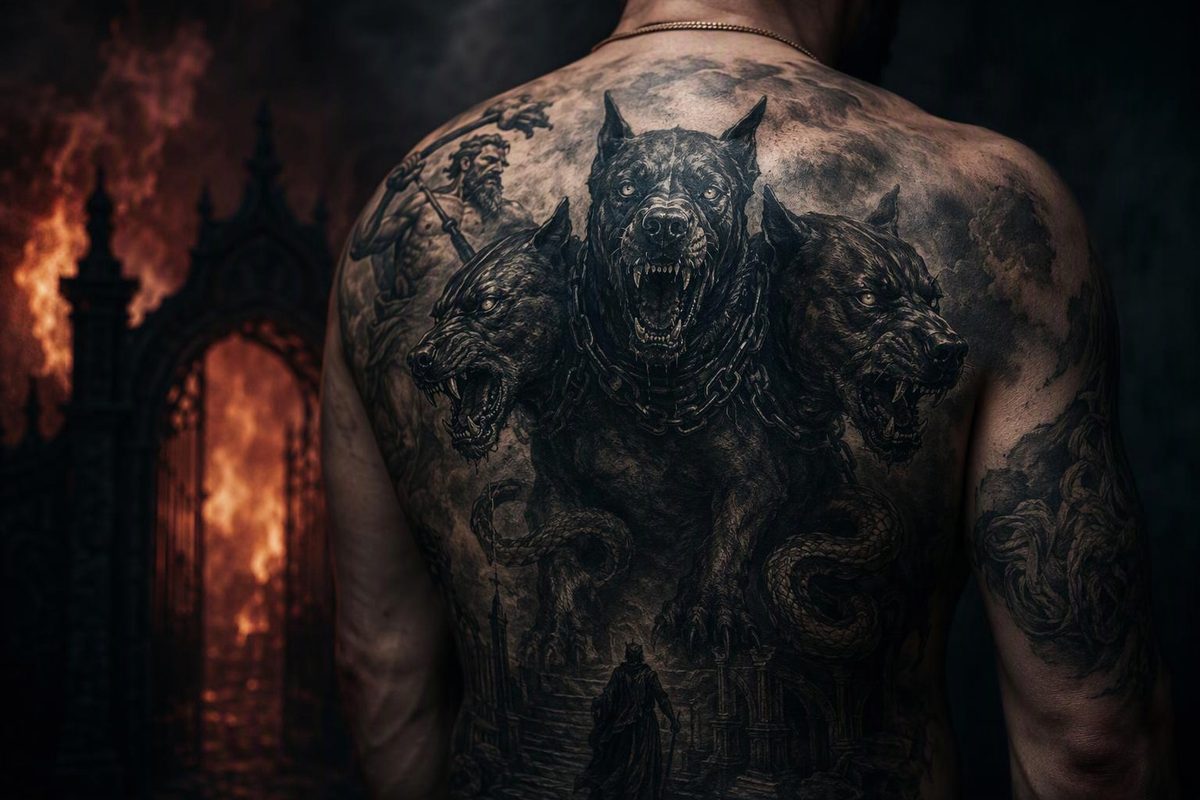
A Cerberus tattoo most often signifies guardianship, protection, duty or control of a dangerous boundary. Because the hound stands at the entrance to the Greek underworld, it can also represent mortality and the line between two states of being.
Add Heracles, chains or a club, and the emphasis changes: the tattoo becomes a story about confronting a severe trial. There is no single ancient code for a Cerberus tattoo, so the full composition matters more than the creature alone.
Choose the meaning and composition you want; the builder will suggest the clearest elements.
Build A Clear Cerberus Composition
A Watchful Guardian
Cerberus alone emphasizes protection, vigilance and control of a boundary.
- Three clearly separated heads
- Calm, outward-facing posture
- Optional restrained snake details
Historical caveat
The three heads have no fixed ancient meaning such as past, present and future. Treat that reading as personal symbolism.
Source basis: Hesiod and Pseudo-Apollodorus passages, the Oxford classical entry, the Louvre hydria record and Dante’s Inferno. Recommendations describe composition, not a universal tattoo code.
Cerberus Represents Protection Through Control
Cerberus—Kerberos in Greek—is the monstrous hound stationed at the entrance to Hades. His job is not simply to attack; he controls passage. In Hesiod’s Theogony, the watchdog welcomes those entering but prevents them from returning. That makes him a particularly strong image of guarding a threshold rather than aggression in general (classical passages collected by Theoi).
That role supports several modern readings:
- Protection: guarding a person, family, home or private inner life
- Boundaries: deciding what may enter and what must stay out
- Duty: remaining at a post others fear to approach
- Vigilance: watching in several directions at once
- Mortality: acknowledging death without treating it as defeat
“Loyalty” is a reasonable personal interpretation because Cerberus holds his assigned station, but it is not an ancient tattoo definition. The myths supply the role; the wearer decides how that role connects to a life.
The Three Heads Have No Fixed Ancient Meaning
The familiar three heads make a forceful image, but ancient sources do not give them a standard meaning such as past, present and future or birth, life and death. Either idea can guide a personal design, but neither should be presented as an established Greek explanation.
The number of heads was not even fixed. Hesiod calls Cerberus fifty-headed. Three heads became more normal in later literature and art, while Attic vase painters often used two, according to the Oxford Dictionary of the Classical World.
That variation gives an artist room to simplify the figure without losing its identity. Three heads communicate “Cerberus” immediately to many modern viewers; two can echo ancient vase painting; a mass of heads pushes the design toward Hesiod’s more chaotic monster.
Past, present and future can still be a meaningful personal interpretation if that is what the wearer intends. It should be treated as a modern layer added to the myth, not a decoded message inherited from antiquity.
A Gate Centers Guardianship And Boundaries
A solitary Cerberus, especially facing outward from a doorway, arch or set of columns, centers guardianship and boundaries. The architectural threshold makes the subject’s function clear even to a viewer who does not recognize every mythological detail.
A calm but alert stance suggests controlled power. Bared teeth and forward motion make the same subject read as a warning or active defense. Pose is visual storytelling, not a universal symbolic code.
Chains can reinforce restraint, confinement or controlled danger, but they are less specific by themselves. Without Heracles or another recognizable narrative element, viewers may read a chained Cerberus as restrained power rather than the twelfth labor.
Heracles Turns Cerberus Into A Trial
In Pseudo-Apollodorus, capturing Cerberus is the twelfth labor of Heracles. The hero overpowers the hound without his weapons, brings it before Eurystheus and then returns it to the underworld (the translated passage).
The scene also appears in ancient art. A black-figure hydria made around 525 BCE shows Heracles leading Cerberus, club raised, while Eurystheus gestures from inside a storage jar (Louvre collection record).
In a tattoo, this pairing can suggest endurance, mastery of fear, surviving an ordeal or completing the hardest task. A lion skin, club or the cowering Eurystheus makes the Heracles story clearer than chains alone.
Composition determines who appears dominant. Placing Cerberus beneath Heracles emphasizes conquest. Showing the two locked in struggle keeps the outcome—and therefore the meaning—less settled. Heracles leading the captured hound reads more like a completed trial than an ongoing battle.
Snakes Strengthen The Underworld Identity
A serpent tail and snakes along the back belong to documented descriptions of Cerberus, not only modern fantasy art. Pseudo-Apollodorus describes three dog heads, a serpent tail and snake heads along the hound’s back; the Oxford entry likewise notes a shaggy mane and writhing snakes (Oxford Reference).
These details add menace and distinguish Cerberus from an ordinary three-headed dog. They can also make the mythological identity clearer when the design does not include a gate, Heracles or written context.
Bones, shades, dark water or a gate shift the emphasis toward death, confinement and passage between worlds. A design focused on mortality does not have to present Cerberus as evil. He can remain a keeper of order at a place no living person can permanently cross.
Dante’s Cerberus Represents Uncontrolled Appetite
Cerberus also appears in Dante’s Inferno among the gluttonous in the third circle. Virgil quiets his famished jaws by throwing earth into them; Dante then compares him to a hungry dog intent on devouring food (Digital Dante, Columbia University).
In a design built specifically around this medieval version, Cerberus can suggest gluttony, uncontrolled appetite or consuming desire, rather than guardianship alone. Mud, filthy rain or suffering shades help distinguish that reference from a general Greek-underworld scene.
Without those details, most viewers are more likely to see a general Cerberus image than a specific reference to Dante. Famished mouths and an environment drawn from the third circle make the intended source more legible.
Clear Head Separation Keeps The Design Readable
Three muzzles, six ears, multiple eyes and a serpent mane create visual traffic quickly. Rather than choosing placement from a fixed rule, ask the artist to show how the heads separate at the intended size. A simple three-head arrangement may stay clearer at a smaller scale than a full scene with Heracles, architecture and underworld figures.
For an American traditional approach, bold silhouettes, open mouths and a restrained number of snake shapes suit the style’s emphasis on clarity. Black-and-gray work can support a darker underworld atmosphere.
Color has no inherited Cerberus code. Red eyes, green snakes or blue flame carry whatever associations the composition gives them; they do not have fixed meanings established by the Greek sources.
Before collecting references, settle the sentence the tattoo should communicate: “I guard this boundary,” “I survived the hardest trial,” or “I live with an awareness of death.” That choice tells the artist whether Cerberus should stand alone, hold a gate or struggle against Heracles. For broader composition prompts, see these tattoo ideas organized by meaning, style and placement.