
What a Dagger Tattoo Can Say—From Protection to Betrayal
Protection, betrayal, danger and survival are all plausible. Upward or downward orientation has no consistent code, while the full composition narrows the reading.
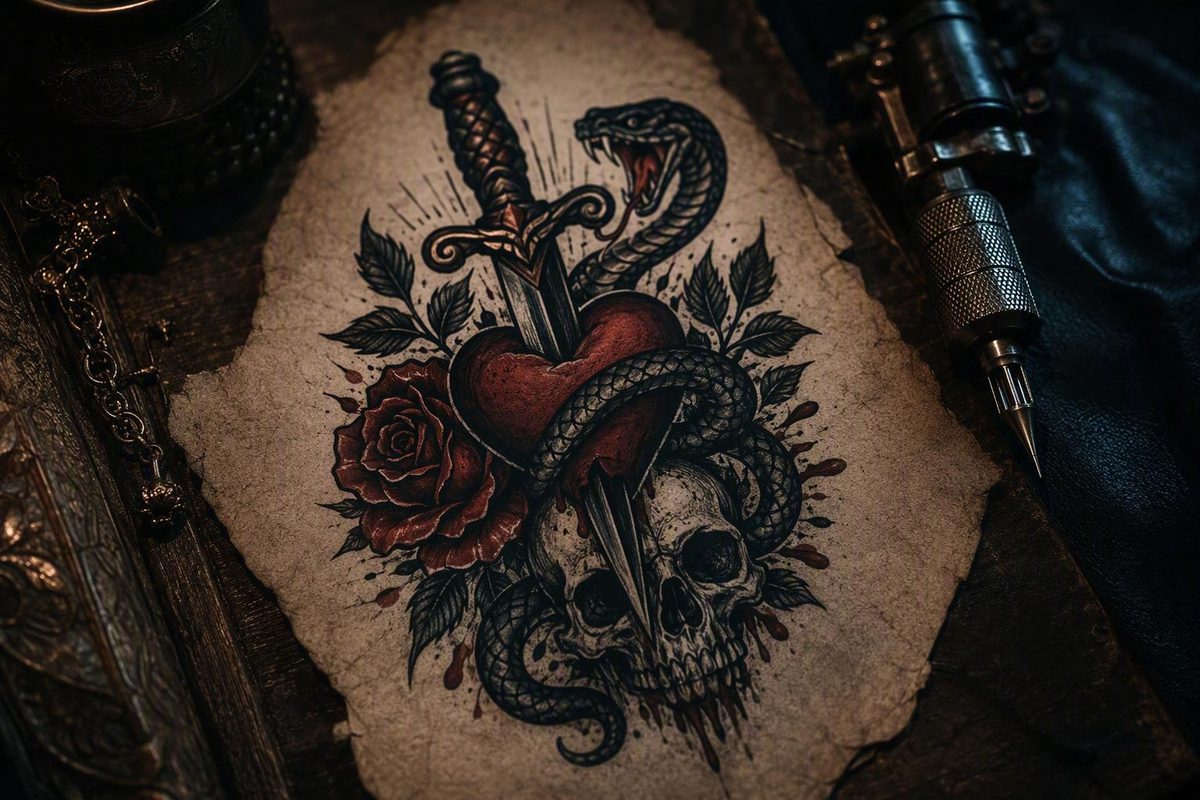
The short answer: what does a dagger tattoo mean?
A dagger tattoo has no single universal meaning.
- Protection — defense, boundaries, loyalty, or readiness to protect someone.
- Courage or strength — bravery, sacrifice, determination, or decisive action.
- Conflict or danger — threat, violence, risk, or an internal struggle.
- Betrayal or loss — heartbreak, broken trust, grief, or emotional injury.
- Survival or resilience — enduring pain, recovering from hardship, or reclaiming power after being hurt.
These apparently contradictory meanings come from the dagger’s central duality: a blade can defend, but it can also injure. The tattoo can therefore represent the weapon, the wound, protection from the wound, or the strength required to survive it.
Tattoo studios, retailers, and aftercare brands repeatedly associate dagger imagery with protection, bravery, betrayal, sacrifice, danger, and resilience. That repetition demonstrates a recognizable contemporary tattoo-industry vocabulary, not a universal symbolic code or proof that every interpretation has a fixed historical origin. Commercial sources also acknowledge that meaning depends on the wearer and accompanying imagery, as illustrated by this overview of contemporary dagger symbolism.
The complete composition usually tells you more than the blade alone. Ask what the dagger is doing, what surrounds it, how it is rendered, and what story the wearer intended. A dagger piercing a heart creates a different impression from one resting behind a heart. A snake confronting the blade feels different from one shedding its skin around it. A banner, name, date, memorial detail, flower, crack, scar, or new growth can make an otherwise ambiguous image more specific.
Here is a quick reference:
| Design | Plausible contemporary readings |
|---|---|
| Standalone dagger | Protection, courage, boundaries, sacrifice, danger, decisive action, survival |
| Dagger through a heart | Heartbreak, betrayal, grief, broken trust, emotional injury, survival after loss |
| Dagger with a rose | Beauty or love contrasted with pain, danger, sacrifice, betrayal, or growth |
| Dagger with a snake | Danger, deception, temptation, conflict, wisdom, transformation, rebirth, or balance |
| Dagger with a skull | Mortality, impermanence, fearlessness, acceptance, memento mori, or survival |
These are starting points, not verdicts. You cannot reliably reconstruct another person’s character, history, affiliations, or intentions from a dagger tattoo alone.
Why the dagger can represent both protection and harm
The clearest way to understand dagger symbolism is to begin with the object’s opposing functions rather than memorizing a disconnected list.
On one side, a dagger can be imagined as a means of defense. In that frame, it may communicate readiness, courage, vigilance, loyalty, sacrifice, firm boundaries, or the willingness to protect a person or value. It can also stand for decisive action: the moment when hesitation ends and a difficult choice is made.
On the other side, the dagger remains a weapon. That makes it visually compatible with danger, violence, betrayal, emotional injury, personal conflict, and loss. A concealed or unexpected blade can evoke treachery; a visible wound can evoke pain; a bloodied composition can suggest that conflict has already occurred.
Contemporary tattoo writing regularly places those positive and negative associations beside one another. Cloak and Dagger Tattoo London, for example, presents betrayal, loss, and danger alongside protection, sacrifice, and bravery while emphasizing that a standalone tattoo can carry a meaning unique to its owner in its traditional dagger tattoo guide.
The two sides do not have to cancel each other out. In a recovery-focused design, their coexistence may be the point. A dagger can acknowledge that a wound happened while representing the strength needed to live beyond it. Someone might choose the image after betrayal, bereavement, fear, or another difficult period—not to glorify the source of pain, but to mark survival.
This is why a dagger tattoo does not necessarily indicate aggression, criminality, or harmful intent. An image of a weapon can be autobiographical, protective, memorial, decorative, or metaphorical. It may represent a boundary rather than an attack, or a painful experience rather than a desire to cause pain.
Composition helps make those distinctions more legible:
- A clean standalone blade can be framed as readiness, precision, protection, or resolve.
- A dagger within a decorative frame may feel emblematic rather than actively violent.
- A blade piercing another object makes injury, conflict, betrayal, or sacrifice more visually immediate.
- Flowers or new growth surrounding a wound can direct attention toward endurance.
- A memorial date or name can transform a general emblem into a personal remembrance.
None of these devices creates an infallible code. They influence what a viewer is likely to notice first.
Broad historical claims deserve particular caution. The available commercial sources do not establish that sailors, soldiers, prisoners, or other groups always used dagger tattoos for one settled purpose. Meanings can vary by period, region, tattooer, community, and individual. A recurring modern interpretation should not automatically be projected backward into history.
Standalone dagger tattoos: strength, boundaries, sacrifice, or danger
A standalone dagger leaves more room for personal interpretation than one paired with a heart, rose, snake, or skull. With fewer contextual clues, the viewer sees the blade’s basic tension—defense versus harm—but may not know which side matters most.
Possible readings include:
- Protection or defended boundaries
- Courage, strength, or bravery
- Loyalty to a person or principle
- Sacrifice or duty
- Survival and resilience
- Recovery after hardship
- Decisiveness and clarity
- Danger, threat, or conflict
These remain possibilities, not definitions. One commercial account assigns standalone daggers both qualities such as loyalty and protection and darker associations such as danger and threat, while explicitly stating that there is no single answer to the design’s meaning in its discussion of dagger tattoo interpretations.
If you want a standalone dagger to carry a more readable story, add one or two details that anchor it:
- A banner or short phrase: identifies the principle, promise, or lesson associated with the blade.
- A date: connects it to a decision, loss, recovery, anniversary, or turning point.
- A name or initials: frames the dagger around loyalty, protection, memory, or a relationship.
- A decorative frame: makes the image feel like an emblem or personal marker.
- A broken chain, scar, or crack: can point toward release, damage, or survival.
- Leaves, flowers, or new growth: can bring recovery or development into the foreground.
- A personal object: gives the blade a story that generic symbolism cannot supply.
Begin with the theme rather than the accessory. If the intended meaning is a defended boundary, the dagger could sit upright inside a frame or be paired with wording about self-respect. If it marks a difficult decision, a date or concise phrase might be enough. If it represents survival, a repaired break, scar, or emerging growth can show that the story continues after injury. If it represents a willingness to protect someone, a name, birth flower, or personal emblem may make that relationship visible.
It is also worth distinguishing a dagger from a generic knife or sword when briefing an artist. Commercial symbolism articles sometimes discuss these blades together, but shared themes such as strength, danger, or sacrifice do not make the forms historically or symbolically interchangeable. If the exact blade type matters, provide visual references instead of relying on the broad word “blade.”
Most importantly, do not use a standalone dagger to diagnose someone else. It does not prove that the wearer is violent, has been betrayed, belongs to a particular group, or has lived through a particular event. Without context, several readings remain open.
Dagger through heart and dagger with rose meanings
Hearts and roses give the dagger an emotional setting, but the interaction between the elements matters as much as the elements themselves.
A dagger piercing a heart is commonly read through heartbreak, betrayal, broken trust, grief, lost love, or emotional pain. Because the blade visibly enters the heart, the composition makes injury central. Contemporary tattoo-industry accounts also give it a recovery-oriented reading: the heart may be wounded, but the wearer survived. Stories & Ink presents betrayal, heartbreak, loss, and broken trust alongside survival and resilience in its discussion of dagger-through-heart imagery.
That distinction matters. One wearer may use the design to preserve the memory of a devastating loss. Another may use a similar image to say that betrayal no longer controls them. A third may simply value the dramatic contrast of the motif. The composition establishes an emotional wound more clearly than a bare dagger does, but it cannot tell you whether the wearer is still experiencing that pain or looking back on it.
A dagger beside, behind, or in front of a heart is less explicitly injurious because the heart is not being pierced. The arrangement might suggest guarding love, emotional courage, or readiness to defend a relationship. That is a plausible visual reading, not a documented universal tattoo rule. The same placement could be decorative or chosen to produce a balanced silhouette.
Small changes can clarify the intended story:
- A cracked, bleeding, or darkened heart intensifies damage and grief.
- A stitched or repaired heart makes recovery more visible.
- New leaves or flowers around the wound can suggest growth after suffering.
- A name or date can frame the design as memorial or autobiographical.
- A banner can state the lesson rather than asking the imagery to carry everything.
A dagger and rose creates a related but broader contrast. The hard, dangerous blade sits against a delicate living form. Contemporary interpretations commonly frame that contrast as beauty or love beside pain, danger, sacrifice, loss, struggle, or betrayal. Mantra Tattoo & Piercing describes the pairing through dualities such as pain and beauty, strength and softness, and heartbreak and growth in its guide to dagger-and-rose symbolism.
The rose itself does not have one fixed meaning. Depending on the wearer and design, it may suggest passion, devotion, beauty, purity, remembrance, or growth. Color can contribute to the visual mood, but the supplied evidence does not establish a universal color key.
Again, action changes emphasis:
- A dagger piercing or cutting the rose makes damage, loss, sacrifice, or betrayed love more prominent.
- A rose blooming around the dagger can foreground endurance, growth, or the coexistence of softness and strength.
- A rose resting behind the blade creates contrast without depicting a wound.
- Thorns wrapped around the dagger can heighten tension or suggest that beauty has defenses.
- Falling petals may imply change or loss, although that interpretation still depends on context.
As a visual synthesis, the pierced-heart composition places emotional injury in the foreground, while the rose pairing can hold beauty and pain in tension. Either design can be adapted to emphasize suffering, remembrance, protection, or recovery.
Snake, skull, flames, and blood: how added imagery shifts the story
A snake-and-dagger tattoo supports an unusually broad range of contemporary readings. Depending on its pose, surroundings, and the wearer’s intentions, it may suggest:
- Danger or hidden threat
- Deception or temptation
- Wisdom or alertness
- Poison and healing
- Inner conflict
- Transformation or rebirth
- Balance between opposing forces
- Confronting or overcoming adversity
The supplied commercial sources do not agree on one definition for this pairing. Some foreground deception and danger; others emphasize wisdom, regeneration, healing, or overcoming old patterns. Fountainhead New York, for example, connects the combination with temptation, deceit, healing, poison, rebirth, and personal conflict in its discussion of dagger combinations.
Composition can help narrow that range. A snake coiled tightly around the blade or confronting its point can heighten danger, tension, or unresolved conflict. A snake shedding its skin makes transformation easier to recognize. A balanced, symmetrical arrangement may suggest coexistence, while a visibly defeated snake may imply overcoming a threat. Even then, viewers can bring different associations to the snake.
A skull and dagger commonly directs the design toward mortality. It can function as a memento mori—a reminder that life ends—or suggest impermanence, acceptance of death, fearlessness, or survival after a threatening period. A skull does not prove that the wearer is fascinated with death. It may instead say that time is limited, that fear should not dictate life, or that the wearer survived a dangerous chapter.
The relationship between the elements makes a difference:
- A dagger piercing the skull emphasizes violence or confrontation with death.
- A skull positioned behind the blade can serve as a mortality reminder.
- New growth around both elements shifts attention toward survival and continuation.
- A damaged dagger beside an intact skull may suggest the limits of force.
- A memorial date can turn a general memento mori into a remembrance.
Flames and dripping blood are less consistently corroborated additions. One commercial discussion that treats knives and daggers together assigns flaming blades themes such as passion, purification, determination, and transformation, while associating bloodied blades with sacrifice, pain, endurance, and significant change in its overview of flame and blood motifs.
Those associations should remain secondary and tentative. The available evidence does not establish universal meanings for flames, blood, a clean blade, a broken blade, rust, ornamentation, or any particular color. These details work best as narrative devices: they establish tone, imply an event, or direct attention toward one part of the wearer’s story.
Culturally specific blades and motifs require a different standard of research. A Japanese tantō, Namakubi imagery, or another culturally situated design should not be reduced to a sentence from a generalized commercial tattoo blog. Their histories, conventions, and regional meanings fall beyond what this evidence can responsibly establish.
Read the action, not just the objects
A useful way to interpret or design a dagger tattoo is to start with the verb. Is the dagger piercing, crossing, wrapping, guarding, resting, breaking, or emerging?
Standalone
A standalone dagger leaves the action implied. It can feel ready, displayed, ceremonial, defensive, or threatening, depending on its angle and treatment. Because nothing else is happening, personal details become especially useful.
Piercing
Piercing creates the strongest visual impression of injury, conflict, betrayal, or sacrifice. The object being pierced identifies what is wounded: a heart points toward emotion or love, a flower toward beauty or growth, and a skull toward mortality or confrontation with death.
Piercing can also support a survival story, but recovery generally needs an additional cue. Stitches, scars, new leaves, a repaired crack, or a banner can indicate that the wound is not the ending.
Wrapping or intertwining
A snake, vine, chain, ribbon, or flower wrapped around a dagger can suggest tension, balance, constraint, mutual dependence, or transformation. The surrounding object may appear to control the blade, be threatened by it, or coexist with it. The pose determines which relationship feels most prominent.
Crossing
Two crossed objects may suggest opposition, alliance, equality, symmetry, or simply a strong emblematic arrangement. Crossed daggers do not have one established meaning. If alliance or conflict matters, supporting details should make that intention clearer.
Guarding or standing beside
A dagger beside, in front of, or behind another symbol can look protective because it does not visibly wound that object. A blade placed before a heart, family emblem, or flower may therefore suggest guarding what the second image represents. This remains a compositional inference rather than a universal rule.
Context can narrow the reading further. A banner names a value. A date identifies an event. A memorial element ties the design to loss. A scar records damage. New growth announces continuation. These details are often more communicative than adding several unrelated symbols.
Consider three contrasting examples:
- Heartbreak versus recovery: A dagger through a cracked, bleeding heart centers injury and loss. Keep the pierced heart but add stitches, new leaves, or a phrase about endurance, and the motif can focus on recovery.
- Danger versus renewal: A snake striking at the dagger creates confrontation. A snake shedding its skin while winding around the blade makes transformation more prominent.
- Mortality versus survival: A dagger driven into a skull emphasizes violence or death. A skull behind an upright blade, surrounded by living plants or a meaningful date, can read more like a reminder to live or a record of survival.
No arrangement guarantees that every viewer will reach the same conclusion. Composition supports the intended story; it cannot control interpretation completely. The practical goal is usually to make the most important idea visible first.
American Traditional style, modern treatments, and placement
Dagger imagery is prominent in American Traditional tattooing. Its elongated silhouette, strong central axis, and capacity for dramatic pairings suit bold, readable compositions. That prominence does not establish that American Traditional tattooing invented dagger tattoos or assigned them one settled historical meaning. Kings Avenue Tattoo identifies the dagger as classic imagery within the style and shows it paired with roses and skulls in its studio overview of dagger iconography.
At the visual level, American Traditional treatment commonly uses bold outlines, simplified forms, solid areas of color, and a limited palette. Those choices can make a dagger feel immediate, forceful, and legible. For broader stylistic context, see this guide to American Traditional tattoo history and visual rules.
A dagger can also work in:
- Neo-traditional, with expanded color, ornament, and dimensional detail
- Blackwork, using heavy black shapes or high-contrast pattern
- Fine-line, for a quieter and more delicate presentation
- Illustrative, allowing a drawn or narrative quality
- Realism, emphasizing metal, texture, reflection, blood, or weathering
- Minimalist treatment, reducing the design to its essential silhouette
Style affects tone more reliably than meaning. A bold traditional dagger may feel direct and forceful; a fine-line version may feel restrained or reflective. Blackwork can heighten severity or graphic impact, while realism can make the implied event feel immediate. None of these approaches automatically changes protection into betrayal or danger into resilience.
Placement also influences presentation more reliably than symbolism. Its main effects are:
- Available scale
- Visibility or concealment
- Anatomical flow
- Readability from a distance
- Space for detail
- Room for future additions
The forearm and calf are frequently recommended because their elongated shapes can accommodate a long, narrow dagger. Cloak and Dagger’s studio guide recommends those areas for the motif’s slim silhouette. Other workable options identified across the supplied sources include the thigh, upper arm, chest, ribs, back of the arm, and spine, depending on the design’s size and detail.
A simple dagger may fit comfortably in a narrow area. A dagger piercing a heart or surrounded by a rose needs more width. A coiled snake requires enough room for overlapping forms to remain distinguishable. A realistic skull, ornate handle, banner, or detailed flames may require a larger placement than a compact fine-line blade.
Before settling on a location, consider:
- Should the blade follow the length of the limb?
- Should it cross the anatomy to create tension?
- Will the design be read upright by other people, by the wearer, or both?
- Is there enough width for the paired motif?
- Will clothing regularly cover part of the composition?
- Should the placement leave room for a sleeve, panel, or future additions?
- Does the scale allow the artist to separate lines and preserve the intended visual hierarchy?
Placement does not objectively make a dagger more intimate, dangerous, powerful, or courageous. Choose the location for how the design fits, moves, and reads—not because a generic placement list promises a particular identity.
Direction, cultural claims, and choosing a meaning responsibly
The available sources do not establish a consistent symbolic code for upward- and downward-pointing daggers. Some commercial pages assign readiness or power to an upward blade and sacrifice or survival to a downward one. Others claim that an upward dagger is masculine while a downward dagger is feminine or lunar. These claims are inconsistent and unsupported by qualified historical evidence.
There is therefore no sound basis for saying that an upward dagger is inherently masculine or that a downward dagger is inherently feminine, lunar, submissive, or sacrificial.
Choose direction first according to:
- The anatomy of the placement
- The design’s visual balance
- How the paired elements interact
- Whether the image must be read from a particular viewpoint
- The movement you want the blade to create
- The space required for a handle, point, banner, flower, heart, snake, or skull
You can still give direction a personal meaning. An upward blade might represent readiness to you; a downward one might represent a conflict that has ended. The important distinction is that this would be your assigned meaning, not an accepted code every viewer can be expected to recognize.
Be equally cautious with broad claims about Japanese, Celtic, Greek, Egyptian, military, sailor, prison, gang, or religious symbolism. Meanings can change across places, periods, institutions, and communities. The supplied commercial sources cannot establish that one image has always meant the same thing to every member of a large cultural or historical group.
Culturally specific blade forms and imagery deserve dedicated research. If the design includes a tantō, Namakubi, religious emblem, military insignia, regional gang symbol, or another culturally situated component, consult sources and artists with relevant knowledge. Ask whether the exact form is accurately drawn, appropriate to use, and likely to carry associations beyond the one you intend.
A practical design brief can begin with six prompts:
- Intended theme: Is the central idea protection, grief, betrayal, courage, sacrifice, boundaries, survival, or something else?
- Life event or value: What experience, person, promise, or principle gives the image personal weight?
- Dagger action: Is it standalone, piercing, guarding, crossing, wrapped, broken, or at rest?
- Accompanying motif: Why a heart, rose, snake, skull, banner, flower, flame, or another object?
- Artistic style: Should the tattoo feel bold, severe, ornate, delicate, realistic, graphic, or understated?
- Desired visibility: Is it meant to be regularly visible, easy to cover, or integrated into a larger project?
Then bring the brief to an artist and ask:
- What scale is needed for the details to remain clear?
- How will the lines and small spaces change as the tattoo ages?
- Does the design follow the anatomy or fight against it?
- Does the first read feel like protection, injury, conflict, or recovery?
- Would changing the action make the intended theme clearer?
- Is there enough room for the paired symbols to remain distinct?
- Does any component have culture-, institution-, or region-specific associations?
- Would a banner, date, scar, flower, or other detail clarify the story without overcrowding it?
Finally, define the tattoo in your own words. “This marks the boundary I learned to defend” is more useful than selecting “protection” from a symbolism list. “This represents the heartbreak I survived” gives an artist more direction than simply requesting a dagger and heart.
The wearer controls the story, but the public sees the composition before hearing its explanation. That is the difference between personal meaning and public readability. Common symbolism can help you construct a readable design, but it is a vocabulary rather than a rulebook.
Frequently asked questions
Does a dagger tattoo always mean violence or aggression?
No. Although a dagger is a weapon and can communicate danger, conflict, or injury, it can also represent protection, bravery, sacrifice, boundaries, decisive action, survival, or resilience.
A clean standalone dagger may emphasize readiness or self-protection, while a blade piercing another symbol creates a stronger impression of harm. Neither design proves anything about the wearer’s character, conduct, history, or affiliations.
What does a dagger through a heart tattoo mean?
A dagger through a heart is commonly interpreted as heartbreak, betrayal, broken trust, grief, lost love, or emotional pain. It can also represent surviving those experiences.
Surrounding details determine which side of the story receives more emphasis. Blood, cracks, or a darkened heart can foreground injury. Stitches, new growth, a memorial date, or a recovery-focused phrase can shift attention toward endurance.
What is the difference between a dagger-and-rose and a dagger-and-snake tattoo?
A dagger and rose generally builds its message around contrast: beauty or love against pain, danger, sacrifice, loss, or struggle. A blooming rose can suggest endurance or growth, while a cut or pierced rose makes injury more prominent.
A dagger and snake has a broader and less settled range. It may suggest danger, deception, temptation, wisdom, healing, transformation, rebirth, inner conflict, or balance. A striking snake creates a different story from one shedding its skin. In both pairings, visual action matters more than a generic symbol list.
Does an upward- or downward-pointing dagger have an accepted meaning?
No consistent, well-supported code is established by the available evidence. Claims that upward daggers are inherently masculine or that downward daggers are inherently feminine or lunar should not be treated as accepted rules.
Choose orientation for anatomical flow, readability, and composition unless you deliberately want to assign direction a personal meaning.
Where does a dagger tattoo fit best on the body?
The forearm and calf are frequently recommended because their elongated shapes suit a long, narrow blade. The thigh, upper arm, chest, ribs, back of the arm, and spine may also work, depending on the design’s size and detail.
The best placement gives the dagger and its accompanying imagery enough room to remain readable. Consider whether the blade should follow or cross the anatomy, how visible you want it to be, and whether you need space for a heart, rose, snake, skull, banner, or future additions.
The meaning begins with the story
The dagger’s defining duality gives the motif its range. It can depict the wound, the defense against it, or the resilience that follows.
Begin with the story you want the tattoo to carry. Then use the paired motif, visual action, style, orientation, and placement to make that story clearer. Common symbolism is a useful design vocabulary, not a rulebook. Discuss the complete composition—and any culturally specific references—with a knowledgeable tattoo artist before committing.