
What South Carolina’s Face Tattoo Ban Means for You
South Carolina bars artists from tattooing the head, face or neck. See penalties, shop buffer rules, exceptions and the Tiny Zaps challenge.
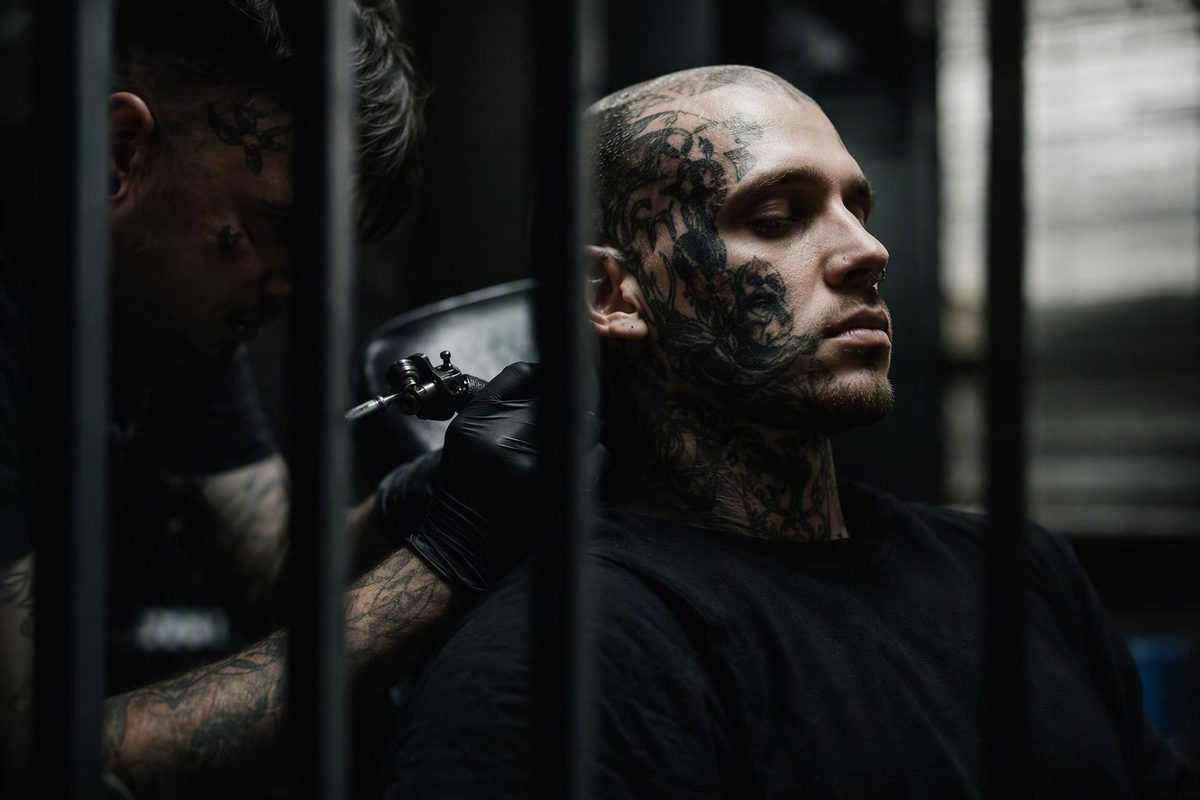
A South Carolina tattoo artist may not legally tattoo another person’s head, face, or neck, even if the customer is an adult who consents. South Carolina Code § 44-34-100(E) prohibits the artist from performing the procedure. Merely having or displaying an existing face tattoo is not prohibited by that provision. A violation of the tattooing chapter is a misdemeanor carrying up to a $2,500 fine, up to one year in prison, or both.
Choose a placement and shop distance to check both South Carolina restrictions, then explore the legal timeline and neighboring-state comparison.
Check the proposed body placement and the shop’s distance from a church, school or playground. The two restrictions operate independently.
| Issue | Rule | Who It Affects | Known Consequence |
|---|---|---|---|
| Head, face or neck application | Prohibited by § 44-34-100(E) | Artist | Chapter violation |
| Having an existing face tattoo | Not prohibited by cited chapter | Wearer | No chapter penalty stated |
| Customer younger than 18 | Tattooing prohibited | Artist and minor customer | Chapter violation |
| Customer impaired by drugs or alcohol | Tattooing prohibited | Artist and customer | Chapter violation |
| Specified unhealthy skin condition | Tattooing prohibited | Artist and customer | Chapter violation |
| Facility within 1,000 feet of church, school or playground | Licensing restricted by § 44-34-110 | Shop | Facility-location barrier |
| Facility licensing and sanitation | State requirements apply | Shop and artist | Chapter violation if breached |
| Any chapter violation | Misdemeanor under § 44-34-100(F) | Violator | Up to $2,500, one year, or both |
The supplied sources establish South Carolina’s rules but do not provide verified placement, buffer or penalty figures for its neighbors. Unknown values are shown as — rather than inferred.
| Georgia | — | — | — |
| North Carolina | — | — | — |
| South Carolina | Artist cannot tattoo head, face or neck | 1,000 feet from church, school or playground | $2,500, one year, or both |
Sources: South Carolina Code Title 44, Chapter 34; Pacific Legal Foundation’s July 17, 2026 case announcement; Reason reporting dated July 20, 2026; WIS-TV reporting dated July 29, 2026. Neighbor-state figures were not supplied by these sources.
The Law Targets The Artist, Not The Tattoo Wearer
The official South Carolina tattooing chapter states in § 44-34-100(E) that it is unlawful for a tattoo artist to tattoo any part of another person’s head, face, or neck.
Three parts of that wording determine the answer:
- The regulated person is the tattoo artist.
- The prohibited act is tattooing another person.
- The prohibited placements are the head, face, and neck.
The provision does not declare a completed face tattoo contraband. It does not make it a crime under this chapter to enter South Carolina, live or work there, or appear in public with facial ink.
Adult consent does not override the placement rule. South Carolina separately prohibits tattooing someone younger than 18, but reaching the minimum age only satisfies the age requirement. It does not authorize a head, face, or neck tattoo.
The statute does not supply exact anatomical boundaries for placements near the hairline, ear, jaw, upper throat, base of the skull, or transition from the lower neck to the upper torso. Calling a piece a behind-the-ear tattoo, upper-chest tattoo, or hairline tattoo does not settle its legal classification.
Existing And Out-Of-State Tattoos Are Treated Differently
The legal result changes depending on whether the tattoo is being applied in South Carolina or is already complete.
| Situation | Result Under This Chapter | Qualification |
|---|---|---|
| An artist in South Carolina tattoos an adult’s face | Prohibited | Consent does not create an exception |
| A person wears an existing face tattoo in South Carolina | Not prohibited | Private appearance policies may still apply |
| A resident returns with a face tattoo obtained elsewhere | Not prohibited | The other state’s law governs the original procedure |
A Tattoo Applied In South Carolina
An artist who tattoos another person’s head, face, or neck in South Carolina performs the conduct covered by § 44-34-100(E). Identification, informed consent and a signed waiver do not remove that restriction.
Marketing terms do not necessarily change the result. Describing the service as a micro tattoo, fine-line piece or ornamental mark does not determine whether it is statutory tattooing or whether its placement falls within a prohibited area.
An Existing Face Tattoo
The person wearing a completed face tattoo occupies a different position from the artist who applied it. The tattooing chapter does not criminalize merely possessing or displaying that tattoo.
An employer, school, professional organization, event organizer or property owner may have an appearance policy. Such a policy is separate from South Carolina’s criminal tattooing restrictions, and its enforceability depends on facts and law outside this chapter.
Work Performed In Another State
The chapter does not say that a South Carolina resident commits an offense merely by returning with a face tattoo obtained elsewhere. The relevant provision regulates the procedure performed by an artist, not later possession of the finished work.
That does not establish whether the original appointment complied with the other state’s age, consent, practitioner, facility, health or placement requirements. Those rules must be checked where the procedure occurs.
Artists Face A Misdemeanor And Up To One Year
Section 44-34-100(F) makes a violation of South Carolina’s tattooing chapter a misdemeanor. Upon conviction, the authorized punishment is a fine of up to $2,500, imprisonment for up to one year, or both.
Those are statutory maximums, not mandatory outcomes in every case. Charging and sentencing depend on the alleged conduct, court proceedings and applicable law. The penalty is chapter-wide rather than a sentence written only for face tattooing.
The body-placement provision is directed at the artist. The same potential penalty should not automatically be assigned to a customer merely because that person requested or wears the tattoo.
Other requirements remain separate from the placement ban. The chapter prohibits tattooing a person younger than 18, someone impaired by drugs or alcohol, or skin displaying specified unhealthy conditions. Tattoo facilities must be licensed and comply with applicable sterilization, sanitation, infection-control and safety standards.
An appointment can satisfy the age, sobriety, skin-condition, licensing and sanitation rules yet remain prohibited because the placement is on the head, face or neck. Choosing a permitted placement likewise does not excuse a violation of those other requirements.
The 1,000-Foot Buffer Restricts Shop Locations
South Carolina Code § 44-34-110 creates a separate restriction involving tattoo-facility locations. It prevents licensing a tattoo facility within 1,000 feet of a church, school or playground.
This rule concerns where a tattoo business may operate. It does not determine which part of a customer’s body may be tattooed. A shop must account for both rules independently: a facility outside the buffer can still be barred from providing head, face or neck tattoos, while a shop offering otherwise permitted placements can still encounter the location restriction.
The federal plaintiffs challenging the law argue that the buffer makes suitable storefronts difficult to find. The cited material does not provide a statewide count of eligible or ineligible properties, so no reliable percentage of South Carolina commercial space can be stated.
Municipal zoning, occupancy, permitting and business-license rules may impose additional requirements. Compliance with the 1,000-foot state provision does not establish compliance with every local rule.
The Tiny Zaps Lawsuit Has Not Suspended The Statutes
On July 17, 2026, Tiny Zaps and Greenville residents Joshua and Stephanie McDonald filed a federal lawsuit challenging both the head, face and neck restriction and the 1,000-foot facility buffer. The reported case is Tiny Zaps v. Dr. Brannon Traxler. Pacific Legal Foundation, counsel for the plaintiffs, announced the South Carolina tattoo lawsuit.
The plaintiffs allege that tattoo creation and receipt are artistic expression protected by the First Amendment. Reporting also identifies Fourteenth Amendment claims. These are allegations and legal theories presented by the plaintiffs, not findings already made by a court.
A complaint begins a case; it does not suspend a statute. Requesting an injunction is also different from obtaining one. Reporting on July 20 said the plaintiffs were seeking an injunction, but did not report that one had been granted or that a final judgment had invalidated either restriction. Local reporting later that month continued to describe the dispute as a filed federal lawsuit.
The litigation could produce an injunction, final judgment, dismissal, settlement or appeal. Until an applicable court order or legislative change alters the rule, artists should not treat the lawsuit’s existence as permission to perform prohibited work. The current official code and federal docket must be checked before acting.
Courts Have Disagreed About Tattooing As Expression
The constitutional dispute turns partly on whether making a tattoo is protected expression or regulable conduct. The plaintiffs contend that images, words, symbols, style, placement and collaboration between artist and recipient make tattooing expressive activity.
The legal background is divided. According to the July 2026 reporting, the South Carolina Supreme Court held in 2002 that the tattooing process was not protected by the First Amendment, and the U.S. Supreme Court declined to hear the case. The same report says the U.S. Court of Appeals for the Ninth Circuit reached a different conclusion in 2010, treating tattooing as protected expressive activity.
Those summaries provide context but do not replace the judicial opinions or analysis of later precedent. A ruling from another federal circuit also does not, by itself, invalidate a South Carolina statute.
Even if a court determines that tattooing involves protected expression, that finding alone does not decide the case. The result would depend on the governing constitutional framework, the state’s defenses, the factual record and the scope of any relief ordered.
Medical And Cosmetic Labels Do Not Guarantee An Exception
The tattooing chapter says it does not restrict the activities of physicians or surgeons licensed in South Carolina. That language may matter in a medical setting, but it does not establish a blanket exception for every procedure advertised as cosmetic, reconstructive, therapeutic, paramedical or medically related.
The result can depend on who performs the procedure, the professional authority under which that person acts, what the procedure involves, where it occurs and which statutes, regulations or board rules apply.
The available cited evidence does not support a categorical claim that permanent makeup, microblading, cosmetic tattooing or reconstructive pigmentation is exempt from the head, face and neck restriction. A business’s marketing label is not a legal classification.
Anyone relying on an exception should identify the exact procedure, the practitioner’s license or authority, the facility’s status and the specific law supporting the exception. Borderline placement near the scalp, ear, jaw or upper torso also warrants authoritative guidance rather than reliance on shop terminology.
Answers To Common Face-Tattoo Questions
Can Someone Be Arrested Merely For Having A Face Tattoo?
The cited tattooing chapter does not make merely having, wearing or displaying an existing face tattoo a crime. Its body-location provision regulates an artist’s act of tattooing another person.
That answer is limited to the tattooing chapter. It does not resolve unrelated conduct, another law or a private appearance policy.
Can An Artist Tattoo My Face If I Am Over 18?
No, not under § 44-34-100(E). The minimum age and body-placement restriction are separate. Being an adult and consenting does not authorize an artist to tattoo your head, face or neck in South Carolina.
Can I Return With A Face Tattoo Obtained Elsewhere?
The cited chapter does not prohibit returning to South Carolina with or displaying a completed face tattoo. Whether the original procedure was lawful depends on the jurisdiction where it occurred.
Did The 2026 Lawsuit Make Face Tattooing Legal?
No. Filing a complaint does not suspend the challenged law. The July reports described a request for an injunction, not a granted injunction or final judgment invalidating the restriction.
Because the case can change, the federal docket should be checked for later orders before an artist or shop relies on the lawsuit.
What Is The Maximum Penalty?
A violation of the tattooing chapter is a misdemeanor punishable upon conviction by up to a $2,500 fine, up to one year of imprisonment, or both. These are maximum penalties, and the placement provision regulates the artist’s conduct rather than criminalizing the customer’s completed tattoo.
This is general legal information rather than advice for a particular artist, customer, shop or procedure. A South Carolina attorney can assess uncertain placements, claimed professional exceptions and the effect of any later order in Tiny Zaps v. Traxler.