
Decode an Eagle Tattoo by Its Strongest Details
Decode an eagle tattoo by its pose and surrounding symbols, from freedom and strength to U.S., Mexican, Christian, military or Haudenosaunee meanings.
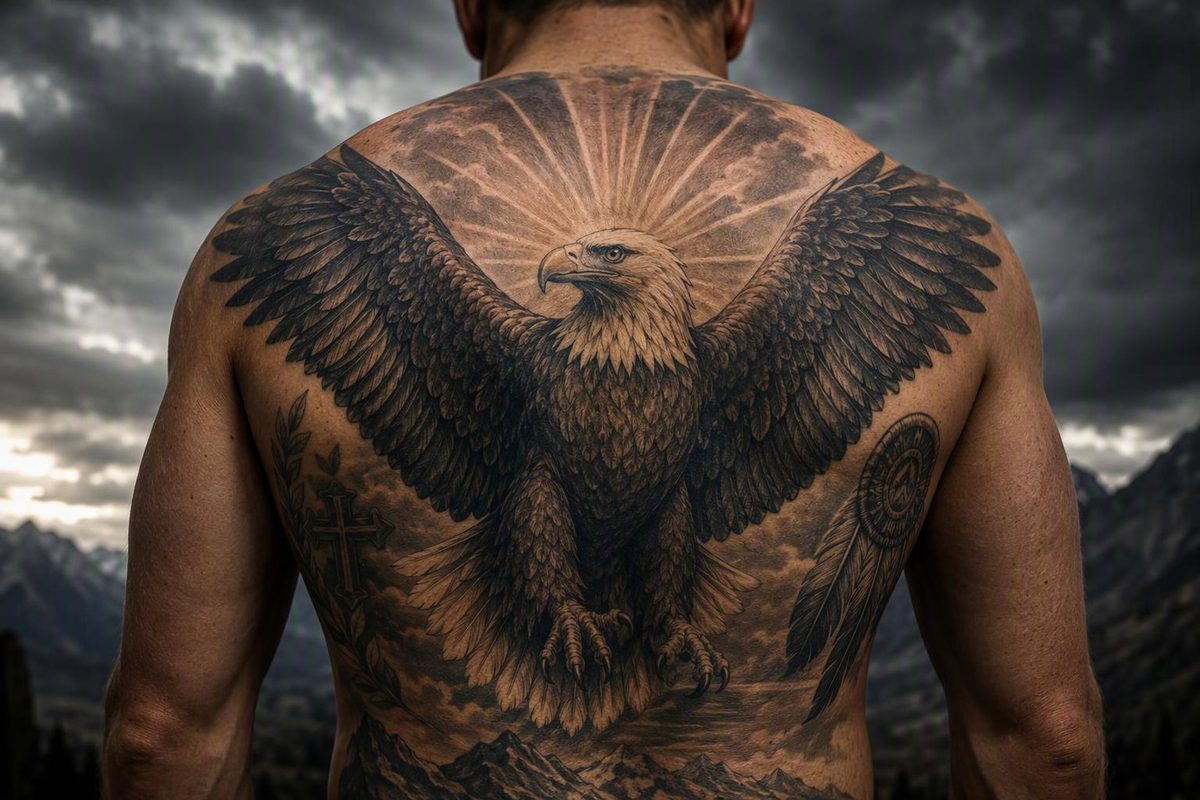
An eagle tattoo can mean freedom, strength, courage, independence or pride, but pose alone does not fix its meaning. Specific objects carry clearer associations: the 1782 Great Seal points to the United States, while a cactus, globe and anchor, Gospel book or white pine can identify other traditions.
Choose the design’s strongest visual cue; the reader shows the most defensible interpretation.
Read the Design by Its Strongest Cue
Likely reading
Freedom, independence, strength or watchfulness
This remains broad personal symbolism. Flight may emphasize movement or release; a perched bird can suggest control or vigilance.
Eagle Alone, Flying or Perched
Broad personal symbol
Freedom, independence, strength, watchfulness or ambition are plausible readings, not a universal code. Ask the wearer before assigning a personal story.
American Traditional Eagle
Courage, freedom or American pride
A World War II aviation flash sheet pairs an eagle with the U.S. flag. The museum account connects wartime servicemen’s tattoos with nationalism, courage, honor, bravery and freedom, but that history does not make every traditional eagle patriotic.
U.S. Flag, Shield, Olive Branch or Arrows
United States and national service
The 1782 Great Seal represents strength, unity and independence. The olive branch and arrows denote peace and war, and the eagle faces the branch to express a preference for peace. Its 13 arrows, shield stripes and stars refer to the original states.
Eagle, Globe and Fouled Anchor
U.S. Marine Corps
This exact combination is the Corps’ official emblem. The eagle represents the nation it serves, the globe its worldwide presence, and the anchor its naval history and amphibious role. It should not imply service that did not occur.
Eagle With a Snake and Cactus
Mexico or Mexican identity
The cactus is the decisive clue. Mexico’s Foreign Ministry traces the eagle perched on a cactus to the origin and foundation of Tenochtitlan; the current flag shows the eagle in profile devouring a rattlesnake.
Gospel Book, Dragon or Saint John Reference
Christian faith and Saint John
The eagle is an emblem of Saint John the Evangelist in Christian art. The Met’s circa-1500 eagle lectern places a winged dragon beneath its talon and interprets the composition as the triumph of the Word over evil. An eagle alone does not establish Christian intent.
White Pine or Named Haudenosaunee Imagery
Haudenosaunee guardian and messenger
A guide prepared with Haudenosaunee scholars and community members describes the eagle atop the Tree of Peace as guardian of the Haudenosaunee and messenger to the Creator. This meaning belongs to a named confederacy, not all Indigenous nations.
Feathers, Regalia or Copied Tribal Designs
Specific nation or community required
Eagle parts and feathers have ceremonial and regalia uses among Native Americans. Federal distribution through the National Eagle Repository is restricted to eligible enrolled members of federally recognized tribes, but those rules govern physical remains and feathers—not tattoo images. Consult the specific nation rather than combining generic motifs.
Prey, Snake, Dagger or Skull
Conflict, survival or mortality
Without a documented emblem, this is a compositional reading rather than fixed code. Talons and defeated prey emphasize conflict or dominance; a skull adds mortality, while a dagger may suggest danger, protection or betrayal.
Names, Dates or Unit Insignia
Remembrance, service or loyalty
Text and emblems narrow the reading more reliably than pose. The Smithsonian account says some World War II servicemen used tattoos to identify their unit, commemorate their experience or honor lives lost.
Sources: National Air and Space Museum; National Museum of American Diplomacy; U.S. Marine Corps; Mexican Foreign Ministry; The Met; NMAI; U.S. Fish and Wildlife Service.
Pose charts are not a universal tattoo code, and the wearer’s account remains decisive. The reader draws on the National Air and Space Museum, National Museum of American Diplomacy, U.S. Marine Corps, Mexican Foreign Ministry, Metropolitan Museum of Art, National Museum of the American Indian and U.S. Fish and Wildlife Service.