
What Does an Ornamental Tattoo Mean?
Ornamental tattoos can be adornment, personal expression or symbol-led designs. Learn how jewelry shapes, flowers and mandalas change the reading.
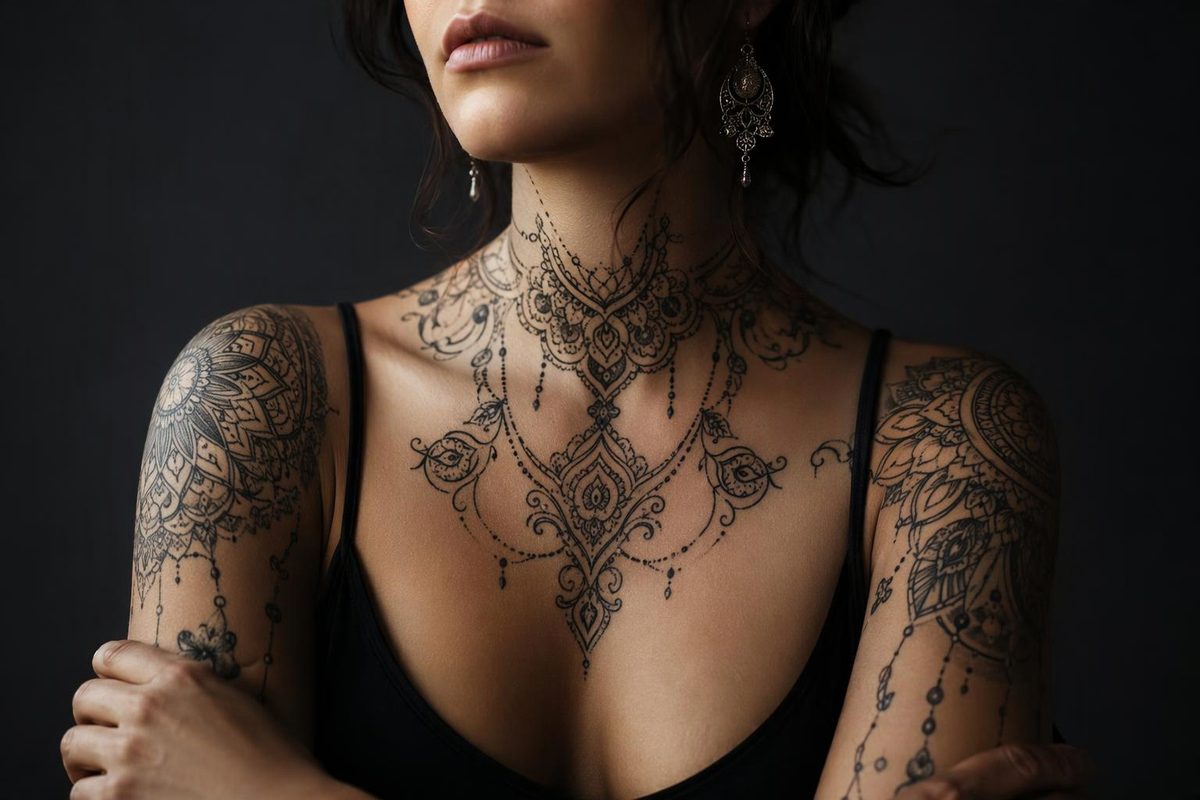
An ornamental tattoo has no single fixed meaning. It can be chosen simply to decorate the body, or to express a personal idea through pattern, flowers or a specific symbol. The useful distinction is between ornamental—the design’s decorative approach—and the meaning of whatever it contains.
A lace-like wrist cuff, mirrored floral chest piece and Buddhist mandala may all look decorative, but they do not communicate the same thing. To interpret one, look at the motif, its source and the wearer’s intention—not just the style label.
Adornment can be the whole point
An ornamental tattoo does not need a hidden story to justify it. Its purpose can be the pleasure of wearing a pattern that follows the body: a border around an arm, a pendant-like shape below the collarbones or flowing decoration across the back.
Artist Giulia Covelli describes tattooing as “dressing the body with a permanent form of elegance.” In her interview with World Tattoo Events, she also explains that she starts with the client’s intention and placement, then designs around their anatomy. That is one artist’s account of ornament as both adornment and a personal encounter—not a universal symbol dictionary. Read Covelli’s interview.
If your reason is “I love how this looks on me,” that is a complete answer. If you want it to represent confidence, a fresh start or ownership of your appearance, those can be personal meanings without becoming meanings shared by everyone wearing ornamental work.
What the details add
Jewelry-like shapes and mirrored patterns
A tattoo arranged like a necklace or cuff can be understood as permanent adornment. If it references a particular heirloom, the meaning may instead center on that object and the person associated with it.
Symmetry can be your way of expressing balance or order, but it is not proof that the tattoo has a spiritual message. Ornamental-floral artist Kessy Borges identifies mirror designs—where both sides are identical—among her favorite subjects. She also distinguishes between clients bringing a story and those wanting a simple design. Both approaches belong in ornamental tattooing. Read Borges’s interview.
Flowers, leaves and scrolling stems
First ask whether the design contains an identifiable flower or an abstract plant pattern. A recognizable lotus invites questions about lotus symbolism; a curling stem is not automatically a coded message about growth or rebirth.
Historical ornament offers a useful corrective. The Metropolitan Museum of Art’s Department of Islamic Art explains that vegetal motifs and patterns in Islamic art are largely without symbolic meaning, with the exception of the garden and its usual reference to paradise. That account concerns a particular artistic tradition, not every floral tattoo—but it shows why decoration should not always be translated into symbolism. See the Met’s account of vegetal patterns.
Mandalas and religious imagery
A radial flower pattern and a religious mandala should not be treated as interchangeable. The Met describes the mandala in Tibetan Buddhist practice as a diagram of the universe used to conceptualize a path to enlightenment. Its meaning comes from that religious context, not merely from circular symmetry. See the Met’s mandala exhibition.
If your reference is a specific devotional image, identify it before requesting a copy. Calling it “ornamental” does not remove its religious content.
Choose the reference as carefully as the pattern
Ornamental work can draw from more than one source. In a 2020 Things&Ink interview, Abigail Tonge names embroidery, paintings, buildings, temples and homewares among her inspirations. That variety is a reason to ask where a design comes from rather than assuming the entire style has one origin or meaning. Read Tonge’s interview.
For your consultation, separate three things:
- Appearance: the shapes, density and placement you like.
- Personal meaning: what you want the tattoo to express, if anything.
- Source: any particular artwork, tradition or symbol being referenced.
A useful brief might be: “I want a mirrored floral cuff for adornment, with a flower connected to my grandmother. I don’t want religious imagery.” That gives the artist a clearer direction than asking for an ornamental tattoo that universally means “protection” or “balance.”