
Read the Meaning Behind a Sun Tattoo Design
Learn how sunrise, sunset, faces, paired moons, color and cultural symbols change a sun tattoo’s message—and which designs require extra care.
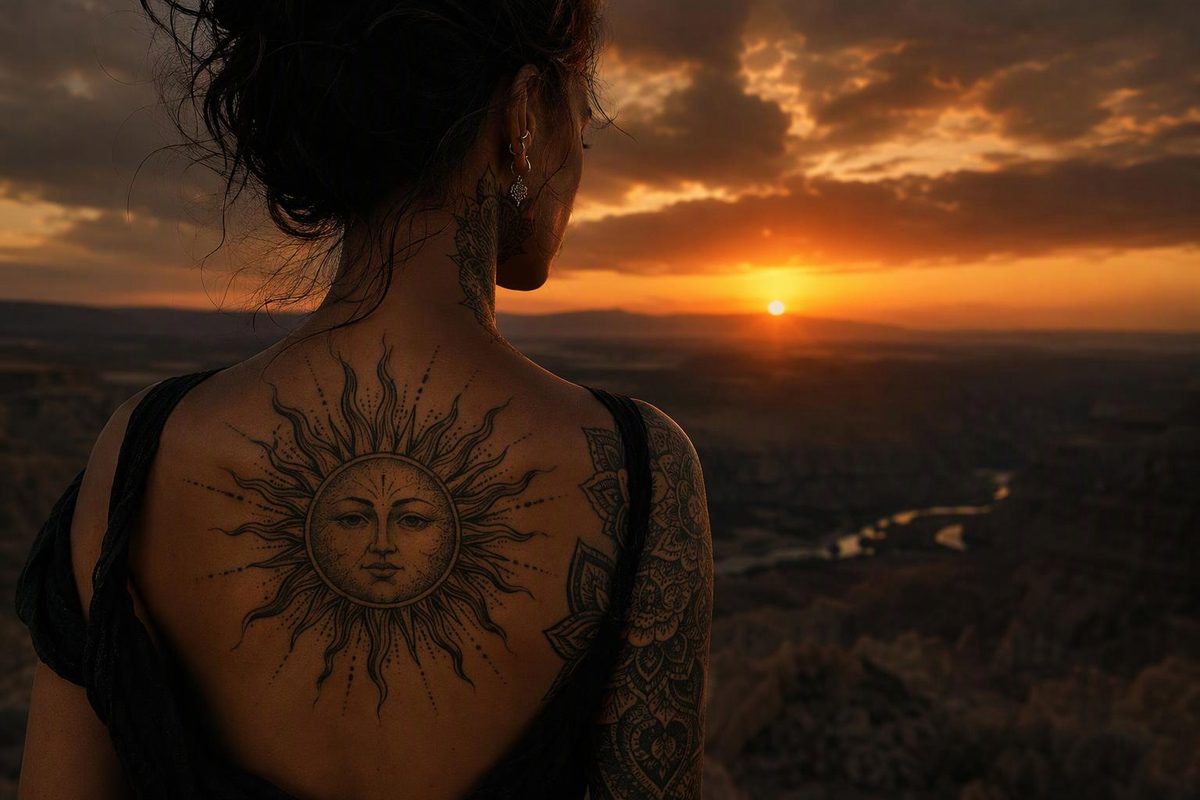
A sun tattoo most often suggests life, energy, warmth, hope or renewal. It can also represent clarity, constancy or the passage of time because the sun illuminates, sustains life and returns each morning.
That is a starting point, not a fixed code. A sunrise and a darkened sun do not tell the same story, and a generic circle with rays is not equivalent to a named religious or Indigenous emblem. The wearer’s reason, surrounding imagery and source of the design matter more than a one-word lookup.
Choose the sun treatment and companion imagery; the tool will show the likely reading and any context to check.
Likely Design Reading
A beginning, recovery, hope or another chance.
What Makes It Legible
The sun breaking the horizon emphasizes renewal.
Source: Design readings summarized from the museum, cultural-center and symbol references cited in the accompanying article.
How The Design Changes The Meaning
- Rising sun: A beginning, recovery, hope or another chance. A sun breaking the horizon makes renewal especially legible.
- Setting sun: Closure, rest, transition or the end of a period. It can memorialize a person or a chapter without making death its only possible meaning.
- Full sun with open rays: Vitality, confidence, warmth or outward energy. Long, sharp rays can feel forceful; soft or wavy rays produce a gentler impression.
- Sun with a face: Personifies the sun as watchful, wise, joyful or serene. The expression does much of the work: a calm face and a grimacing face carry different moods.
- Sun and moon together: Balance between opposites such as day and night, action and reflection, or two people with contrasting temperaments. Do not assume that the sun must mean “male” and the moon “female.” The pairing appears in some traditions: the Met documents an Inca belief associating gold and the male sun with silver and the female moon, but that is not a universal code (The Metropolitan Museum of Art).
- Clouded, eclipsed or dark sun: Struggle, obscured hope, grief or transformation. Specific Black Sun geometry requires a separate check before it becomes a tattoo.
- Floral or landscape composition: Growth, home, a favorite place or connection to a season. Dates, coordinates and local plants can turn a broad solar image into a personal one.
Color changes the visual emphasis rather than supplying a universal definition. Yellow and orange heighten the impression of light and warmth. Red can feel hotter or more urgent. Blackwork shifts attention to shape, contrast and mood.
If you are deciding what should surround the sun, use these tattoo ideas by meaning, style and placement as prompts rather than as a symbol dictionary.
Why The Sun Carries Many Meanings
Solar imagery has never belonged to one culture or interpretation. A British Museum survey shows how varied its roles can be. A Bronze Age gold pendant from Britain depicts the sun at the horizon; the museum connects solar symbolism with the source and rhythm of life in farming communities.
In Mesopotamia, the sun god Utu or Shamash was shown rising through the mountains. In a Shintō myth, Amaterasu’s emergence from a cave restored light and order. For Inca peoples, the sun’s importance was tied in part to crops and the planting season (British Museum).
Ancient Egypt offers more distinctions rather than one neat definition. The Aten was depicted as a sun disc with rays ending in hands and was associated with life, light, energy and food. Atum was sometimes associated with the evening sun, its nightly passage and rebirth at dawn (British Museum).
These histories show why life and renewal are plausible readings. They do not make every radiating circle an Aten, Amaterasu or Inti design. Referencing a named figure or sacred image calls for more research than choosing a generic solar composition.
Two Designs Require Extra Context
A Zia sun is not generic Southwestern decoration. Its central circle and 16 rays come from Zia Pueblo. The Indian Pueblo Cultural Center notes that the symbol appears on countless tattoos and asks viewers to recognize the Zia people who created it rather than reducing it to “a Native American symbol” (Indian Pueblo Cultural Center).
Reporting on the center’s exhibition records that tattoo use can be off-putting to Zia Pueblo people, especially when the emblem is altered or combined with imagery that conflicts with its cultural meaning (Oneida Nation). If a reference has four rays in each of four directions, identify it before borrowing it.
The Nazi-derived Sonnenrad, commonly called the Black Sun, is another specific design—not simply any sun rendered in black. It has concentric circles and 12 lightning-bolt-like radial forms. The Anti-Defamation League distinguishes ordinary historical sunwheels from this design, which first appeared in an SS-owned castle remodeled during Nazi rule and is now almost always used as a white-supremacist symbol (ADL).
A visual search for “black sun tattoo” can blur that distinction. Check the exact geometry rather than assuming that black ink, a dark center or radiating lines are culturally neutral.
Settle The Meaning Before The Composition
Write one sentence before choosing the final artwork: “This sun marks…” Finish it with a person, event, place or principle. Then make the image support that sentence.
A low sun over water can mark a farewell. The first edge of a sun above mountains can mark recovery. A bright sun surrounded by a relative’s birth flowers can represent the life they brought into yours.
Bring the sentence and several visual references to the artist, but let them draw an original composition. Ask what the design resembles at tattoo size, whether any geometry reads as a recognized emblem, and which details are likely to remain clear as the tattoo ages.
The strongest meaning is not the longest list of associations. It is the one the finished image communicates without borrowing a history you did not intend.