
What Story Can a Butterfly Tattoo Tell?
One current interpretation links a butterfly with a semicolon to continuation or survival, transformation and mental-health awareness.
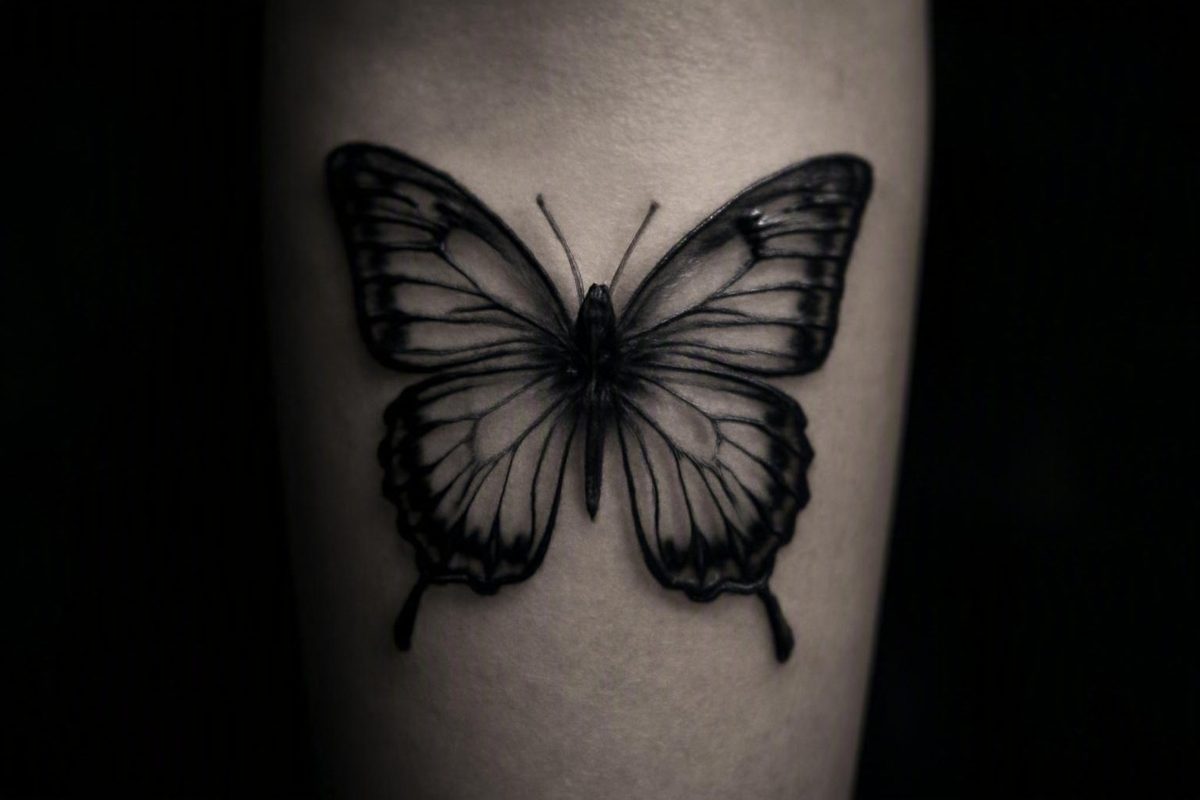
The short answer: what a butterfly tattoo commonly means
A butterfly tattoo most commonly represents transformation—becoming different through a period of change. The association comes from metamorphosis, as a butterfly develops from a caterpillar through a chrysalis into a winged adult. Related interpretations include rebirth, resilience, freedom, hope, healing, growth, beauty, and a new beginning.
Transformation is the familiar starting point, not a compulsory definition. Contemporary tattoo guidance connects butterfly imagery with change while emphasizing that personal intention may matter more than conventional symbolism (Black Palette Tattoo & Piercing’s overview of butterfly meanings).
Two people can wear visually similar butterflies for entirely different reasons. One might be marking a decisive life transition. Another might use the image as a private reminder to remain hopeful. A third might associate it with someone they love. Someone else may simply enjoy the symmetry, wing patterns, color, or sense of movement.
All of those reasons are valid. A tattoo does not need a profound origin story, and choosing a butterfly because it looks beautiful does not make the design less personal. Meaning can also develop after the tattoo is made rather than being completely defined beforehand.
If you want the design to carry a particular message, begin with your own history rather than a symbolism dictionary. Ask what the butterfly should remind you of, then use its color, species, number, depicted state, style, accompanying imagery, and visibility to make that idea more precise.
Transformation, rebirth, resilience, and freedom are not the same message
The words commonly attached to butterfly tattoos overlap, but they do not say exactly the same thing. Choosing the most accurate one can make it easier to explain your idea to an artist.
Transformation is about becoming different. It may describe a shift in identity, priorities, circumstances, or self-understanding. The emphasis is on the difference between who or where you were and who or where you are now.
Rebirth places more emphasis on beginning again. It suits a story organized around a new chapter: starting over, reclaiming a part of yourself, or choosing a different direction. Transformation describes the change; rebirth highlights the renewal that follows it.
Resilience is about endurance. A resilience tattoo need not imply that everything has been left behind or completely resolved. It can recognize the ability to continue, adapt, or emerge from difficulty while acknowledging that the experience remains part of the wearer’s story.
Freedom emphasizes release, independence, or self-direction. It may represent leaving a restrictive situation, loosening an old expectation, making an autonomous choice, or refusing to be defined by the past. A butterfly in flight can support this reading, although flight is a visual interpretation rather than a fixed tattoo code.
Growth is often quieter and more gradual. It may suit someone who does not identify one dramatic turning point but wants to recognize a long process of learning, maturing, or becoming more comfortable in their life. A sequence moving from chrysalis to flight can help distinguish gradual development from one decisive break.
One commercial tattoo-studio guide presents butterflies as possible markers of healing, major transitions, personal freedom, and the end of a difficult chapter. These are design possibilities, not facts automatically disclosed by the image (Mantra Tattoo & Piercing on transformation and personal interpretation).
A butterfly does not prove that its wearer has experienced trauma, addiction, illness, grief, or a mental-health condition. Nor does it tell an observer whether a transition was painful, welcome, public, private, complete, or still underway. The same motif can recognize a difficult survival story or celebrate an uncomplicated new beginning.
To identify the message you want, try completing these prompts:
- What changed? Name the difference between before and after.
- Was it gradual or decisive? Decide whether the design should show a process, a threshold, or an outcome.
- What did I survive or learn to carry? This can clarify whether resilience is more accurate than rebirth.
- What am I leaving behind? The answer may point toward release, flight, distance, or a broken boundary.
- What am I moving toward? This can suggest hope, freedom, purpose, peace, or another future-facing value.
- What should the tattoo reinforce on an ordinary day? A useful concept can work as a reminder, not only as a record.
- How much of the story do I want other people to understand? The answer can guide both imagery and placement.
You do not have to condense a complicated experience into one perfect word. A butterfly can hold transformation and resilience together or combine rebirth with freedom. The aim is not to pass a symbolism test; it is to give the artist a clear emotional priority.
Butterfly tattoos for remembrance, love, and continuing connection
A butterfly can function as a memorial. In that context, it might represent remembrance, continuing connection, hope after loss, or the ways a relationship continues to shape the wearer’s life.
Grief and hope can coexist in the same design. A memorial butterfly does not have to imply that the wearer believes butterflies literally carry souls or messages from an afterlife. It may simply express affection that remains present, movement through grief, or the transformation caused by knowing someone.
The number of butterflies can help organize the composition:
- One butterfly can focus attention on one person, one relationship, or the wearer’s individual journey after a loss.
- Two butterflies can represent partnership, companionship, mutual growth, or two connected stories. This is an optional personal reading, not a fixed code for marriage or romance.
- Several butterflies can stand for a family, a group of loved ones, stages of life, movement, or freedom. A group can also be chosen because it creates a stronger sense of direction and flow.
A contemporary studio guide presents multiple butterflies as possible symbols of movement, freedom, or different stages of life while noting that tattoo meanings vary by wearer (Studio Aureo’s guide to butterfly symbolism and design).
Personal details usually communicate a memorial more clearly than the butterfly alone. Possibilities include:
- initials or a name;
- a birth date, anniversary, or date of remembrance;
- handwriting reproduced with permission;
- a flower connected with the person or relationship;
- a small object, phrase, or pattern with shared significance;
- a color the person wore or loved;
- several butterflies corresponding to particular people.
These additions do not carry automatic meanings. A flower may symbolize someone because it grew in their garden, not because an online guide assigns it a particular definition. A date can be concealed within a wing pattern rather than displayed openly. Initials may be prominent, barely visible, or omitted if the wearer wants the memorial to remain private.
Relationship tattoos deserve the same flexibility. Two butterflies do not have to signify romance; they can represent siblings, friends, a parent and child, or two versions of the self. Conversely, a single butterfly can honor a partnership without needing a matched pair.
When looking at someone else’s butterfly tattoo, do not assume it is a memorial or demand a painful explanation. If the meaning is relevant and the setting is appropriate, invite the wearer to describe it in their own terms.
Meaning by color, species, and added symbols
Color can sharpen a concept, but there is no established butterfly-tattoo color code. Contemporary associations overlap and sometimes contradict one another, and the same color may feel peaceful to one wearer and mournful to another.
Commonly suggested associations include:
- Black: mystery, mourning, remembrance, resilience, rebirth, or change through darkness.
- Blue: peace, hope, serenity, spirituality, freedom, happiness, or luck.
- Red: passion, love, vitality, courage, or strength.
- White: purity, peace, remembrance, or spiritual connection.
- Yellow or orange: joy, energy, hope, creativity, optimism, or a bright beginning.
These are design prompts, not definitions. Monolith Studio’s contemporary guide, for example, gives overlapping interpretations for black, blue, red, white, and yellow butterflies rather than establishing one universal system (Monolith Studio’s butterfly tattoo guide).
Choose a palette because it supports your story and works visually, not because you feel bound by a chart. Black may be a memorial color for one person and simply the clearest aesthetic choice for another. Blue may recall a place, an eye color, a favorite object, or a personally defined sense of calm. Contradiction is normal because color symbolism depends on context.
Species can add another layer. A monarch may evoke endurance, migration, a long journey, purpose, or an inner sense of direction. It is also visually recognizable, so it can communicate the concept more specifically than a generic butterfly silhouette. You can still choose a monarch solely for its wing pattern or personal connection without adopting any symbolic explanation.
A butterfly combined with a semicolon is presented in contemporary tattoo coverage as joining continuation or survival with transformation and mental-health awareness. That is a tattoo-source interpretation, not evidence of a universal convention. The design also does not reveal whether its wearer has a diagnosis, has attempted suicide, has received treatment, or identifies with any particular recovery story (Monolith Studio on semicolon-butterfly designs).
Added imagery can narrow an otherwise broad motif:
- Flowers can connect the butterfly to a person, place, season, or memory.
- Names and dates can turn a general symbol into a specific memorial or milestone.
- Broken chains may support a wearer-defined theme of release.
- Directional movement can make the composition feel as though it is leaving, returning, rising, or moving forward.
- A chrysalis can emphasize the period before or during change.
- Wing patterns can conceal initials, coordinates, symbols, or repeating shapes.
Consider how the parts operate together rather than assigning every element a separate dictionary definition. A design can become confusing when it tries to communicate transformation, grief, romance, freedom, spirituality, family, and recovery with equal emphasis. One primary idea and one or two supporting details usually create a more coherent concept.
For example:
- A monarch with a date could mark a defining journey or turning point.
- A black-and-grey butterfly with initials could serve as a restrained memorial.
- A blue watercolor butterfly could represent a personally defined sense of peace.
- A sequence of butterflies could show stages of growth or increasing freedom.
- A butterfly and semicolon could express continuation through change.
- A butterfly moving away from a broken chain could make release the visual priority.
These are concept frameworks, not established formulas. Their meaning comes from the wearer’s reason for combining the elements.
How artistic style changes the mood—not the definition
Style influences how a butterfly feels and what viewers notice first, but it does not impose a mandatory meaning. A blackwork butterfly can celebrate joy; a watercolor butterfly can be a memorial. Technique establishes visual tone, not personal history.
Minimalist and fine-line designs are visually restrained. They may use an outline, a few interior marks, or a simplified silhouette. This approach can keep attention on the butterfly’s form or suit a message the wearer does not want to explain publicly. Restraint does not necessarily make the meaning less significant.
Realistic work emphasizes recognizable anatomy, wing structure, pattern, texture, and species. It can suit a wearer whose connection is to a particular butterfly, landscape, season, or natural detail rather than to a generalized icon.
Watercolor and full-color approaches place more emphasis on movement, color relationships, energy, and expressive mood. Those qualities are visual effects, not meanings inherent in the technique. A watercolor piece can feel exuberant, gentle, unsettled, or reflective depending on its palette and composition.
Floral work integrates the butterfly with stems, blossoms, leaves, or a wider botanical scene. This can make the design feel abundant or connect it to a personally significant flower.
Geometric work translates the butterfly into symmetry, repeated shapes, grids, or abstraction. It may foreground balance and structure without requiring those ideas to become the tattoo’s symbolic definition.
Traditional and neo-traditional approaches can make the image bolder through strong outlines, simplified forms, concentrated color, and decorative framing. The visual conventions of American traditional tattoo style provide one possible language for a butterfly design, while blackwork can emphasize silhouette, contrast, pattern, or graphic weight.
The butterfly’s depicted state can also refine the concept:
- A chrysalis can place attention on waiting, uncertainty, or change in progress.
- An emerging butterfly can emphasize a threshold or new chapter.
- A wearer and artist can compose a resting butterfly to feel contemplative or settled.
- A butterfly in flight can suggest movement, direction, or release.
- A sequence from chrysalis to flight can depict stages rather than a single moment.
These are wearer-led design interpretations, not rules recognized by every viewer. If the distinction is important, reinforce it with composition or personal details instead of expecting the pose alone to communicate the entire story.
A butterfly is also not interchangeable with a moth. Contemporary tattoo guides tend to frame butterflies around visible change, growth, beauty, freedom, and new beginnings, while moths are more often associated with night, mystery, intuition, vulnerability, attraction to light, or the unknown (The Black Hat Tattoo’s butterfly-and-moth comparison).
Both insects undergo metamorphosis, and either can represent personal change. Their visual and symbolic moods nevertheless differ. If your idea centers on darkness, nocturnal imagery, mystery, or navigating the unknown, a moth may communicate it more directly. Do not automatically transfer moth interpretations to a butterfly—or choose one insect while describing the other to your artist.
Cultural symbolism: what can and cannot be claimed responsibly
Modern tattoo articles repeatedly mention the soul, departed loved ones, love, renewal, and spiritual change. The difficulty is that many describe entire countries, religions, or Indigenous peoples in a few sentences without adequate historical evidence or attribution to a named community.
That is not enough to establish a tradition.
It helps to separate three kinds of meaning:
- A recurring modern tattoo interpretation is an idea that appears in current design discussions, such as transformation or freedom.
- Personal symbolism is the meaning assigned by the wearer, such as associating a butterfly with a grandparent’s garden.
- A historically documented tradition requires credible evidence about a particular community, period, practice, object, story, or belief.
The first category can be useful for design planning, but it does not prove the third. A studio blog may accurately describe what some clients currently request while still being an inadequate source for claims about an ancient religion or a diverse cultural group.
Be cautious with statements beginning “In Asian culture,” “Native Americans believed,” “the Celts saw,” or similarly broad phrases. Such labels can collapse distinct communities, regions, periods, and beliefs into a convenient symbolism list. The available commercial tattoo sources help identify contemporary interpretations, but their broad cultural summaries are too thin to support definitive historical claims.
Before incorporating a culture-specific explanation or motif, identify:
- the named community or tradition;
- the historical period;
- the original object, story, practice, or visual form;
- a credible museum, scholarly, archival, or community source;
- whether the motif has restrictions or significance beyond its appearance.
If that verification is unavailable, use language that reflects the uncertainty. “I use this butterfly as a personal symbol of renewal” is more responsible than presenting an unsupported cultural claim as historical fact.
You can also choose culturally neutral, wearer-specific details: a local butterfly species, a meaningful date, a family flower, a place-based color palette, or a composition reflecting your own experience. Personal specificity usually produces a stronger concept than borrowed certainty.
No butterfly motif permits assumptions about a wearer’s gender, beliefs, spirituality, diagnosis, grief, relationships, or life history. Butterfly tattoos are not inherently feminine or masculine, and symbolic interpretation is not a reliable biography.
Turn the symbolism into a tattoo-ready concept
A useful concept gives the artist enough direction to understand the story while leaving room to solve the visual problem. Work through the design in this order.
1. Identify the intended message. Choose the central idea: transformation, rebirth, resilience, freedom, remembrance, love, hope, growth, beauty—or simply enjoyment of the image. If several apply, rank them. Decide what the tattoo must communicate and what can remain background context.
2. Choose one primary visual idea. This might be a monarch, an emerging butterfly, a pair in flight, a sequence of forms, or one butterfly integrated with a flower. Avoid turning every part of your story into a separate object. An artist can often suggest complexity through posture, spacing, contrast, and movement rather than by adding more symbols.
3. Select color and style. Decide whether you prefer black-and-grey, a limited accent color, naturalistic species coloring, or an expressive palette. Then identify the visual language: minimalist, realistic, watercolor, floral, geometric, traditional, illustrative, or blackwork. Bring references for qualities you like rather than asking an artist to reproduce someone else’s tattoo.
4. Decide whether the tattoo should be public or private. Placement mainly affects visibility, intimacy, composition, exposure to wear, and maintenance. It does not come with an inherent symbolic meaning.
A wrist or forearm tattoo can function as an easily seen reminder and will also be visible to other people more often. The ribs, back, or hip can be easier to conceal under ordinary clothing. Neither option is more meaningful. Choose according to your lifestyle, privacy preferences, anatomy, and the needs of the composition.
5. Match the scale to the detail. A simple silhouette can work at a smaller size than a realistic monarch with wing veins, layered shading, hidden initials, flowers, and a date. Do not insist that an intricate reference be compressed into a tiny area merely to preserve every element. Treat simplification as a consultation question rather than assuming every detail will remain equally clear at every scale (Cali Ink’s guidance on sizing, detail, and artist selection).
6. Find an artist whose portfolio matches the idea. Review work relevant to the design rather than relying on general popularity. For a butterfly, useful portfolio details may include:
- balanced or intentionally asymmetric wings;
- clean linework;
- controlled curves;
- smooth shading;
- naturalistic patterning;
- saturated or subtle color, depending on the plan;
- floral or geometric integration;
- healed examples, where available.
An artist who excels at bold traditional work may not be the right match for a tiny realistic species study, and the reverse can also be true. Skill is specific to the visual problem.
7. Use the consultation to adapt, not merely approve. Discuss your skin, placement, sizing, pigment choices, technique, detail level, and expected maintenance. Ask what should be enlarged, removed, strengthened, or repositioned. No style, pigment, body location, or technique comes with a guaranteed lifespan or result, so an experienced artist’s assessment of the individual design is more useful than a universal promise.
Before leaving the appointment, obtain written aftercare instructions from the artist. Ask those instructions to address cleaning, moisturizing, scratching, soaking, and sun exposure, then follow the individualized guidance rather than treating a general article as medical advice. General tattoo guidance likewise recommends following the artist’s directions because care can depend on the work and individual circumstances (HowStuffWorks’ design and aftercare overview).
Bring this consultation checklist:
- [ ] Intended primary meaning
- [ ] Reference images and visual preferences
- [ ] Butterfly species, if any
- [ ] One butterfly, a pair, or a group
- [ ] Resting, emerging, or in flight
- [ ] Black-and-grey or color palette
- [ ] Names, dates, flowers, semicolon, or other added imagery
- [ ] Approximate size
- [ ] Preferred body area
- [ ] Desired level of visibility
- [ ] Elements that can be simplified or removed
- [ ] Questions about technique, maintenance, and written aftercare
Butterfly tattoo meaning FAQ
Does a butterfly tattoo always mean transformation?
No. Transformation is the most familiar contemporary interpretation because the butterfly’s metamorphosis provides an intuitive image of profound change. A butterfly can instead represent rebirth, resilience, freedom, hope, healing, remembrance, love, beauty, growth, or no narrative beyond aesthetic preference.
The wearer’s intention and the design context matter more than the motif alone. A butterfly should not be treated as evidence of a particular event or struggle.
What does a black butterfly tattoo mean?
A black butterfly can suggest mystery, mourning, remembrance, resilience, rebirth, or transformation through a dark period. Black can also be an entirely visual choice made for contrast, restraint, compatibility with existing tattoos, or preference for black-and-grey work.
Because these associations overlap and conflict, there is no fixed black-butterfly meaning. Initials, dates, flowers, pose, and composition can clarify whether the design is intended as a memorial, a survival symbol, or something else.
What do two or multiple butterfly tattoos symbolize?
Two butterflies may represent companionship, partnership, two loved ones, or two connected life stories. They are not a definitive code for marriage or romance.
Several butterflies can represent family members, stages of growth, movement, freedom, or a transition unfolding over time. They can also be a compositional choice: a group creates direction and can follow the body differently from a single symmetrical butterfly.
What does a butterfly tattoo with a semicolon mean?
One contemporary tattoo-studio guide presents a butterfly with a semicolon as combining continuation or survival with transformation and mental-health awareness. In that interpretation, the semicolon emphasizes continuing while the butterfly adds change, emergence, or growth.
This should remain wearer-led rather than being treated as a universal code. The design does not prove that someone has a diagnosis, has attempted suicide, has undergone treatment, or identifies with a particular recovery experience.
Is a butterfly tattoo different from a moth tattoo?
Usually, yes. Contemporary tattoo interpretations tend to associate butterflies with visible transformation, growth, freedom, beauty, and new beginnings. Moths are more often framed around night, mystery, intuition, adaptation, attraction to light, or the unknown.
The categories can overlap because both insects undergo metamorphosis, but their appearance and mood are not interchangeable. Choose the insect whose form and associations best fit your intended story, then make that meaning personal through the final design.
Transformation remains the most familiar butterfly meaning, but it is not an obligation. Decide which experience or value you want the tattoo to hold, then use species, number, color, style, personal details, movement, and visibility to make the story specific. An experienced artist can simplify and adapt that concept to the chosen body area without taking away its personal meaning.