
What an Evil-Eye Tattoo Is Really Meant to Say
It usually means protection from envy, not support for evil. A nazar, Hamsa and Eye of Horus are distinct designs, and color meanings are not universal.
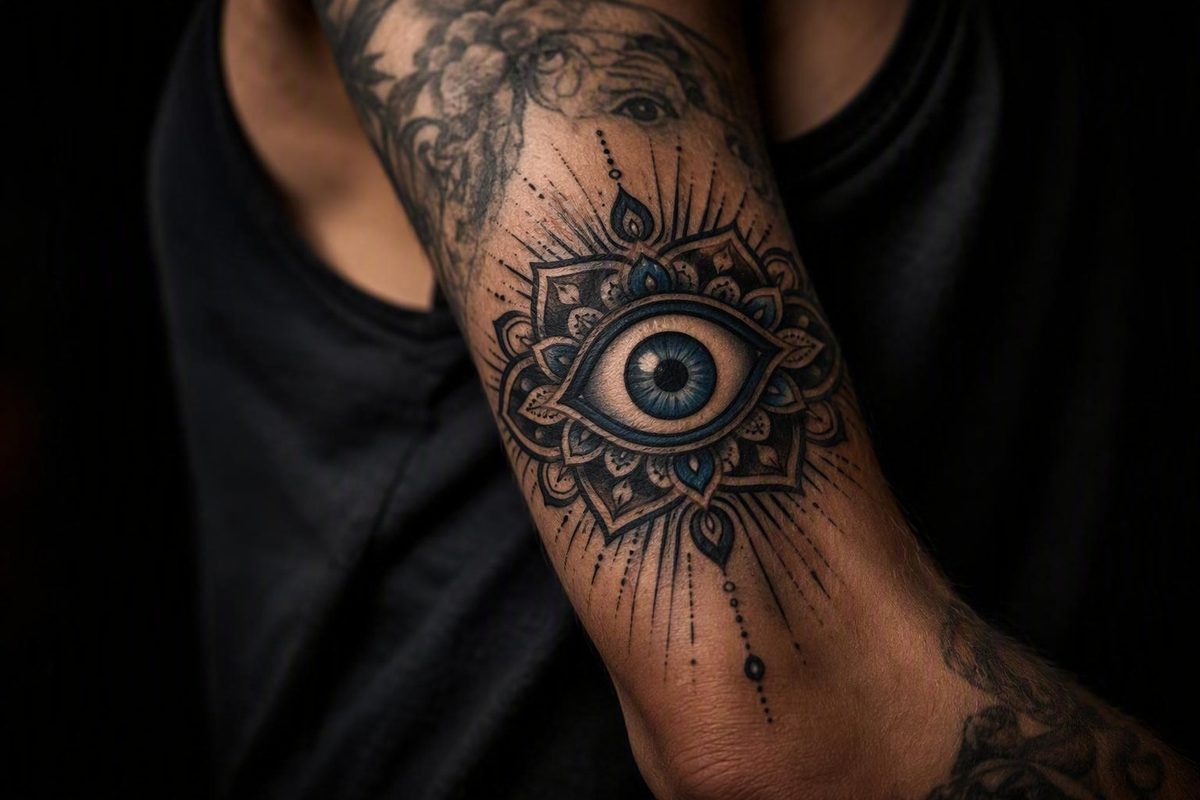
The short answer: an evil-eye tattoo usually means protection
An evil-eye tattoo usually represents protection from envy, jealousy, malicious attention, harmful intentions, misfortune, or bad luck. It does not ordinarily express support for evil. Contemporary tattoo guides commonly describe the familiar eye motif as a defense against the “evil eye”—the harmful gaze—rather than an endorsement of it. Certified Tattoo Studios summarizes this interpretation as protection from negativity, jealousy, bad luck, and harmful intentions.
The confusing part is the name. In traditions involving the evil eye, the phrase may refer to an envious or hostile look believed to cause harm. In casual English, however, people also use “evil eye” for the protective eye-shaped design intended to resist that gaze. The same phrase can therefore identify both the perceived threat and the emblem used against it.
A useful one-sentence interpretation is:
This design represents protection from envy and a reminder not to be controlled by other people’s negativity.
“Protection” can mean different things to different wearers. The tattoo may be understood as:
- a spiritual safeguard;
- a cultural symbol;
- a metaphor for emotional self-protection;
- a reminder to recognize unhealthy attention;
- an expression of resilience or personal boundaries;
- or an attractive design carrying a protective association.
Claims that the motif repels curses, redirects energy, or prevents misfortune belong to cultural or spiritual belief. This article treats them as beliefs rather than guaranteed effects. A tattoo can still have substantial personal value as a statement of intention, identity, family connection, or self-awareness.
There is no single meaning that applies to everyone wearing one. The message depends on the image, the wearer’s cultural context and intention, and any colors or surrounding symbols. A blue concentric nazar, an eye inside a Hamsa, and an Egyptian Eye of Horus are distinct designs, even though all three may be described casually as protective eyes.
Evil eye, nazar, and mati: the terms are related but not identical
The terminology becomes clearer when the harmful gaze is separated from the image used against it.
The evil eye can refer to an envious, resentful, or malicious gaze believed in some traditions to bring harm or misfortune. Interpretations differ among languages and communities, so it is better to understand the evil eye as a family of related beliefs rather than one universal doctrine.
A nazar commonly refers to the protective eye-shaped amulet or motif. Its familiar visual form uses concentric shapes—often dark blue, white, light blue, and black—to resemble an eye. It can appear in jewelry, glass ornaments, home decorations, printed images, and tattoos. One commercial style guide distinguishes the nazar’s standalone concentric eye from the Hamsa’s open-hand shape and places the two within overlapping Middle Eastern and Mediterranean contexts rather than one exclusive source. See the illustrated nazar and Hamsa comparison.
Mati is a Greek term associated with the evil-eye tradition. The supplied tattoo material identifies it with the Greek evil eye, but its exact use should not be assumed to map neatly onto every English use of “evil eye” or “nazar.” When cultural or linguistic precision matters, ask how the term is used in the particular Greek context being referenced.
| Term | Visual form | Common interpretation | Caution |
|---|---|---|---|
| Harmful gaze or “evil eye” | A concept rather than necessarily a physical object | A gaze believed to cause harm or misfortune | This is the perceived threat, not automatically the protective tattoo |
| Nazar or protective eye motif | Usually a stylized eye made from concentric forms, commonly blue, white, light blue, and black | Symbolic defense against envy, jealousy, ill will, or bad luck | Usage varies, and not every stylized eye is a nazar |
| Mati | A Greek term associated with evil-eye belief | Connected with the evil eye in Greek usage | Its exact meaning and everyday use can vary by speaker and context |
Someone may say, “I have an evil-eye tattoo,” when the more precise meaning is, “I have a tattoo of the amulet intended to protect against the evil eye.” That explains why one description calls the evil eye harmful while another calls it protective or lucky: the descriptions may address different sides of the same belief.
When interpreting a tattoo, ask a more precise question: Does it depict a threatening gaze, or does it reproduce a recognized protective motif such as a nazar?
What the tattoo can mean beyond spiritual protection
Protection from envy and ill will is the central interpretation in the reviewed tattoo and jewelry guides, but it is not the only possible personal meaning. Eye imagery may also suggest watchfulness, perception, intuition, awareness, clarity, wisdom, self-knowledge, resilience, and vigilance.
A wearer may choose the image as a reminder to remain observant—to recognize manipulation, jealousy, judgment, or unhealthy social pressure before becoming consumed by it. The outward-looking eye may also function as a personal boundary: other people can look, criticize, or envy, but their attention does not determine the wearer’s identity.
Possible personal readings include:
- Watchfulness: remaining alert to motives and recurring patterns.
- Perception: looking beyond appearances.
- Intuition: trusting internal warning signals.
- Awareness: paying attention to one’s surroundings and relationships.
- Clarity: refusing to let envy or comparison distort judgment.
- Wisdom: learning from past scrutiny or difficult relationships.
- Self-knowledge: seeing oneself independently of outside approval.
- Resilience: continuing despite hostility or misfortune.
- Boundaries: limiting the influence of other people’s judgment.
These are possible interpretations, not motives that should be assigned to every wearer. Spiritual belief, cultural connection, personal empowerment, and aesthetic preference can overlap. Choosing a tattoo because it is beautiful does not automatically empty it of cultural meaning, just as choosing it for cultural reasons does not prevent the wearer from caring about its appearance.
Three bounded examples show how the same general motif may function differently:
- A spiritual safeguard: The wearer believes the nazar protects against envious attention. The tattoo makes that intention permanent, while its supernatural effect remains a matter of belief.
- A memorial or family-cultural reference: The image recalls a charm displayed in a family home, worn by a relative, or recognized within the wearer’s community. Its meaning comes partly from that relationship rather than from a generic symbol chart.
- A secular emblem of vigilance: The wearer does not claim supernatural protection but uses the eye as a reminder to maintain emotional boundaries and resist judgment, jealousy, or social pressure.
Personal intention matters, but it does not erase the established identity of a recognizable design. A wearer can add an individual story to a nazar while acknowledging that the motif already carries cultural and spiritual associations.
Nazar, Hamsa, and Eye of Horus are different designs
A request for a “protective eye tattoo” is not specific enough for an artist. Several distinct symbols can fit that description, and mixing them carelessly may produce an image that does not communicate what the wearer intends.
A standalone nazar is generally a stylized eye constructed from concentric circles, ovals, or teardrop-like forms. Blue is its most recognizable color, often accompanied by white, light blue, and black.
A Hamsa is an open-hand emblem. The hand—not the eye—is its defining visual feature. An eye may appear in the palm, but the Hamsa can also be shown without one. In different contexts, it is called the Hand of Fatima or the Hand of Miriam. Those names reflect different cultural or religious frames and should not be taken to mean that every community interprets the symbol identically. Tattoodo’s Hamsa overview identifies both names while noting that the hand’s meanings vary by culture and period.
A Hamsa with an eye combines two recognizable forms: the open hand and a protective eye motif in its palm. It is commonly presented in modern tattoo and jewelry material as layered protective symbolism, with the eye particularly associated with defense against envy. The combination should not be described as producing stronger, doubled, or guaranteed supernatural power.
The Eye of Horus is a separate Egyptian symbol with a distinctive lined and extended eye shape. The reviewed tattoo material associates it with protection and health while distinguishing it from the Greek evil-eye concept. It should not be labeled as another name for a nazar or Hamsa. Similar themes do not make symbols historically or visually interchangeable. Tattoo Stylist’s guide shows the nazar, Hamsa, and Egyptian eye as different design categories.
| Design | Visual form | Commonly intended meaning | Frequent identification mistake |
|---|---|---|---|
| Nazar | Standalone stylized eye, usually made from concentric blue, white, light-blue, and black forms | Protection from envy, jealousy, ill will, or misfortune | Calling every eye tattoo a nazar |
| Hamsa | Open hand, often symmetrical or stylized | Protection, blessing, welcome, or another context-dependent meaning | Assuming it must contain an eye |
| Hamsa with eye | Open hand containing an eye in the palm | Layered protective symbolism, often including defense against envy | Calling the entire design a nazar or claiming it guarantees stronger protection |
| Eye of Horus | Distinctive Egyptian eye with extended markings | An Egyptian symbol with its own cultural and protective identity | Calling it an evil eye, nazar, or Hamsa |
Give the artist a clearly labeled visual reference. Ask for a “standalone blue nazar,” a “Hamsa containing a nazar-style eye,” or an “Eye of Horus,” rather than requesting a generic mystical eye. If a reference combines features from several symbols, decide whether that fusion is deliberate and informed before the stencil is prepared.
What blue and other evil-eye tattoo colors may suggest
Blue is the color most consistently associated with the nazar in the reviewed commercial sources. A recognizable treatment uses concentric dark-blue, white, light-blue, and black forms.
Modern tattoo, jewelry, and spirituality sellers also assign intentions such as purity, courage, strength, abundance, happiness, confidence, creativity, balance, or guidance to alternative colors. These assignments are not consistent across the supplied sources. They are best understood as contemporary commercial or personal associations—not a universal inherited color code.
| Color | Common contemporary association, not a universal definition | How cautiously to interpret it |
|---|---|---|
| Dark blue | Protection, calm, watchfulness | The strongest visual connection to the familiar nazar palette |
| Light blue | Clarity, peace, openness | Often used with dark blue rather than as an independent rule |
| White | Purity, renewal, a fresh start | A modern association that may differ by source or wearer |
| Red | Courage, strength, vitality | Optional personal symbolism rather than a universal meaning |
| Green | Growth, abundance, health, or luck | Commercial sources assign several different meanings |
| Yellow or gold | Happiness, confidence, optimism, or success | Often reflects general color symbolism |
| Purple | Intuition, creativity, spirituality, or guidance | Common in modern spiritual and tattoo marketing but not standardized |
| Black or gray | Seriousness, clarity, contrast, or minimalism | May describe tattoo style more than inherited symbolism |
| Multicolor | Several intentions or a decorative composition | Meaning depends primarily on the wearer and the overall design |
Before selecting a palette, decide which priority matters most:
- Traditional visual recognition: Use the familiar concentric blue palette so the design reads clearly as a nazar.
- Personal symbolism: Choose colors connected to your own story while describing their meaning as personal rather than universal.
- Compositional compatibility: Adapt the colors to an existing sleeve, ornamental piece, or broader tattoo plan.
Conversely, coloring an unrelated eye blue does not automatically make it a nazar. Shape, arrangement, context, and stated intention all affect identification.
How style and surrounding imagery shape the message
The tattoo does not have to reproduce a glass charm exactly. Documented contemporary options include minimalist linework, geometric treatments, flowers, ornamental framing, mandala-inspired patterns, watercolor effects, animal imagery, and larger compositions. These additions may emphasize aesthetics or personal expression without automatically removing the core association with protection.
The important distinction is between stylistic adaptation and symbolic substitution. Adding flowers around a nazar changes its frame. Replacing its concentric structure with the Eye of Horus changes the symbol. Placing a nazar-style eye inside a Hamsa introduces a second established emblem rather than mere decoration.
The following briefs can help translate intention into a workable design.
1. Traditional concentric nazar
A standalone nazar made from clearly separated dark-blue, white, light-blue, and black concentric forms. The intended meaning is protection from envy and ill will. Keep the silhouette close to the recognizable amulet instead of turning it into a realistic human eye.
2. Minimalist protective eye
A simplified black or limited-color eye based on the nazar’s concentric structure. The intended meaning is vigilance, emotional boundaries, and symbolic protection. Preserve enough of the form that it does not resemble an Eye of Horus, Eye of Providence, or generic realistic eye.
3. Floral or ornamental nazar
A recognizable blue nazar surrounded by flowers, filigree, geometry, or mandala-inspired details. The eye retains the protective theme. Treat the surrounding elements as decorative unless particular plants or patterns have been deliberately chosen for their own symbolism.
4. Clearly identified Hamsa with eye
An open-hand Hamsa containing a nazar-style eye in the palm. Keep the hand and eye visually distinguishable. The intended message is layered protective symbolism, not greater supernatural power.
During the consultation, tell the artist:
- the exact symbol you intend;
- what you want it to mean;
- whether cultural recognition or artistic reinterpretation is the priority;
- whether the palette should be familiar or personal;
- how visible you want the tattoo to be;
- whether surrounding elements are decorative or meaningful;
- which other eye symbols must not appear;
- and whether the piece should stand alone or connect to existing work.
A useful reference package contains a labeled picture of the correct symbol, examples of the desired tattoo style, and a short written statement of intent. That is more helpful than a folder of unlabeled images collected simply because they contain eyes.
Cultural respect matters more than blanket permission
The supplied evidence does not support declaring every evil-eye tattoo universally acceptable, universally offensive, or automatically appropriative. Evil-eye traditions occur in multiple cultural and religious contexts, and those contexts do not necessarily share identical terminology, practices, or attitudes toward tattooing.
That breadth makes accuracy important. Assigning the symbol exclusively to one country, religion, or ethnic group can flatten meaningful differences. At the same time, saying that it simply “belongs to everyone” can dismiss the significance it holds in particular families and communities.
Appreciation does not automatically make every execution informed or respectful. Intent matters, but so do research, terminology, visual accuracy, and willingness to listen.
Use this cultural-respect checklist before finalizing a design:
- Identify the symbol accurately. Determine whether the reference is a nazar, Hamsa, Hamsa with an eye, Eye of Horus, or another eye image.
- Learn the relevant terminology. Find out what the motif is called in the particular tradition or community being referenced.
- Research the specific context. A general search for “evil eye meaning” cannot resolve every question about a specifically Greek, Turkish, Jewish, Muslim, North African, Mediterranean, or South Asian reference.
- Avoid casual religious conflation. Do not merge symbols merely because search results group them under protection, luck, or spirituality.
- Separate documented tradition from commercial symbolism. Modern product descriptions and color charts may reflect marketing rather than a consistent inherited practice.
- Seek culturally informed perspectives where possible. These may come from community members, cultural institutions, specialist artists, museums, or careful academic work.
- Explain your intention honestly. Aesthetic attraction, spiritual belief, family connection, and personal symbolism are different reasons. There is no need to invent ancestry or authority.
- Be prepared for disagreement. One person cannot grant universal permission on behalf of every community associated with a motif.
The evidence available in popular tattoo searches has clear limitations. Much of it comes from tattoo studios, jewelry sellers, inspiration sites, aftercare retailers, and spirituality shops rather than academic or community authorities. Repetition across commercial pages does not establish a precise origin story, universal color code, religious rule, or community-wide position on appropriation.
Research should become more specific as the proposed tattoo becomes more specific. A conventional standalone nazar presents different questions from a Hamsa incorporating religious text, sacred names, or tradition-specific ornament. Familiarity with an amulet also does not establish how every associated community views permanently tattooing it. Religious approval or prohibition cannot be inferred from the evidence reviewed here.
Choosing placement and preparing an accurate artist brief
Commonly suggested locations include the wrist, forearm, finger, hand, ankle, collarbone, neck, bicep, and behind the ear. Placement generally affects visibility, available space, composition, discretion, and connection to other tattoos. The supplied material does not establish a universal spiritual rule that makes one body location more protective than another.
Practical considerations include:
-
Wrist or forearm: visible and suitable for a standalone design or larger composition.
-
Ankle: relatively discreet and adaptable to a small motif.
- Collarbone or neck: prominent or selectively visible depending on clothing and hair.
- Bicep: provides more room for framing, color, or a larger Hamsa.
Hands and fingers deserve particular discussion with the artist. A commercial aftercare guide warns that tattoos in these areas may fade faster because of movement and exposure, although it does not establish an exact schedule that applies to everyone. It also recommends choosing an experienced artist and following the artist’s aftercare instructions. The same guide treats scleral tattooing—injecting pigment into the white of the eye—as a separate, highly risky procedure associated with serious complications, including blindness. After Inked outlines these placement, aftercare, and scleral-tattooing cautions.
An evil-eye tattoo placed on ordinary skin has nothing to do with scleral tattooing. The shared word “eye” should not blur that critical distinction.
Bring these questions to the artist:
- What is the exact symbol name?
- Which cultural or visual tradition does the reference draw from?
- Is the intended meaning spiritual protection, cultural connection, vigilance, boundaries, memorial significance, aesthetics, or a combination?
- Should the design use the familiar blue palette or alternative colors?
- Is it a standalone nazar or an eye inside a Hamsa?
- Which other eye symbols must it not resemble?
- Where will it be placed?
- How visible should it be in daily life?
- How much detail can the available area accommodate?
- Are surrounding flowers, geometry, text, or ornament decorative or symbolic?
- How does the artist expect the design and placement to age?
- What aftercare instructions does the artist provide?
Do not rely on a universal minimum size, line thickness, or spacing guarantee. Ask to see healed examples of comparable work and request an explanation of any simplifications needed to keep the concentric eye readable.
Frequently asked questions
Does an evil-eye tattoo mean you are evil?
No. Its common contemporary meaning is protection from envy, jealousy, harmful attention, ill will, or misfortune. The apparent contradiction comes from using “evil eye” for both the harmful gaze and the protective design intended to resist it.
Individual intention still matters. A wearer may use the tattoo spiritually, culturally, metaphorically, or aesthetically, but the design does not ordinarily communicate allegiance to evil.
Is an evil-eye tattoo the same as a nazar?
Often, but not always. Many tattoos casually called evil eyes depict a nazar: the familiar protective eye motif made from concentric forms and commonly colored blue. In that case, “evil-eye tattoo” is the informal description and “nazar” is the more precise identification.
Not every eye tattoo is a nazar. A realistic eye, Eye of Horus, Eye of Providence, third eye, or eye inside another composition has its own identity. Examine the form rather than relying on the caption attached to an online image.
What does an evil eye inside a Hamsa hand mean?
It commonly represents layered protective symbolism. The Hamsa is the open hand, while the eye in its palm may be a nazar-style motif associated with defense against envy or malicious attention. A commercial Judaica guide similarly distinguishes the eye-shaped nazar from the hand-shaped Hamsa while explaining why they frequently appear together. Its comparison illustrates why “hand” and “eye” are not interchangeable symbol names.
The combination does not establish stronger or guaranteed supernatural protection. Its significance may also vary with cultural context and personal intention.
Does an evil-eye tattoo have to be blue?
No. Blue is the most recognizable choice for a nazar, especially when used with white, light blue, and black concentric forms. Tattoos can also use blackwork or alternative colors.
Meanings assigned to alternative colors are not standardized. Red may suggest courage to one wearer, green may suggest growth, and white may suggest renewal, but those are optional contemporary or personal associations. If immediate recognition matters, the familiar blue palette is the clearest choice.
Does the direction or placement of an evil-eye tattoo change its meaning?
There is no universal rule in the supplied evidence. Placement primarily changes visibility, scale, composition, and how often the wearer sees the tattoo. A wrist or forearm design may function as a frequent personal reminder, while an ankle or behind-the-ear design may be more discreet. Those effects are practical and personal rather than automatically spiritual.
Some commercial sources assign directional meanings to versions of the Hamsa, but those claims should not be generalized to every community or to a standalone nazar. Do not assume that turning an eye upward, downward, inward, or outward creates a fixed protective effect. Choose the orientation according to visual clarity, the relevant cultural context, and how the design sits naturally on the body.
An evil-eye tattoo most often communicates defense against envy or ill will, not evil itself. Before committing, decide whether yours will express cultural connection, spiritual belief, personal boundaries, remembrance, or primarily aesthetic preference. Then verify whether the reference is a nazar, Hamsa, Eye of Horus, or another eye symbol.
Bring an experienced artist a labeled visual reference and a clear statement of intent. Treat supernatural protection as belief rather than guaranteed fact, and make sure the finished design says what you actually mean.