
What an Oni Mask Tattoo Can Mean
An oni mask tattoo can suggest strength, protection or confronting danger. Learn which readings come from tattoo practice and what Japanese folklore adds.
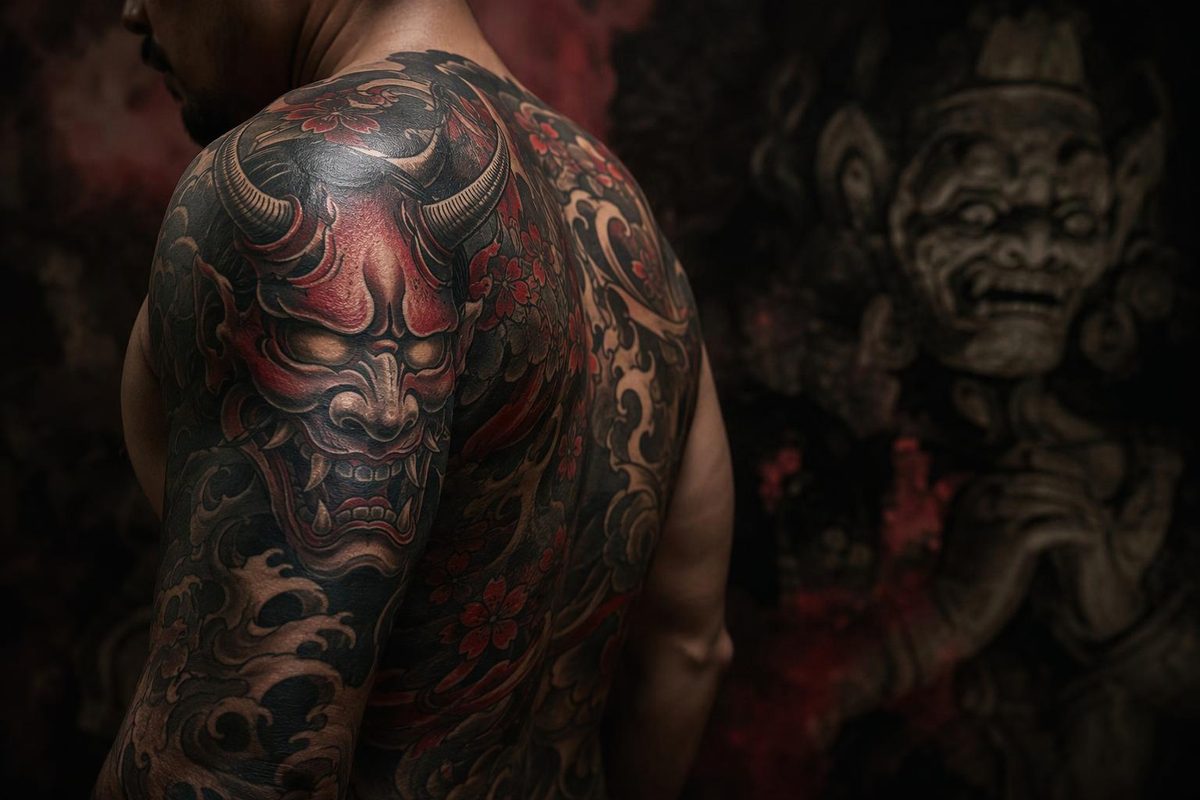
An oni mask tattoo can be worn as a symbol of strength, protection or confronting a destructive side of yourself. Those are contemporary tattoo interpretations, not a single traditional definition. The horned, fanged face draws on Japanese oni—supernatural beings whose roles range from dangerous ogres to more complicated, sometimes beneficial figures.
The useful question is not just “What does oni mean?” but “What role is this oni playing in my tattoo?” A threatening face, a personal guardian and an image of an inner struggle can share similar features while communicating different intentions.
What the tattoo can communicate
Lighthouse Tattoo’s guide to Japanese masks presents three oni tattoo readings: protection and guardianship, strength and resilience, and the duality of good and evil. These are interpretations offered by a tattoo studio, rather than proof of an ancient symbolic code.
They give you several workable starting points:
- Strength: the fierce face can stand for determination or the ability to face adversity.
- Protection: you might intend the oni as an intimidating guardian—a visual statement of defending yourself or others.
- Inner conflict: the image can acknowledge anger, destructive impulses or contradictory parts of your character.
You do not have to claim all three. “This is about protecting my family” is a clearer brief than a list of every meaning attached to the motif online. Choosing it for its horns, teeth and dramatic expression is also a valid aesthetic decision; it does not require an invented spiritual explanation.
Why the dangerous face matters
Oni are not simply Japan’s equivalent of a Western devil. In an interview with Discover, Japanese literature scholar Noriko T. Reider explains that they are considered evil, but not entirely evil, and that their character changes across history. The article describes their familiar horns, conspicuous canine teeth and immense strength, while noting that some traditions depict them bringing prosperity.
That complexity supports an ambiguous tattoo reading. It does not make every oni a benevolent protector, or establish “balance between good and evil” as a universal Japanese teaching attached to the mask.
Historical masks also served particular purposes. The Smithsonian’s record for an Edo-period oni mask says it was probably used in tsuina, or oni yarai: a ritual exorcism to drive out demons. Here, the mask represents the demon involved in an expulsion ritual—not straightforward evidence that the face itself was a protective talisman. A modern protective tattoo can still be meaningful, but its intended role needs to be stated rather than assumed.
Oni is broader than hannya
A horned face is not automatically a hannya mask. Hannya identifies a particular Noh theater mask representing a woman transformed by jealous rage into a demon, as the British Museum’s collection record explains. Oni is a broader category, and Reider’s account includes both male and female figures.
If your intended meaning centers on jealousy, grief or emotionally consuming transformation, explore the more specific hannya mask meaning. If it centers on an ogre’s power, danger or your own guardian interpretation, start with oni references rather than treating the two names as interchangeable.
Make the design match your intention
Bring your artist a reference and a sentence explaining the role you want the face to play. For example:
An oni mask about strength under pressure: fierce and watchful, with the mask form still visible.
Ask whether the drawing depicts a physical mask or a living demon face. If the mask aspect matters, discuss showing its rim, eye openings or ties. If you add a weapon, another figure or a named character, ask what story those details introduce.
Treat color as a design decision unless your chosen reference supplies a specific meaning. Reider describes oni in several colors, including red, green, black and blue; that variety alone does not establish a tattoo dictionary of “red means anger” or “blue means calm.” The clearest meaning comes from the figure you choose, its role in the composition and the story you intend—not a color chart.