
The “Viking Compass” Tattoo Means Guidance—But the Name Misleads
A Vegvísir tattoo can symbolize guidance, protection and finding your way. Learn what its Icelandic manuscript says—and why “Viking compass” misleads.
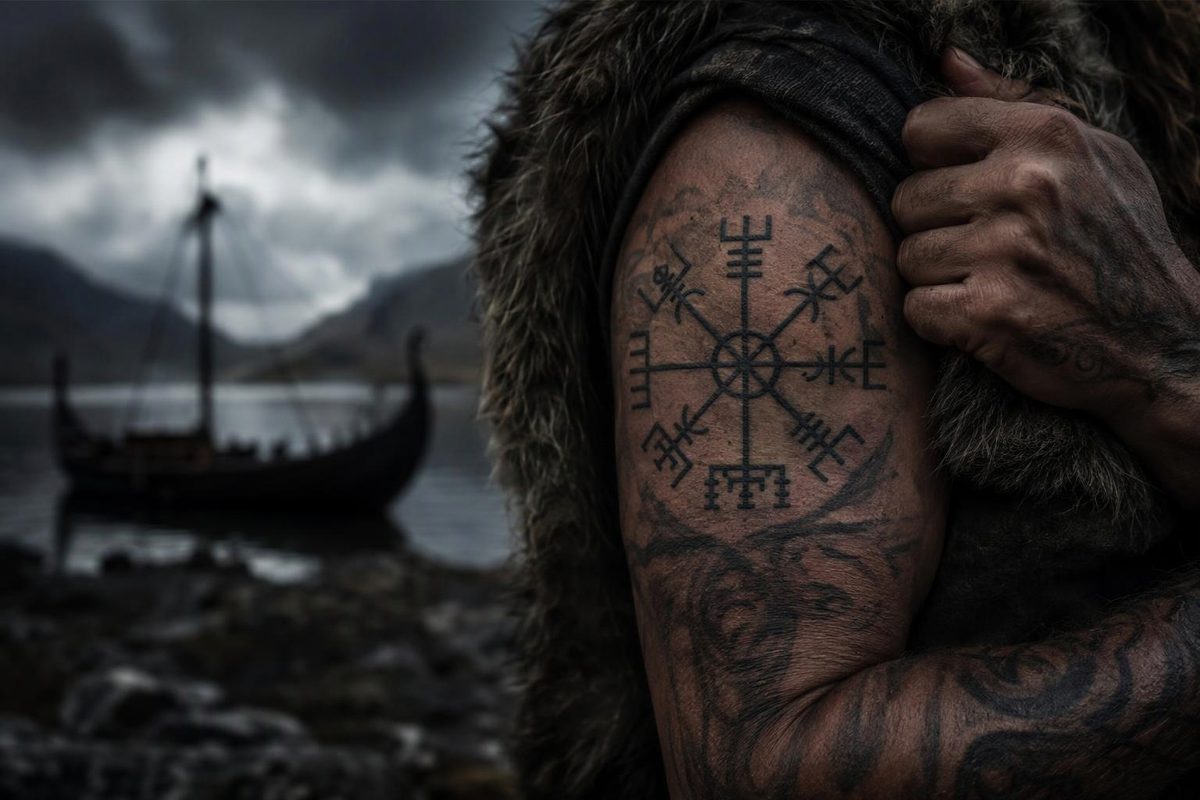
A “Viking compass” tattoo usually refers to Vegvísir, an Icelandic magical sign associated with finding your way through bad weather. As a tattoo, it can express guidance, protection on a journey, or holding your course through a difficult period. The historical distinction matters: the surviving manuscript evidence is nineteenth-century Icelandic, not Viking Age. Tomáš Vlasatý’s account of the surviving sources separates that documented history from the popular nickname.
You can choose it for the idea of not losing your way without claiming that Viking sailors wore it.
What the original sign meant
Vegvísir is commonly translated as “wayfinder” or “way-shower.” It belongs to the Icelandic tradition of galdrastafir, or magical staves: symbolic diagrams rather than ordinary compass instruments.
The key source is the Huld manuscript, compiled by Geir Vigfússon in 1860. On page 10 of his English translation of Huld’s magical signs, Justin Foster translates the accompanying instruction:
“Carry this sign with you and you won’t get lost in storms or bad weather, even though in unfamiliar surrounds.”
That is a statement of magical belief, not evidence that the sign could navigate. Its protection is specific: avoiding becoming lost in dangerous conditions. The instruction says to carry it; it does not prescribe tattooing it.
The familiar “Viking compass” label moves the sign into a much earlier period without supporting evidence. Vlasatý identifies three nineteenth-century Icelandic manuscripts containing it. One version’s instructions explicitly invoke God and Jesus—an important complication if you have been told it is an ancient, exclusively pagan symbol. His manuscript comparison documents those differences.
What it can mean as a tattoo
The original promise gives a wearer several possible personal readings:
- Direction: a reminder of your priorities when you feel uncertain.
- Protection while travelling: a symbolic wish to reach your destination safely.
- Endurance through difficulty: turning literal storms into a metaphor for grief, upheaval or recovery.
- Finding your way again: marking a new course after a major change.
These are interpretations you can give the tattoo, not separate meanings assigned to each arm in the manuscript. “Finding my way through life” extends the old weather-and-travel idea into a modern personal story. It is useful to keep that distinction when explaining your ink.
An interest in Icelandic folk magic is another reason to choose it. A claim of Viking ancestry or devotion to a particular Norse god, however, needs context beyond this sign alone.
Check the design before choosing it
The familiar Vegvísir has eight radiating arms with different endings. Do not confuse it with Ægishjálmur, the Helm of Awe, whose commonly reproduced form has repeated trident-like arms. They are distinct staves, despite their similar outlines. Guide to Iceland’s comparison describes those visual differences.
Also check anything surrounding the sign. Vlasatý notes that popular circular versions, sometimes enclosed by a rune alphabet, differ from the squarer manuscript examples without surrounding runes. A rune ring is therefore not a required part of Vegvísir. If yours includes lettering, establish what it says rather than treating it as automatic “Viking” decoration.
For your artist brief, choose between a manuscript-based rendering and a contemporary adaptation, then state the meaning plainly: “An Icelandic wayfinding sign, representing keeping my direction through uncertainty.” Ask the artist to preserve the distinct arm endings and discuss enough space to make them readable. That gives the design a clear story without borrowing a history it cannot support.