
How Tattooing Developed in America: Ports, Sideshows and Custom Studios
Trace tattoo history in America through Indigenous records, sailors’ documents, New York’s tattoo ban, West Coast studios and tattoo imagery in fashion.
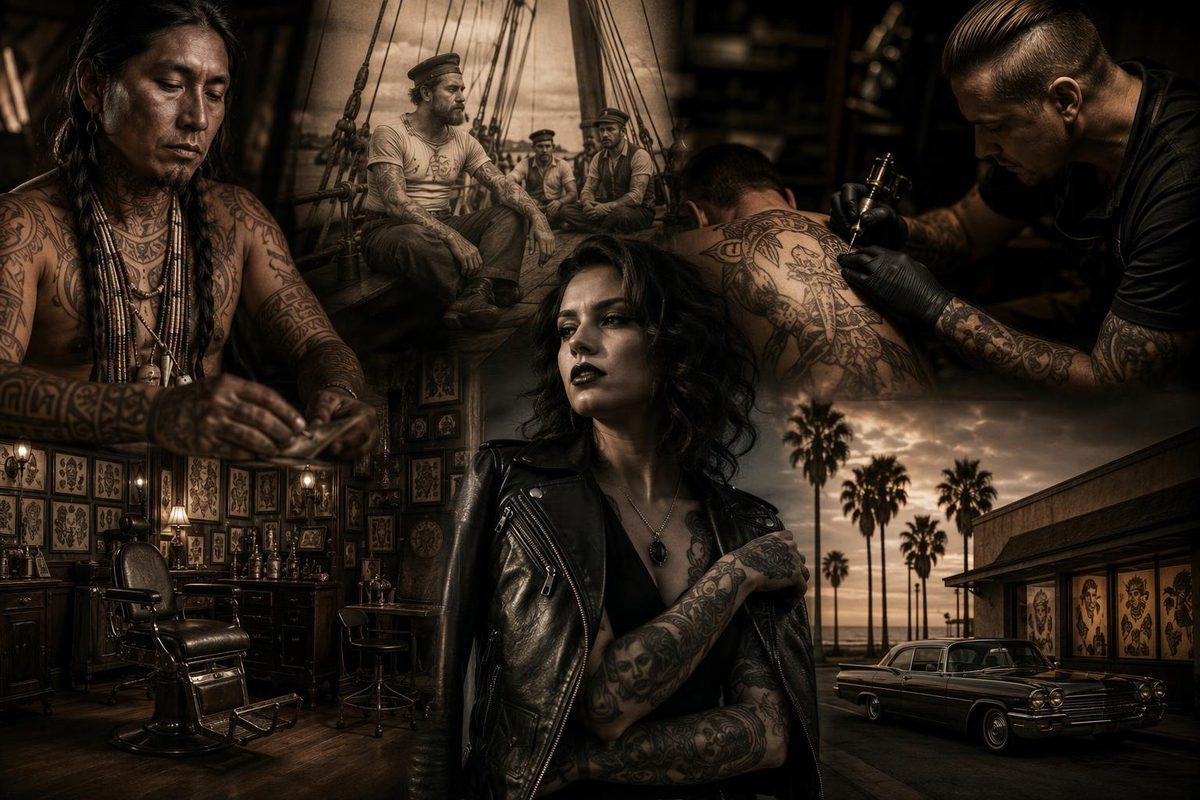
Tattooing in America has no single starting date. Indigenous tattoo practices preceded the commercial shops associated with sailors, and the later history extends well beyond the bold designs now called American traditional. Following the places where tattoos were made, displayed and circulated reveals several overlapping histories—not one inventor or one national style.
Here, “America” means the United States, including records from before its founding. This is a selective history, following maritime records, New York’s tattoo archives and the West Coast career of Ed Hardy rather than attempting to cover every regional tradition.
Indigenous records before the United States
Among the objects in The New York Historical’s Tattooed New York exhibition was a 1706 Western account recording a Seneca warrior’s pictograph representing his tattoos and personal signature. The exhibition also included the museum’s 1710 Four Indian Kings prints. The museum’s exhibition record places these objects in its account of tattooing before the United States existed.
An early surviving description tells us when an observer documented a practice, not when a community developed it. The Seneca record is not evidence that tattooing began in 1706, nor can it explain the purposes or designs of every Indigenous tattoo tradition.
Colonial ports and the Bowery’s commercial trade
The New York Historical traces sailors’ role in bringing tattooing into colonial New York’s maritime culture. Tattoos also entered the documentary record as identifying marks. Seamen’s Protection Certificates, authorized by a 1796 federal act to help protect American seamen from impressment by the Royal Navy, recorded physical descriptions that could include the location of tattoos. Mystic Seaport Museum explains how these documents functioned as proof of citizenship. They preserve evidence of tattooed sailors without telling us everything about why those sailors chose their designs.
Later New York records document a commercial tattoo scene around the Bowery, with designs by Samuel O’Reilly, Lew Alberts, Bob Wicks, Ed Smith and Bill Jones. Early twentieth-century tattoo machines appear alongside their work. The exhibition brings together these artists’ designs and equipment.
One surviving O’Reilly design—an eagle and shield, dated approximately 1875–1905—makes that history tangible. Rather than reducing the period to a story about machinery, the drawing preserves the imagery of the trade.
Tattoo history and style history overlap here, but they are not interchangeable. The broader history of tattooing follows developments across cultures; the American story also concerns how a local commercial trade took shape and found audiences.
Tattoos as public spectacle—and an underground practice
Tattoos circulated beyond the shop. The New York exhibition brought together sideshow banners, cabinet cards and an approximately 1880 photograph of Nora Hildebrandt. These objects document another setting in which tattooed bodies became visible: publicity and public display. They also keep women in the historical picture rather than presenting tattoo culture solely through male artists and sailors. The exhibition’s objects and captions preserve that visual record.
Visibility did not mean secure legal acceptance. New York City instituted a tattooing ban in 1961, followed by an underground tattoo culture. This was a city restriction, not a nationwide prohibition. The ban was lifted in 1997.
A 1976 photograph by John Wyatt shows children watching Thom deVita work in his apartment. It is a concrete example of tattooing continuing outside a conventional storefront during the ban. The museum also documents work by visual artists who tattooed in those years. Its account distinguishes the prohibition from the practice that persisted.
West Coast studios and cross-Pacific exchange
The West Coast offers a different route through the same decades. As a child in the 1950s, Ed Hardy studied tattoo imagery at the Long Beach Pike, an amusement zone with tattoo parlors. He later worked in Vancouver, Seattle and Honolulu, where Sailor Jerry introduced him to Japanese subject matter. Hardy also studied with a master tattooist in Gifu, Japan, in 1972. The Fine Arts Museums of San Francisco’s retrospective documents those connections.
In 1974, Hardy opened Realistic Tattoo in San Francisco as a private studio undertaking commissions tailored to individual clients. Its preparatory drawings included back pieces, chest pieces and full-body tattoos. This provides a documented example of custom, large-scale work alongside flash—sample designs clients could choose from. It does not establish that Hardy invented custom tattooing. The museum describes both phases of his practice.
Tattoo imagery beyond the tattoo shop
The Fine Arts Museums dates the use of Hardy’s tattoo designs as the basis of his namesake global fashion line to 2003. The imagery could now circulate on clothing without requiring the wearer to get tattooed. The museum records this licensing chapter, an important distinction between the spread of tattoo imagery and the practice itself.
These records show why American tattoo history cannot be told through anchors and eagles alone. Indigenous documentation, maritime identification, waterfront commerce, sideshow publicity, underground apartment work and custom studios each reveal a different relationship between tattoos and American life.