
What Surviving Evidence Really Tells Us About Tattoo History
Explore tattoo history through ancient bodies, Pacific traditions, Japanese prints and machine patents, with clear limits on what each source can prove.
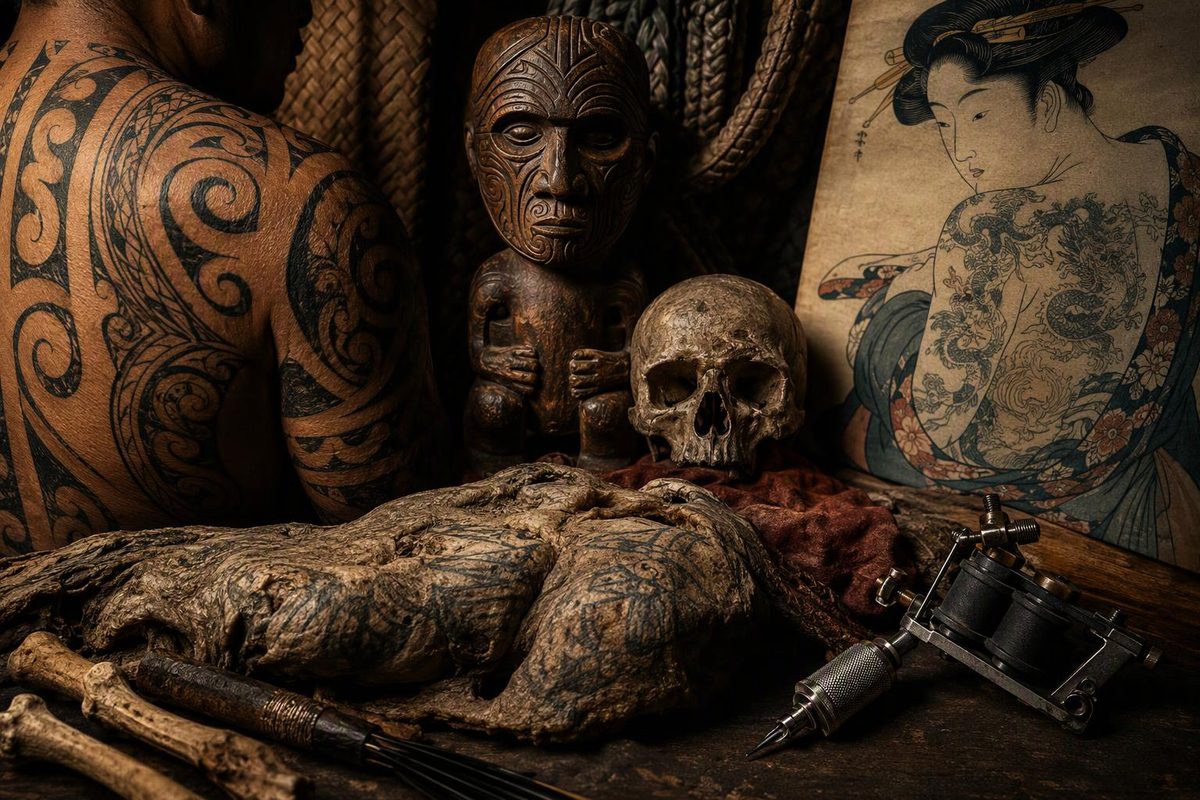
Tattooing is more than 5,000 years old, but when people first began tattooing remains unknown. Ötzi’s 61 preserved tattoos provide direct evidence of ancient tattooing—not proof that he or his community invented it. Smithsonian’s account of the archaeological research explains why the oldest surviving tattoos are not necessarily the first tattoos ever made.
Tattoo history has several overlapping timelines: surviving marks on skin, living cultural traditions, the circulation of designs and changes in equipment. The evidence answers different questions. A machine patent can establish a technical milestone; it cannot establish the beginning of tattooing.
Choose a historical question to see the evidence and what it can establish.
Match the Question to the Evidence
No documented starting date. Ancient skin establishes tattooing more than 5,000 years ago. Traditions, prints and patents answer different questions.
| Period | Evidence | What It Establishes |
|---|---|---|
| Around 3250 BCE | Ötzi’s 61 tattoos | Ancient marks on preserved skin.Limits & SourceNot proof of the first tattooing. A therapeutic purpose is proposed, not established. Sources: Smithsonian; South Tyrol Museum of Archaeology. |
| Roughly 5,000 years old | Gebelein mummies | Oldest known figurative tattoos.Limits & SourceIdentified using infrared imaging in 2018. Original meanings remain uncertain. Source: British Museum. |
| Origin date — | Tahitian tattooing comb | A documented tool and technique.Limits & SourceBone teeth, a wooden handle and plant-fibre binding; used with a mallet and candlenut-soot pigment. The object record does not establish when tattooing began. Source: National Museum of Australia. |
| Origin date — | Samoan tatau practitioners | A tradition connected to identity.Limits & SourceThe exhibition documents tufuga tā tatau, pe’a and malu, and survival through suppression. It does not establish rules for every Pacific tradition. Source: Tatau: Marks of Polynesia, Utah Museum of Fine Arts. |
| Around 1827–30 | Kuniyoshi’s tattooed heroes | Prints and tattoo imagery interacted.Limits & SourceScholars remain uncertain whether the prints led or reflected the fashion; they probably did both. Sources: Museum of Fine Arts, Boston; Asian Art Museum. |
| December 8, 1891 | O’Reilly’s US patent 464,801 | A specific electric-machine design.Limits & SourceThe illustrated assembly has five needles but permits other configurations. It is not a specification for every machine or the beginning of tattooing. Source: original patent. |
| 1961–1997 | New York City tattooing ban | A local legal restriction.Limits & SourceNot a nationwide American ban. Artists continued working underground. Source: New-York Historical, Tattooed New York exhibition account. |
Sources: the museums, exhibition accounts and original patent cited in the article. — means no origin date supplied by this evidence.
Ancient Skin Establishes Age, Not an Origin
Ötzi, the Tyrolean Iceman, died around 3250 BCE and was preserved beneath an Alpine glacier. His tattoos appear on his wrist, legs, lower back and torso. The South Tyrol Museum of Archaeology records them as lines and crosses rather than pictures.
Researchers have proposed a therapeutic purpose because many marks sit near areas of bodily wear. That remains an interpretation, not a recovered explanation from the person who wore them. Their meaning is uncertain.
Egypt provides another early record. In 2018, British Museum researchers used infrared imaging to examine two roughly 5,000-year-old, naturally mummified people from Gebelein. On the man’s arm, they identified two horned animals—a bull and a Barbary sheep. On the woman, they found S-shaped markings and a linear design whose interpretation is less certain. The British Museum describes the discovery as the world’s oldest known figurative tattoos.
The distinction matters: Ötzi’s geometric marks and the Gebelein images demonstrate different possibilities already present in ancient tattooing. The animals’ original meanings cannot simply be read from a modern tattoo-symbol guide. Preserved skin establishes that a design existed; it does not always tell us why someone received it.
Pacific Traditions Predate European Accounts
The English word tattoo derives from the Tahitian tatau, according to Royal Museums Greenwich. The word’s entry into English should not be confused with the practice’s beginning.
A tattooing comb documented by the National Museum of Australia makes the craft tangible: a wooden handle carries a finely toothed bone blade, secured with plant fibre. The museum’s catalogue describes Tahitian specialists using a mallet to tap a comb into the skin, with pigment made from candlenut soot. Accounts from Cook’s voyages recorded an existing practice; they did not create it. The museum’s object record documents the equipment and its use.
Samoan tatau has its own practitioners, tools and cultural values. The exhibition Tatau: Marks of Polynesia, curated by Takahiro Kitamura and organized by the Japanese American National Museum, centres tattoo masters known as tufuga tā tatau, especially the Sulu‘ape family.
The exhibition presents pe’a and malu, traditionally male and female tattoos, as practices connected to identity and Samoan cultural values. It also documents survival despite attempts by missionaries and colonists to suppress tattooing in the Pacific. The Utah Museum of Fine Arts exhibition account places the practitioners and their communities at the centre of that history.
“Polynesian tattoo” is therefore too broad to explain a particular tattoo’s history or who should wear it. A Tahitian tool does not establish the rules of Samoan practice. The named tradition and its practitioners provide a more precise starting point than an interchangeable collection of patterns.
Japanese Prints Helped Shape Tattoo Imagery
In early nineteenth-century Edo, now Tokyo, tattooing and colour woodblock prints developed a powerful relationship. Utagawa Kuniyoshi’s One Hundred and Eight Heroes of the Popular Water Margin, produced around 1827–30, portrayed heroic outlaws with elaborate tattoos: coiling snakes, peonies, lions, dragons and supernatural beings. The Museum of Fine Arts, Boston documents this relationship between printed images and tattoo design.
These prints offer dated evidence for recognizable imagery. They do not, by themselves, establish that Kuniyoshi invented the fashion.
Asian Art Museum curator Laura Allen notes that scholars remain uncertain about the direction of influence: the prints probably both inspired and reflected the tattoo boom. Influence is documented; a single-inventor story is not. The Asian Art Museum’s account preserves that distinction.
This is a different historical question from the age of tattooing itself. A practice can be much older than a particular visual style, and a popular image can reshape that style without originating the practice.
The 1891 Patent Marks a Technical Turning Point
On December 8, 1891, New York tattooer Samuel O’Reilly received US patent 464,801 for a tattooing machine. He adapted Thomas Edison’s electric-pen design. The original patent describes an electric motor, an ink reservoir and an adjustable depth gauge. Its illustrated needle assembly contains five needles, while allowing other configurations.
Those details describe O’Reilly’s patented design, not every electric tattoo machine. The patent supplies a precise date and a technical record for one development in a practice already thousands of years old.
The machine changed the trade; it did not create tattooing. For the visual history of the designs sold alongside it, see our guide to vintage tattoo flash.
New York’s History Includes Women and Underground Studios
New York’s tattoo archive includes sailors and soldiers, but also society women, sideshow performers and women who tattooed. The Tattooed New York exhibition documented sideshow performer Nora Hildebrandt and Bowery tattooer Mildred Hull, alongside artists working in later apartment studios.
Acceptance was uneven. New York City banned tattooing in 1961 and lifted the ban in 1997. Artists including Thom deVita and Mike Bakaty continued working underground during the ban. This was a New York City restriction—not a nationwide American ban. New-York Historical’s exhibition account documents these people and the city’s changing tattoo culture.
Women belong inside this history, not in a footnote added after a supposedly complete story about sailors. Likewise, a city’s legal restrictions describe conditions in that jurisdiction, not the status of tattooing everywhere.
Separate the Age of a Practice From the History of a Style
Three questions keep a tattoo’s history precise: Where is its earliest evidence? Who developed its recognizable forms? What did it mean in that community?
Ötzi and the Gebelein bodies help answer the first. Kuniyoshi’s prints illuminate the circulation of imagery. Samoan practitioners and their traditions provide cultural context that an archaeological date cannot supply. O’Reilly’s patent records a change in equipment.
None of these is a universal starting point. Together, they show why tattoo history is better understood through specific bodies, communities, images and tools than through a single story of invention.