
Family Tattoos: Choose a Design That Tells Your Story
Explore family tattoo ideas for parents, siblings, chosen family and remembrance, with personal symbolism and practical advice for your artist brief.
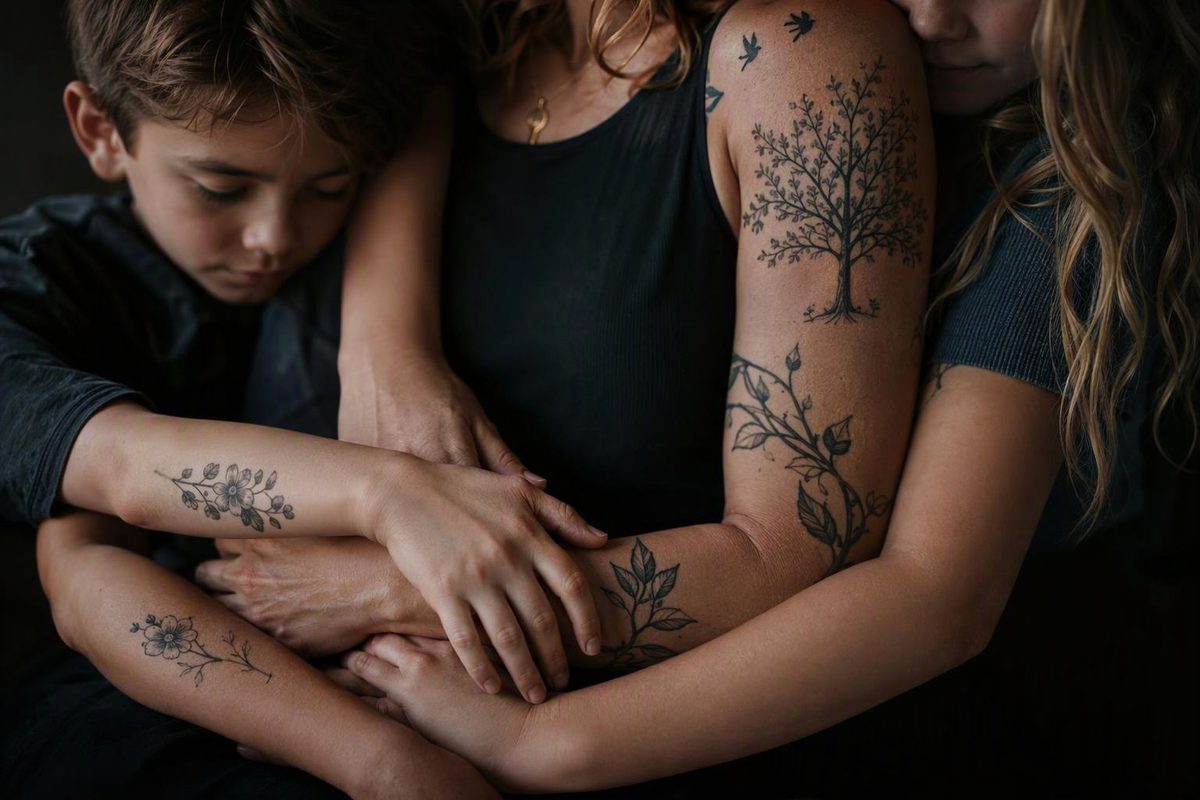
A family tattoo can express belonging, gratitude, shared history or remembrance. It doesn’t have to name everyone, and it doesn’t have to represent a biological family. A small drawing of the kitchen table where you grew up might say more about your people than the word family ever could.
Start with what you want to honour: a particular person, the bond between siblings, the people who raised you, or the home you built together. Then choose an image that carries that story—not just a symbol assigned a meaning by an online list.
Seven ways to give a family tattoo meaning
1. A tree for generations and connection
You could use roots for earlier generations, branches for different family lines, or leaves for individual people. Those are choices you and your artist make, not rules every tree tattoo follows.
For a more personal version, choose a tree from a family garden rather than an anonymous silhouette. If you might want to add people later, ask the artist to leave room in the composition. Explore the different cultural references in our guide to tree of life tattoo meaning before choosing knotwork or religious details.
2. Handwriting for a particular person
A signature, a birthday-card sign-off or a child’s handwritten word can preserve something distinctive about its writer. It can celebrate someone living or serve as a memorial.
Dublin studio The Black Hat Tattoo describes working with cards, letters and handwritten notes, and recommends bringing a clear photograph, scan or original. Its practical warning matters: tight, tiny lettering may need more spacing or a larger scale to remain readable as it ages.
Choose the part you actually treasure. “Love, Dad” might be enough; you needn’t reproduce the whole card.
3. Names, initials or dates for a direct tribute
These make the reference explicit. A name can honour a parent or child; initials can keep it more private; a date can mark a birth, adoption or reunion.
Check every spelling and numeral against the original record before approving the stencil. If you use another language, have a fluent reader check the wording rather than relying on an automated translation. Consider whether a nickname feels more like the person than their formal name.
4. A shared object for everyday family life
Think of a grandmother’s sewing scissors, a father’s fishing float, the family teapot or the key to a first home. The meaning comes from the object’s place in your life, so you don’t need a historical symbolism claim to justify it.
Bring a photograph of the actual object. Its chipped handle or unusual shape might be the detail that makes it yours. Let the artist decide which details belong in the tattoo at the proposed size.
5. A bouquet for several people
Assign each person a flower they love, grow or remind you of. A mixed bouquet could bring different generations together without a list of names.
You can also choose birth-month flowers, but tell the artist which list you are using rather than assuming everyone shares the same convention. A flower connected to a real memory—a rose beside the back door, for instance—doesn’t need an assigned meaning.
6. Matching or related designs for siblings and chosen family
Matching tattoos can mark a shared commitment. Related designs give each wearer more independence: the same plant in different styles, separate objects from one shared memory, or a motif with an individual detail for each person.
Choose something each person would still enjoy wearing alone. Nobody should need another person’s tattoo beside theirs for the design to feel complete, unless that dependence is deliberately part of the idea.
7. A portrait or memory scene for remembrance
A portrait makes the person the subject. An empty chair, a favourite bird or a familiar landscape can instead represent what you remember about them.
For a portrait, bring clear photographs and discuss which expression matters most. For a symbolic memorial, explain the connection: a bird can represent your relative because you watched birds together, without claiming that species universally means grief or family.
Heritage isn’t a catalogue of interchangeable symbols
Distinguish a personal metaphor from a tradition with its own cultural responsibilities. Rawinia Higgins’s account for Te Ara describes tā moko as an expression of Māori and tribal identity, not simply a decorative shorthand for family.
If a heritage design interests you, consult a knowledgeable practitioner from that tradition rather than copying another wearer’s markings or selecting a supposedly universal “family symbol.”
Turn the meaning into an artist brief
Bring three things: who or what you’re honouring, the reference material, and your preferred placement and approximate size. Ask to see healed work relevant to the style, especially lettering or portraits.
A useful brief might be: “I want my grandmother’s teacup, with its blue floral pattern, on my upper arm. The chipped handle is important; the background isn’t.” That gives the artist a specific subject and room to design a tattoo—not merely copy an image.