
Black and Gray Realism Tattoos: How Light Builds a Likeness
Explore black and gray realism tattoos through gray wash, contrast, cultural roots and artists’ approaches—and learn how to brief your own piece.
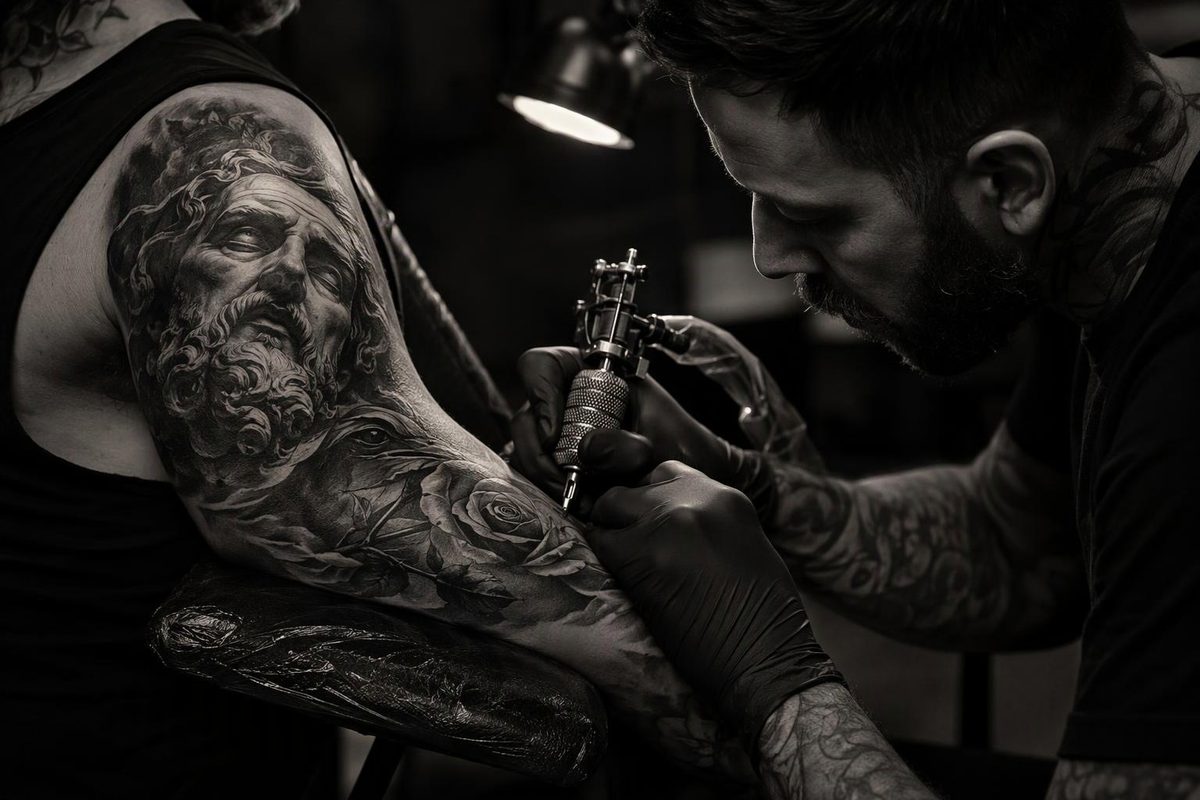
A black and gray realism tattoo makes a face, animal or object look lifelike through tonal shading rather than a full-color palette. Think of the rounded cheek in a portrait, the shine on an animal’s eye or the folds in a marble statue. The subject becomes convincing because light, shadow and texture describe its form. Realism specialist Washington Gomes’s studio explains this approach through controlled contrast and different dilutions of black ink. Washington Tattoo
“Black and gray” describes the palette; “realism” describes the rendering. A monochrome design isn’t automatically realism. The question is whether its shading creates a believable likeness and sense of volume.
Where the gray comes from
Gray wash is diluted black ink used to produce lighter tones. A traditional wash setup gives the artist a range from deep black to very light gray, allowing gradual transitions rather than one flat shaded area. Monolith Studio describes this dilution method alongside shading techniques that produce soft gradients. Monolith Studio
But black and gray is not one fixed ink recipe. Opaque gray inks are another option: Eternal Ink’s Neutral Gray Set contains four opaque grays at different points on the light-to-dark value scale, expressly intended for smooth gradations in black-and-gray work. That is a different approach from simply diluting black. Eternal Tattoo Supply
When looking at a design, separate three jobs:
- Deep shadows anchor the image and distinguish overlapping forms.
- Midtones describe rounded surfaces—the turn of a cheek or the curve of a petal.
- Light areas provide separation and highlights. These can include deliberately uninked skin, often called skin breaks.
Monolith emphasizes both saturated darks and skin breaks in its account of contrast. The useful lesson is that pale areas are not necessarily unfinished areas: leaving space can be part of the design. Monolith Studio
For your own reference, try viewing it in grayscale. Does the subject remain clear, or were two objects distinguishable mainly because they had different colors? Treat that as a discussion prompt, not a demand that the artist reproduce a phone filter. They may need to reorganize the lighting or simplify the background.
A palette with a broader history
Black-and-gray tattooing encompasses more than contemporary photographic portraits. In a Lowrider interview, Jack Rudy recalled working with Charlie Cartwright in East Los Angeles in 1975, where clients requested fine-line, prison-style work. He described adapting that approach to professional tattoo machines and spoke about a practice that included realistic portraits and lettering. Jack Rudy’s Lowrider interview
That account is an important connection between the broader black-and-gray tradition and realistic imagery—not evidence that every monochrome tattoo belongs to one style. Lettering, portraits and other designs can share a palette without sharing the same visual conventions.
Realistic detail does not dictate the composition
A tattoo can contain realistically rendered subjects without copying one photograph wholesale. Carlos Torres offers a particularly clear example. In an OC Weekly interview, he described hiring models, arranging costumes and making photographs for custom tattoos, rather than repeatedly using the same references as other artists. The composition begins before the tattooing does. Carlos Torres’s OC Weekly interview
Nor is maximum photographic precision every artist’s goal. Ryan Evans describes his work as semi-realistic black and gray. He favors projects where clients provide an overall theme and leave room for his interpretation, especially large-scale work that develops across multiple sessions. Ryan Evans’s interview
Those are different briefs: “preserve this person’s expression” and “interpret this theme” ask an artist to solve different problems.
Brief the image, not just the style
Instead of asking only for “black and gray realism,” explain what must remain recognizable. For a memorial portrait, that might be a particular smile. For a pet, the shape of the muzzle and characteristic markings. For a statue, the pose and the way light falls across its surface.
Then ask:
- What will carry the likeness? Identify the essential features before adding smoke, flowers or other background elements.
- Where will the lightest areas come from? Ask the artist to explain the planned skin breaks and tonal range on your skin.
- Can I see comparable healed work? Look for the same kind of subject and a similar scale—not only close-up photographs of fresh detail.
If color is essential to identifying your subject, compare the approach with color realism tattoos. If monochrome is what you want, choose for the arrangement of light and dark as much as the tiny textures.
Black-and-gray shading is not a promise against fading. For sun protection of healed tattoos, the American Academy of Dermatology recommends broad-spectrum, water-resistant SPF 30 or higher because UV light can fade some tattoo inks. Apply it 15 minutes before going outside and reapply at least every two hours. AAD tattoo-care guidance