
Choosing an Old School Tattoo: Look Beyond the Motif
Choose an old school tattoo by its lines, shading and composition—not just its motif. Learn what to bring and ask at an artist consultation.
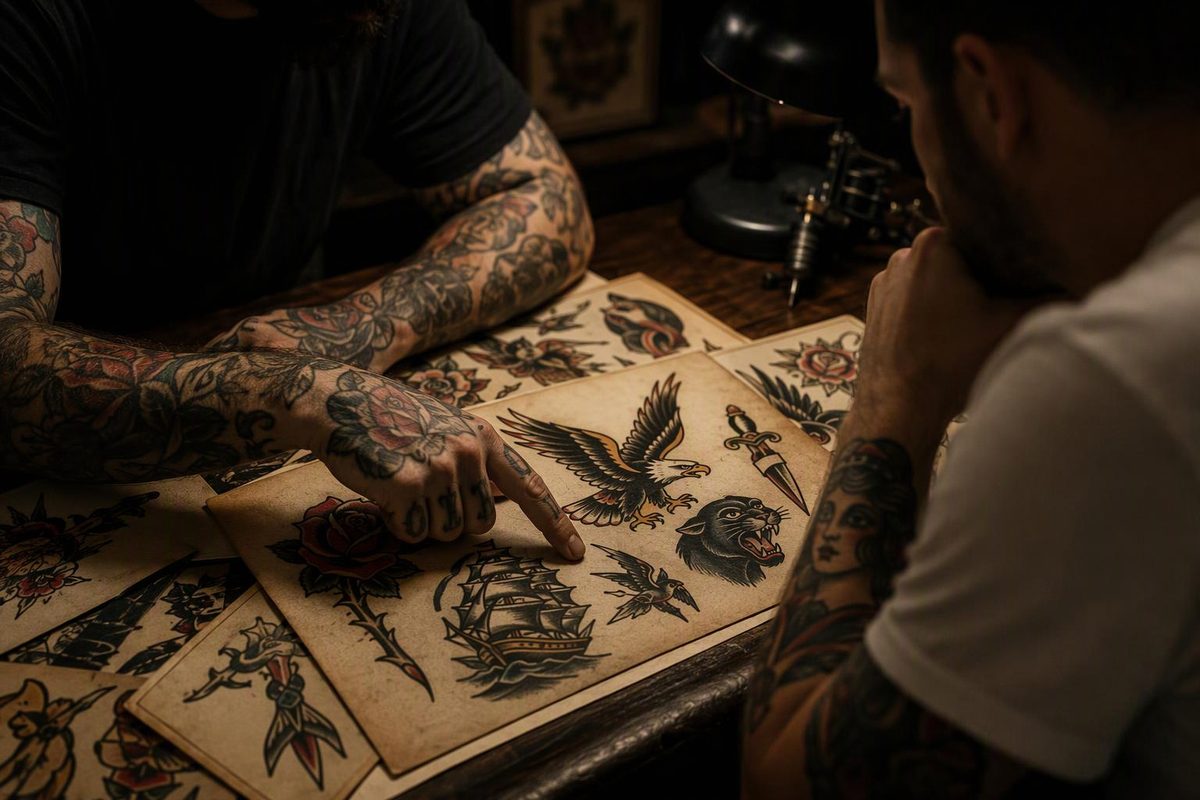
An anchor isn’t automatically an old school tattoo. Draw it with delicate lines and realistic metal reflections, and it becomes a different kind of image. Give it a heavy black outline, solid shading and a few clear color areas, and you’re much closer to the style.
“Old school” usually means American traditional tattoos. Omnia Tattoo Studio uses the names interchangeably. When choosing one, the label is a starting point: your references should show how you want the subject drawn, not just what you want it to depict.
Identify what you like in the drawing
Look for these features in an artist’s portfolio:
- Strong black outlines. The edges establish the image rather than disappearing into realistic shading.
- Simplified shapes. Petals, feathers and faces use clear, deliberate forms rather than photographic detail.
- Solid shading and restrained color. Red, yellow, green and blue are common, with black giving the design contrast.
- A readable composition. The major shapes are easy to distinguish without inspecting every small detail.
These are features emphasized in Seven Swords Tattoo Company’s American traditional style guide. The studio also explicitly includes black-and-grey traditional work. If you like the drawing style but don’t want bright color, say so.
A rose offers a useful comparison. An old school version might use chunky petals, dark pockets of shading and a few pointed leaves. A neo-traditional version can introduce finer interior lines, more elaborate petals and subtler color transitions. Both can have a bold outline; neo-traditional generally expands the detail, shading and palette, as Omnia’s comparison explains.
For a broader comparison, see our guide to different tattoo styles.
Separate the motif from its meaning
Some familiar designs have maritime associations. Royal Museums Greenwich links a full-rigged ship with rounding Cape Horn and an anchor with crossing the Atlantic. These are reported sailors’ traditions, not a reliable biography of everyone wearing those images today.
Separate the subject, its historical associations and your own reason for wearing it. You might want an anchor for a family connection, a ship for travel, or a rose simply because you like its shape. Tell the artist which matters to you; don’t assume the motif supplies the whole story.
If your reference comes from an old-looking flash sheet, clarify what attracts you: the particular drawing, its arrangement or its vintage appearance. Our guide to vintage tattoo flash distinguishes historical sheets, reproductions and newly drawn work with an older look.
Make the consultation specific
Bring a small set of references and identify what you like in each. “This heavy outline, this deep black shading, but without the color” is more useful than “something old school.” Include your intended placement and approximate size.
Ask to see healed examples, and discuss the size needed to keep petals, lettering and other interior shapes distinct. Ask whether the artist offers existing flash, a custom drawing or both. A familiar motif needn’t mean an identical design.
Don’t treat the style as a guarantee against fading. Clear composition is a design strength, but it doesn’t make ink immune to change. The American Academy of Dermatology notes that UV light can fade some tattoo inks and recommends sun protection for tattooed skin.
The useful consultation question isn’t just “Is this old school?” It’s “Does this artist’s version have the lines, contrast and arrangement I want to wear?”