
A Blue Ink Tattoo Is a Color Choice, Not a Fixed Symbol
Explore blue tattoo meanings, design contrast, healed color, ink ingredients, safety and laser removal without treating blue as a universal code.
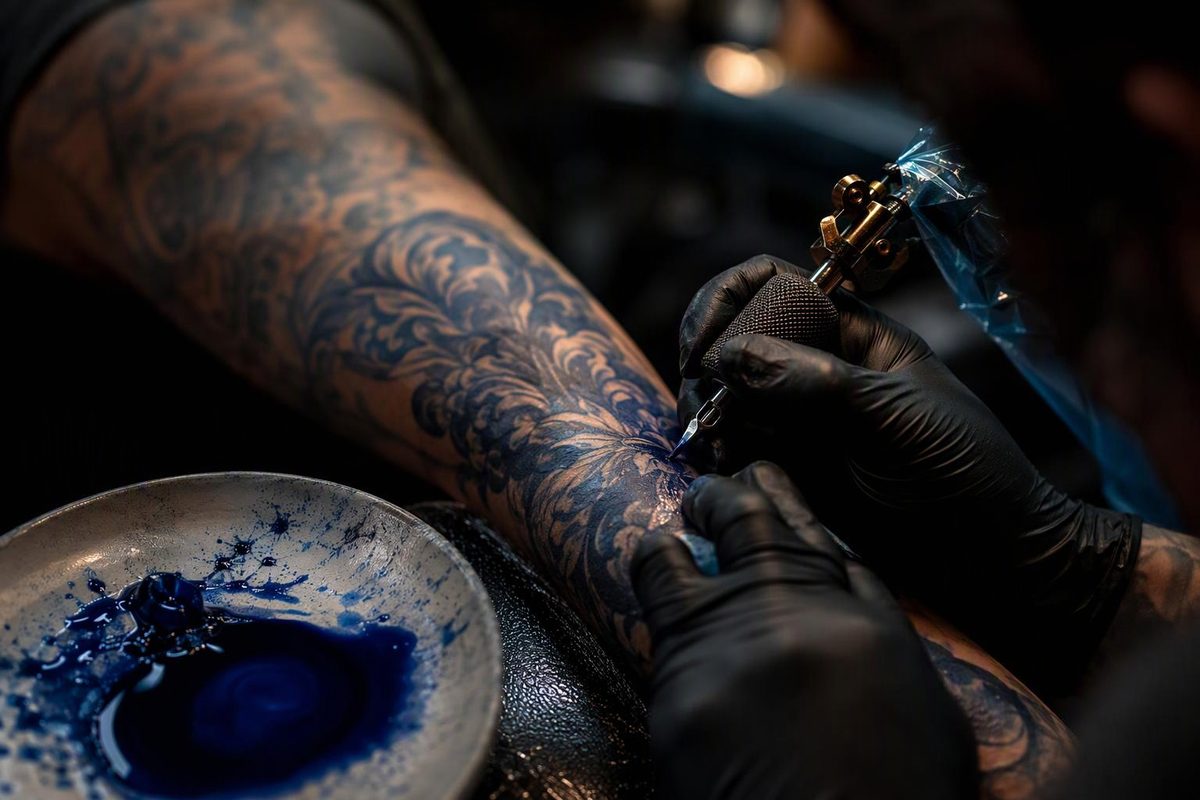
A blue ink tattoo can resemble porcelain, cyanotype, ballpoint pen or deep ocean, depending on its shade, line weight and subject. Blue itself has no fixed tattoo meaning. It can suggest calm, distance, sadness, loyalty, water or sky, but the image and the wearer’s intent do more interpretive work than the pigment.
A blue wave, blue rose and blue portrait do not communicate the same thing simply because they share a palette.
What does a blue tattoo mean?
Treat familiar color associations as possibilities, not a code:
- Water, movement or change: waves, rain, rivers and marine life
- Sky, distance or freedom: clouds, birds, stars and atmospheric landscapes
- Calm or contemplation: spare ornaments, abstract forms and soft botanical work
- Melancholy or memory: portraits, handwriting and commemorative designs
- The color itself: team colors, blue-and-white ceramics, cyanotypes or blue ballpoint drawing
The motif can completely redirect the reading. Sacred, national and culturally specific symbols retain their own histories; coloring one blue does not erase that context. If meaning matters, tell the artist what you want the design to express instead of relying on “blue means X.” Readers still gathering subjects can start with these tattoo prompts organized by meaning, style and placement.
Blue works best as a palette, not one flat swatch
An all-blue tattoo still needs contrast. Navy, mid-blue and pale blue can establish a value range, while open skin can separate forms. Without enough difference between light and dark areas, a detailed composition may be difficult to read from a distance.
Blue can serve several roles:
- Monochrome: one hue family used for outlines, shading and solid areas
- Blue and black: black establishes the darkest values while blue carries the color
- Accent: a small electric-blue element directs attention within blackwork
- Limited palette: blue paired with orange or warm red creates strong contrast
- Decorative reference: cobalt ornament can recall glazed ceramics or printed textiles
Fine blue lines may imitate pen or blueprint marks; broad fields of saturated blue produce a more graphic effect. The useful question is not merely “Do I like blue?” but “Which blue, used where, with how much contrast?”
Skin is also part of the finished palette. Atlanta tattoo artist Russ Abbott explains that fresh ink is seen both in and on top of the skin, while healed pigment is viewed through the upper layers. He argues that artists should evaluate color through healed work, not fresh photographs alone (Ink & Dagger). Ask to see an artist’s healed blue tattoos, ideally on a complexion reasonably similar to yours.
Does blue ink fade quickly?
There is no sound rule that every blue fades at one predictable rate. “Blue ink” can mean different pigments, mixtures and concentrations. Application, design density, placement, healing and sun exposure also affect how a tattoo holds up.
UV exposure is one controllable factor. A dermatology review notes that sun exposure can cause premature fading and recommends sun protection for healed tattoos as part of protecting all exposed skin (Journal of Clinical and Aesthetic Dermatology). While the tattoo is healing, follow the artist’s written instructions rather than applying unapproved products to the wound.
Plan pale or delicate blue work with particular attention to legibility. A tiny light-blue line starts with little contrast and may look less distinct over time. Wider spacing, a darker-blue anchor or selective black may preserve the composition better than additional tiny detail.
What is actually in blue tattoo ink?
A color name is not an ingredient list. New Zealand’s Environmental Protection Authority identifies cobalt blue and phthalocyanine among pigments used in blue tattoo ink. It also describes inks as combinations of pigment, a carrier and additives that may include preservatives or stabilizers (New Zealand EPA). Formulations vary by product and market.
In the United States, the FDA considers intradermal inks cosmetics and their pigments color additives. Although some color additives are approved for cosmetic uses, none is approved for injection into skin. The agency lists contaminated ink, allergic reactions, granulomas and difficult removal among tattoo risks (FDA tattoo fact sheet). Its October 2024 final guidance recommends steps manufacturers and distributors can take to reduce microbial contamination; as guidance, it does not itself create legally enforceable duties (FDA).
Labels are not infallible. A 2024 laboratory study tested ten blue and green inks from five manufacturers that were sold to the European market as compliant with EU REACH rules. Nine did not comply and four contained restricted material. The sample is too small to characterize every product, but it demonstrates that a compliance claim is not the same as independent verification (Communications Chemistry).
Before the appointment, ask:
- Which brand and shade will be used, and does the studio record the lot?
- Can you see healed examples made with a similar palette?
- How will the design maintain light–dark contrast after healing?
- What written aftercare does the studio provide?
A reaction can be limited to one ink color and can appear long after healing. Spreading redness, worsening pain, pus or fever requires prompt medical attention; trouble breathing, intense swelling, chest tightness, dizziness or hives requires immediate care (American Academy of Dermatology).
Can a blue tattoo be removed?
Choose it as permanent. The FDA says dark blue and black are generally the easiest tattoo colors to remove, but laser removal still requires multiple treatments and complete clearance may not be possible. The appropriate laser and likely result depend on the colors used, as well as the tattoo’s size and other individual factors (FDA tattoo-removal guidance). A pale blue mixture is not necessarily equivalent to dark blue, so a qualified health professional needs to assess the actual tattoo rather than promise results from its color name.
A strong blue tattoo plan joins the poetic decision to the practical one: decide what the subject means, build enough contrast for it to read, inspect healed work and know which ink will go into your skin.