
Reading Tattoo Art Through Flash, Body Design and Photography
Explore tattoo art through credited flash, Ed Hardy’s body designs and Chaim Machlev’s collaborations—and turn references into a better artist brief.
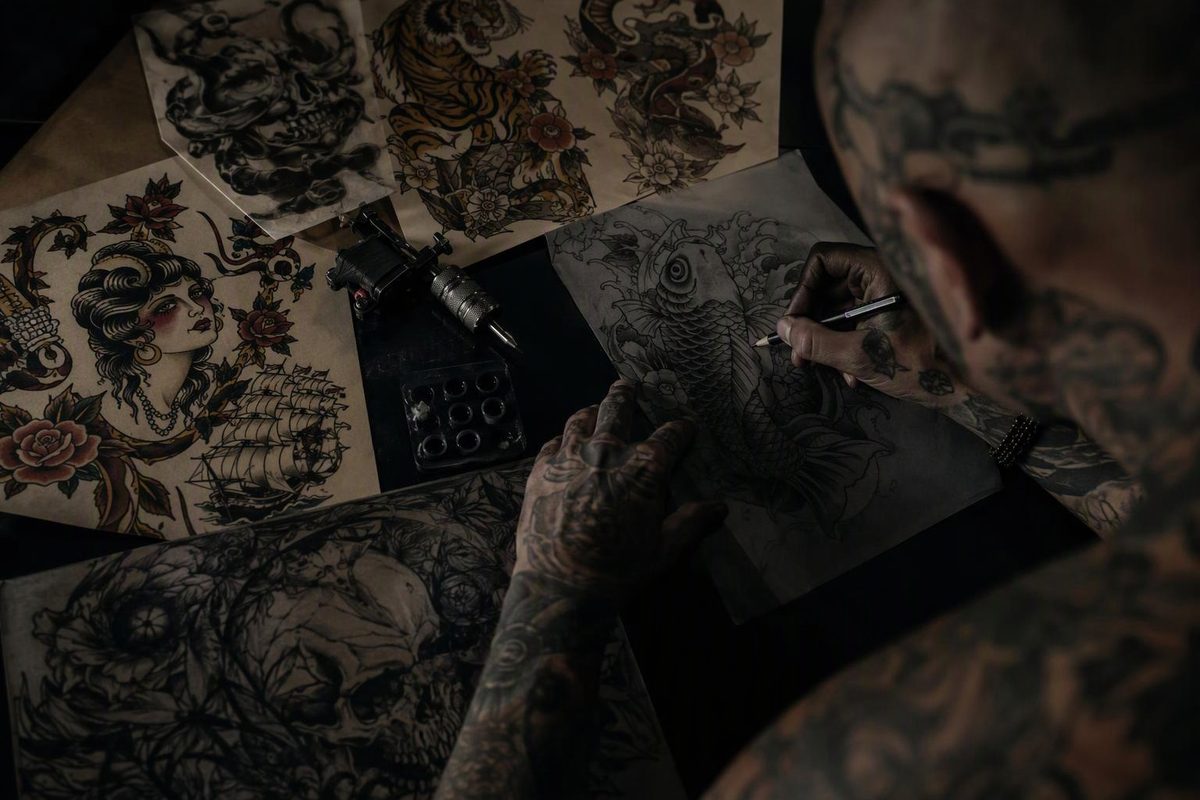
A skull with aviator goggles, a drawing planned for an entire back, and geometric lines shaped around a body ask for different kinds of attention. The subject matters, but so do the artist’s decisions: what to emphasize, how to arrange the image, and how it will meet the person wearing it.
“Tattoo art” can refer to the tattoo itself, the flash and preparatory drawings used to make it, or artwork that carries tattoo imagery into another medium. Keeping those distinctions in view makes browsing more useful than simply collecting pictures of subjects you like.
Flash: a drawing with a job to do
Flash is not just decoration for a shop wall. A Smithsonian feature on the Lyle Tuttle Tattoo Art Collection describes designs that tattooists drew on paper or artist board to advertise their style and skill and offer images that could become tattoos. The collection preserves work by artists including Owen Jensen, Milton Zeis, Sailor Jerry and Lou Normand. The feature credits these artists’ sheets rather than treating them as anonymous “old-school” imagery.
Normand’s aviation flash gives a particularly clear example of context changing a reading. In the feature’s interview with collection curator Danielle Boiardi, she describes an eagle with an American flag atop a bomb, alongside imagery such as a winged skull and a skull wearing an aviator’s cap and goggles. She interprets these within World War II military culture: patriotism, bravery and a display of toughness. That is a historically situated interpretation, not a universal definition of every skull or eagle tattoo.
When looking at flash, ask two separate questions: What does the image show, and what was it designed to communicate to its audience? A recognizable motif can carry a very specific message through its accessories, lettering and neighboring symbols.
Attribution also has limits. The Smithsonian American Art Museum catalogs one twentieth-century Tattoo Flash sheet as pen and colored ink on cardboard, but lists its maker as “Unidentified.” An archive can preserve an object without preserving its artist’s name. The collection record makes that uncertainty visible.
A drawing is not yet the tattoo
Ed Hardy’s work offers a way to examine the journey from flat design to body.
For its 2019 retrospective Ed Hardy: Deeper than Skin, the de Young presented preparatory designs from Hardy’s Realistic Tattoo studio alongside photographs of the bodies he tattooed. Some designs were also animated and projected onto a contoured body form, on the corresponding areas where the tattoos had been applied. The museum’s exhibition account treats drawing and placement as connected parts of the work.
That pairing suggests a useful viewing habit: don’t stop at the isolated design. Look for photographs showing the whole back, chest or limb. Ask where the composition begins and ends, which feature attracts attention first, and how the surrounding untattooed skin contributes.
Hardy also moved tattoo imagery into prints, paintings and porcelain. The museum describes his return to brushes and pens as a departure from tightly controlled tattoo work. These pieces belong to his wider artistic practice, but a painting using tattoo imagery is not automatically a ready-to-tattoo design. The retrospective’s overview explains that movement between media.
The photograph is another interpretation
A photograph can change how tattoo art appears, too. For a 2018 exhibition, photographer Ben Hopper turned photographs of Chaim Machlev’s tattoos into negatives and edited them to enhance detail, producing an X-ray-like appearance. In Cent Magazine’s interviews with the collaborators, Hopper identifies Machlev’s geometric lines as complementing the body. Machlev describes his aim as making tattoos look “organic and natural” through their placement and execution.
Those exhibition photographs are interpretations of the tattoos, not neutral records of their everyday appearance. When choosing an artist, enjoy stylized photography—but also ask to see ordinary views and healed work.
Turn looking into a better brief
Instead of asking an artist to reproduce a saved image, identify what draws you to it:
- Line: strong outlines, delicate marks or repeated geometric paths?
- Contrast: large dark areas, open skin or gradual shading?
- Composition: one compact image or a design that travels around the body?
- Context: a historical reference, a personal story or primarily a visual preference?
Keep the original artist’s credit with each reference, and ask what can be developed into a design for you. Our guide to different tattoo styles helps name visual features; the tattoo placement guide helps connect them to a particular part of the body. The useful brief is not just “I want a skull.” It is an explanation of which artistic decisions you want to explore.