
A Hannya Mask Is Not Just an Angry Demon
A hannya mask tattoo can suggest jealousy, rage, grief or transformation, but its Noh theater context makes the suffering behind the face essential.
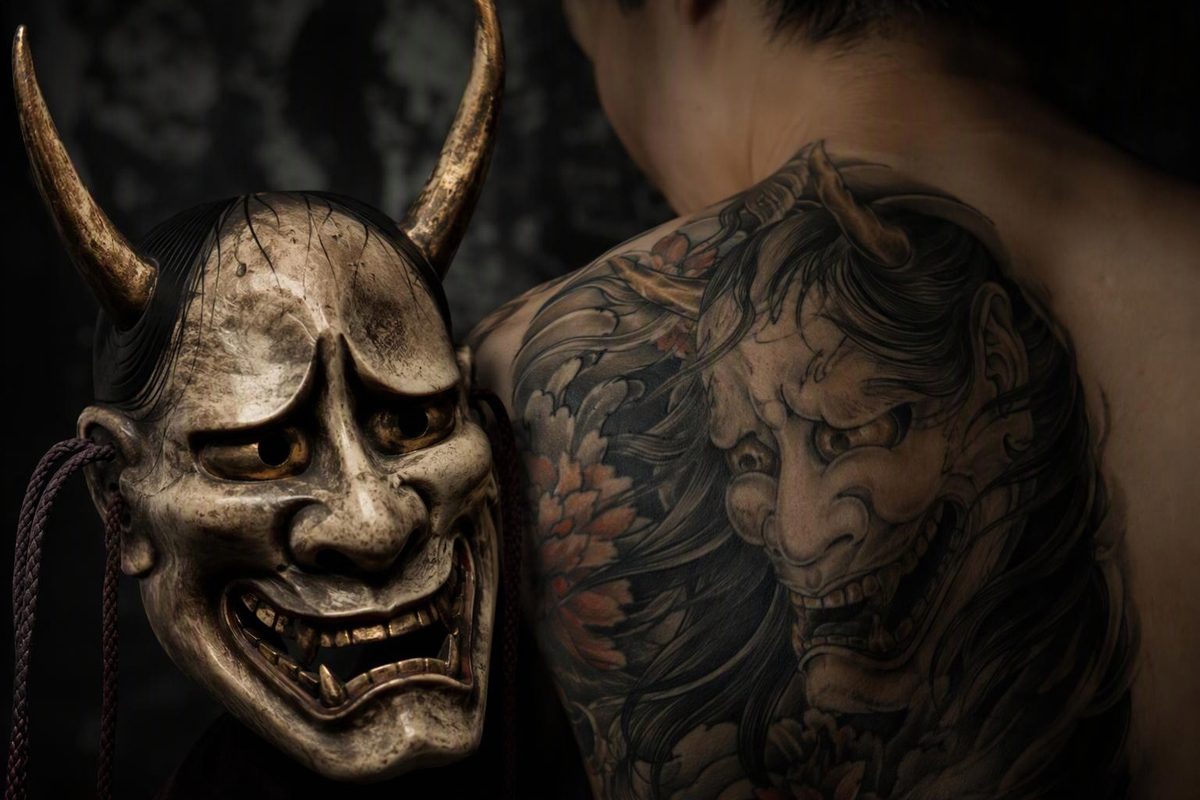
A hannya mask represents a woman transformed into a demon by overwhelming emotion. Jealousy and rage are its clearest documented meanings, but the image can also carry pain: this is not simply a monster, but a person whose suffering has changed her.
That tension makes hannya powerful tattoo imagery. It can communicate destructive jealousy, anger born from hurt, internal conflict or survival after an emotionally consuming experience. Those are possible readings, however—not a universal tattoo code.
The meaning comes from Noh theater
Hannya is a mask from Japanese Noh, a dramatic tradition that originated in the 14th century. The horned face and pointed teeth appear threatening, but its theatrical identity is more specific than “Japanese demon.”
The British Museum’s record for an Edo-period hannya mask describes a once-beautiful woman transformed by jealous rage into a demon. It also identifies the mask’s use in Aoi no Ue and Dōjōji. The museum dates its carved and painted example to the 18th or 19th century, while the Metropolitan Museum of Art holds an 18th-century work titled Noh Mask of a Demoness (Hannya). These records place hannya in a specific theatrical tradition rather than undifferentiated folklore.
In performance, a Noh mask is not emotionally static. An actor’s movement and the shadows cast across a fixed face affect how audiences read it. Experimental research using several types of Noh masks—not hannya specifically—found that changing shadows and vertical orientation changed whether observers perceived expressions as happy or sad (PLOS ONE). The study also notes that head and body orientation, music and dramatic context contribute to a mask’s expression.
That performance principle helps explain why a hannya design can look furious at first glance yet still suggest anguish.
What can a hannya tattoo mean?
A tattoo may emphasize one or several connected ideas:
- Jealousy or obsession: the reading closest to the mask’s documented dramatic role.
- Rage or vengeance: the demonic transformation makes emotion appear to have passed beyond ordinary restraint.
- Grief beneath anger: a modern reading that emphasizes suffering rather than uncomplicated evil.
- Transformation: the human-to-demon change can represent what pain, betrayal or fixation did to someone.
- Confronting destructive emotion: a wearer may use the mask to acknowledge anger rather than celebrate it.
Claims that every hannya tattoo means protection, wisdom, good luck or female strength go beyond the museum evidence. A wearer can give the image any of those personal meanings, but they should be described as personal or modern interpretations—not its single traditional definition.
The same restraint applies to fixed color charts. Red, white or dark tones certainly change a composition’s mood, but the sources above do not establish a dependable traditional code in which each hannya color has one universal meaning. Ask what a color does visually instead of treating it as a translation key.
Hannya is more specific than “oni mask”
“Hannya” and “oni” often appear as interchangeable search labels for horned Japanese faces, but hannya identifies a particular Noh mask: a woman transformed into a demon. Calling every horned face hannya erases that theatrical context; calling hannya merely an oni mask loses some of its emotional and dramatic specificity.
For a tattoo, the reference material matters. Ask an artist to work from documented Noh masks rather than a collage of unrelated demon faces. An 18th-century hannya netsuke in the Met collection, for example, offers another historical reference for the mask’s silhouette beyond modern tattoo designs.
Build the tattoo around the intended reading
Composition can direct the emotional emphasis without pretending there is a fixed symbolic dictionary.
A face shown straight on, with exposed teeth and hard contrast, foregrounds confrontation. A tilted or partly obscured face can pull the design toward conflict and ambiguity. Snakes, chrysanthemums, maple leaves, waves or peonies may produce a strong Japanese-style composition, but each addition needs its own research; combining familiar motifs does not automatically create an “authentic” traditional narrative.
Also decide whether you want an unmistakable theatrical mask—with a visible edge separating it from the wearer—or a living demon face. The former keeps the connection to Noh explicit. The latter can more easily drift into generalized monster imagery.
Bring your tattoo artist a plain-language brief: which emotion matters, whether the face should feel furious or mournful, and whether you want the reference to Noh to remain clear. If you are still comparing symbols, use these tattoo design prompts to narrow the size, placement and visual direction before requesting a final drawing.
Because hannya comes from a living Japanese performance tradition, specificity is more respectful than treating it as interchangeable demon decoration. Learn its theatrical origin, avoid claiming a false universal meaning and choose an artist who can explain how the composition relates to the reference material.