
What a Japanese Tiger Tattoo Can—and Cannot—Claim
Two commercial guides agree on courage and protection, but not a universal code. Separate sourced interpretations from claims about pose, color and placement.
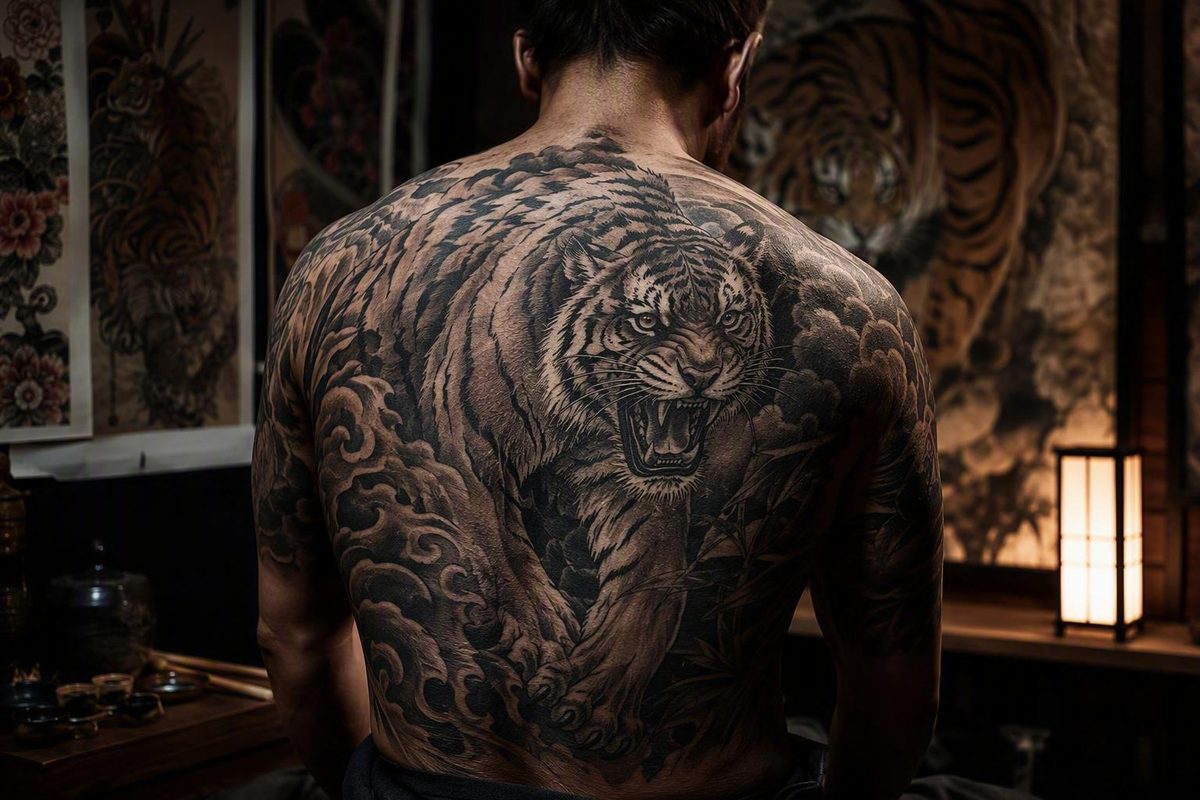
In the limited source set available here, two commercial guides associate the tiger with courage and protection. “Protection” should be understood as an attributed symbolic or personal quality—not evidence that the tattoo can prevent physical harm, disease, misfortune, or supernatural threats.
One retailer also associates the motif with strength, resilience, independence, and emotional control. Those interpretations belong to that publisher; they do not establish what every Japanese-style tiger means.
The short answer: courage and protection are the most consistent readings in these two guides
The narrow, source-checked answer is that the two commercial guides reviewed for this article both connect the tiger with courage and protection. The 71studio guide lists those two qualities in its table of classical Japanese motifs. Wabisabi Mart also names courage and protection, then adds strength, resilience, independence, and emotional control.
That agreement is useful for a design consultation, but it is not evidence of an industry-wide consensus or a fixed meaning across Japanese tattoo history. Neither source provides scholarly citations, named cultural experts, or a documented chain from particular Japanese artworks or texts to its symbolism claims. Both also have commercial interests: one promotes a tattoo studio, while the other sells Japanese masks.
A wearer might intend a tiger to represent courage during a difficult period, a protective role within a family, resilience after hardship, or emotional discipline. Another may choose it for its movement, expression, or place within a Japanese-style composition. In each case, the intended message comes from the design process rather than an automatic translation attached to the animal.
Treat courage and protection as two interpretations reported by the available guides—not as promises about what every viewer will see or what the image can literally do.
A motif-by-motif meaning table
The table below audits what the two commercial sources claim. “Reported by both” means only that both guides make the association; it is not a confidence score or proof of a historical convention. The more detailed combinations and the Byakko identification come from Wabisabi Mart.
| Composition | Attributed interpretation | Source | Evidence status |
|---|---|---|---|
| Tiger alone | Courage and protection; Wabisabi Mart also adds strength, resilience, independence, and emotional control | 71studio and Wabisabi Mart | Reported by both for courage and protection; added qualities reported only by Wabisabi Mart |
| Tiger and dragon | Balance between grounded power and heavenly wisdom | Wabisabi Mart | Retailer-attributed interpretation |
| Tiger and bamboo | Resilience, flexibility, or strength through adversity | Wabisabi Mart | Retailer-attributed interpretation |
| Tiger and wind | Force, movement, change, or command of natural energy | Wabisabi Mart | Retailer-attributed interpretation |
| Tiger and peonies | Contrast or balance between ferocity and beauty | Wabisabi Mart | Retailer-attributed interpretation |
| Byakko | A celestial guardian associated with the west | Wabisabi Mart | Specific identification from one retailer; insufficient for a broader history |
Use these combinations as possible design narratives, not as a codebook. Surrounding imagery may affect emphasis, atmosphere, and the story that the wearer and artist construct, but the available evidence does not establish compulsory meanings for any pairing.
Byakko also needs to be distinguished from a generic white tiger. If that specific identity is intended, ask the artist which references inform the design and how the composition will communicate it. White fur by itself may simply be a color choice.
For every proposed meaning, ask what supports it: a traceable artwork or text, a convention followed by a particular studio or practitioner, a modern commercial interpretation, or the artist’s personal storytelling. These can all inspire a tattoo, but they do not carry equal historical weight.
Traditional and neo-Japanese tigers can frame the motif differently
In one Barcelona studio’s framework, traditional Japanese compositions are anatomy-led, often large, and unified by integrated backgrounds. The studio describes neo-Japanese or modern Japanese work as allowing more flexibility in size, palette, illustrative linework, and stylistic mixing.
This is 71studio’s commercial framework, not an industry-wide taxonomy. It is still a useful way to turn a vague style preference into specific consultation questions.
| Design factor | Traditional, in 71studio’s framework | Neo-Japanese, in 71studio’s framework |
|---|---|---|
| Composition | Designed with the body as a unified composition | May be more standalone or illustration-led |
| Scale | Often large-scale | More adaptable to smaller areas |
| Linework | Follows a more established visual structure | May be more illustrative or experimental |
| Palette | More restricted | May use a broader range of colors |
| Background | Integrates elements such as clouds or waves | May simplify, reinterpret, or omit the background |
These choices affect how the tiger occupies the body. A large piece with an integrated background creates a different rhythm and visual hierarchy from a compact tiger rendered with bright color and illustrative detail. Scale also determines how much room the artist has for the face, paws, stripes, scenery, and open skin.
Within the studio’s framework, the distinction concerns technique, palette, composition, scale, and treatment of motifs. Whether the tiger is meant to communicate courage, protection, resilience, or something personal still has to be established between wearer and artist.
Use the label that best matches the artist’s own practice, then ask what that label means in concrete design terms. The artist’s portfolio and explanation are more useful than assuming everyone applies the same terminology.
Pose, direction, color, and placement do not have proven fixed meanings here
The supplied sources do not establish standard meanings for an attacking, resting, ascending, descending, or backward-looking tiger. They also do not substantiate fixed symbolic rules for direction, color, scale, or placement on the back, shoulder, arm, chest, or leg.
Those choices matter visually. An open mouth and extended claws can make a design appear more confrontational. A low, curved body can create tension, while the tiger’s direction can lead the eye through a limb or across the torso. A larger area gives the artist more room to integrate background elements and preserve detail. Placement also changes visibility and the relationship between the drawing and the wearer’s anatomy.
These are design effects, not proof of inherited cultural meanings. The available evidence therefore cannot support rules such as “a descending tiger means controlled aggression” or “a shoulder tiger symbolizes protection.” If an artist proposes a specific meaning for a pose or placement, ask whether it comes from an identifiable artwork, text, practitioner convention, or personal interpretation.
The same boundary applies to stronger claims about what the image can do. The retailer discusses spiritual threats, disease, Zen, samurai masculinity, and a bamboo narrative, but it does not provide the independent documentation needed to present those ideas as established Japanese tattoo history. A symbolic intention of protection should not be turned into a claim that the tattoo prevents illness, injury, bad luck, or supernatural harm.
Treat Japanese writing as a separate design decision
The tiger image and any accompanying Japanese text require separate checks. A fluent reader might understand the writing while interpreting the tiger differently from the wearer. Conversely, the tiger’s intended symbolism may be clear while the text is awkward, ambiguous, or incorrect.
Japanese writing does not map letter by letter onto English. A font that substitutes a character for each English letter cannot reliably form Japanese words or sentences.
A 2012 Sociological Images commentary reproduces examples attributed to the Hanzi Smatter blog in which intended tattoo meanings reportedly differed from the resulting text. The commentary did not independently document those examples, but it identifies a practical problem: unfamiliar writing should not be assembled through visual guesswork or letter-by-letter substitution.
Before the stencil is finalized, have the exact wording reviewed by a qualified, fluent Japanese reader who can assess:
- literal meaning;
- grammar and natural phrasing;
- formal, literary, archaic, or casual register;
- unintended alternative readings;
- whether the wording works in its intended context.
Japanese and Chinese are distinct languages.
The Sociological Images commentary also characterizes culturally disconnected kanji tattoos as cultural appropriation. That is the commentary’s perspective, not evidence of a current consensus about Japanese tiger tattoos or every non-Japanese wearer. Its practical question remains worth asking: is the writing being used with informed intent, or merely as decoration that neither the wearer nor artist can verify?
Questions to settle with your tattoo artist
A strong consultation should define the design’s intended message before assigning symbolic weight to individual details. Bring references, but ask where each interpretation comes from.
- What should the tiger communicate? Courage, symbolic protection, resilience, composure, ferocity, independence, or a personal experience?
- Which visual approach guides the piece? Traditional irezumi, neo-Japanese work, broadly Japanese-inspired illustration, or the artist’s own approach?
- What will the pose and expression contribute? Discuss mood, movement, and focus rather than assuming a prescribed meaning.
- What role will the background play? Ask how clouds, waves, wind, bamboo, flowers, or open skin will organize the composition and support its intended story.
- Why are the companion motifs included? Is their interpretation grounded in a traceable artwork, text, practitioner convention, modern commercial guide, or personal invention?
- Is a white tiger meant to be Byakko? If so, ask which references make that identity specific. If not, establish that white is a visual choice.
- How will the design follow the body? The spine, shoulder, elbow, and other contours can influence direction, scale, movement, and readability.
- Is the proposed area large enough? Confirm that the scale can support the intended face, paws, stripes, background, and companion motifs.
- What does the artist mean by “traditional” or “neo-Japanese”? Ask for relevant healed examples and an explanation of the design principles being used.
- Has every written element been independently checked? Obtain review from a qualified, fluent reader before approving the final stencil.
The usable answer is deliberately narrow: the two commercial guides examined here both associate a Japanese tiger tattoo with courage and protection, while one adds strength, resilience, independence, and emotional control. That is evidence of what those publishers report—not a universal translation of the motif. Define your intended message, identify the visual approach, verify companion imagery and writing, and ask the artist which decisions follow a documented convention and which are personal interpretation.