
Read a Dragon Tattoo Through Tradition, Pose and Pairings
Learn how Chinese, Japanese, European, Welsh and zodiac dragon designs convey power, rain, protection, danger, heritage and personal identity.
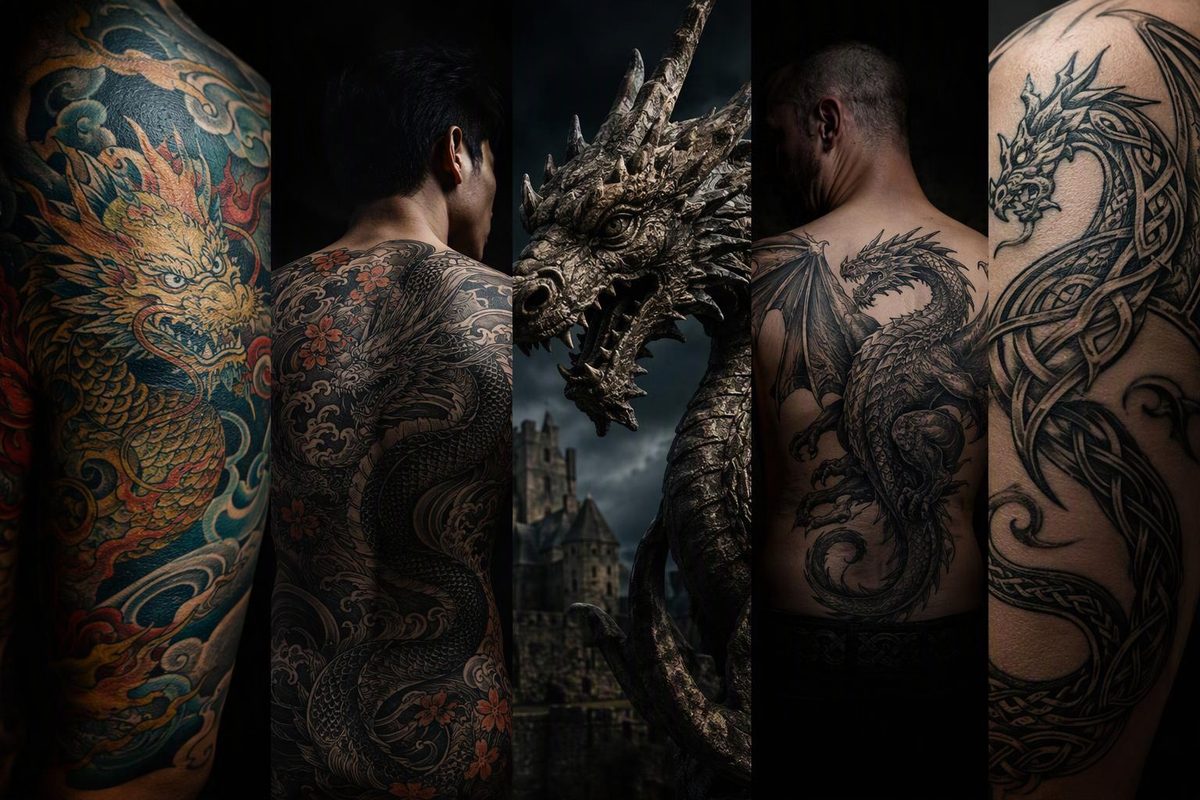
Power is a common dragon tattoo meaning, but it is only a starting point. Depending on the tradition and composition, a dragon may represent water, authority, wisdom, protection, danger, rebellion, heritage or an obstacle overcome. Religion, family identity and fandom can matter more than any general symbol list.
The first question is not what color the dragon is, but which dragon tradition the design draws from. A serpentine dragon among clouds and waves carries different associations from a winged creature facing a knight.
Choose the tradition and visible details; the reader shows the best-supported interpretation.
Dragon Tattoo Meaning Reader
Match the image to its tradition before interpreting individual details.
Power or personal significance
Without a clear tradition or narrative scene, the dragon can suggest power and visual presence while leaving its specific meaning to the wearer.
Why: No universal dragon definition applies across Chinese, Japanese, European and fantasy imagery.
Check next: Identify the artist’s visual source and ask what the wearer intended.
Source basis: National Museum of Asian Art, Metropolitan Museum of Art, Smithsonian Institution, Victoria and Albert Museum, and Museum Wales; interpretations remain context-dependent.
Meanings at a Glance
| Design context | Plausible reading |
|---|---|
| Chinese-style dragon | Water, rain, power, wisdom or imperial associations |
| Japanese-style dragon | Water, clouds, rain or cosmological force; protection in some religious compositions |
| European-style dragon | Danger, evil, ferocity, guardianship or an obstacle overcome |
| Welsh red dragon | Welsh identity, heritage and bravery |
| Chinese zodiac dragon | Birth-year identity, power, luck or creativity |
| Fantasy dragon | Independence, imagination, fandom or a personal story |
These are possible readings, not fixed definitions. The tradition, surrounding imagery and wearer’s intent determine what a particular tattoo communicates.
Chinese Dragons Suggest Water, Rain and Authority
In Chinese art, dragons have long been associated with water rather than only destruction. The Smithsonian’s National Museum of Asian Art explains that, by the Han dynasty, dragons were understood as divine rulers of moving water that could control weather and bring life-giving rain. The museum also identifies masculine power and imperial majesty among their associations. A Chinese-style dragon tattoo can therefore suggest natural force, authority or beneficial power (National Museum of Asian Art).
A dragon chasing or holding a flaming pearl adds another documented layer: the same museum identifies the pearl with wisdom and enlightenment. Clouds, waves and rain reinforce the dragon’s relationship with water and weather.
Imperial imagery requires precision. In one Qing court robe examined by the Metropolitan Museum of Art, five-clawed dragons indicate that its wearer belonged to the imperial family. The absence of the complete group of Twelve Symbols shows that the robe was not the emperor’s, however (Metropolitan Museum of Art). “Five claws always means the emperor” is therefore too blunt a rule for reading either historical clothing or a modern tattoo.
A zodiac dragon can be more personal. The Smithsonian describes the dragon as representing power, luck and creativity within the 12-animal Chinese zodiac cycle (Smithsonian Institution). A tattoo may mark the wearer’s birth year or a family connection rather than make a general claim about character.
Japanese Dragon Meanings Depend on the Complete Scene
Japanese dragon imagery has historical connections with Chinese cosmology, but the two should not be treated as interchangeable. The Met describes an 18th-century Japanese netsuke in which a dragon emerges from an alms bowl holding a jewel. It identifies the dragon as a Chinese-origin cosmological symbol associated with water, clouds and rain; in this particular work, it belongs to Handaka Sonja, one of Buddha’s disciples (Metropolitan Museum of Art).
That makes water, rain and cosmological or spiritual force well-supported readings for a Japanese-style dragon. Protection depends more heavily on the scene.
In one Japanese Buddhist painting, a dragon coils around a sword amid flames, clouds and thunderbolts. The National Museum of Asian Art explains that this form symbolizes Fudō Myōō, the fierce deity shown protecting Buddhism against its enemies (National Museum of Asian Art). Here, the dragon and sword form a specific religious image—not a generic code in which every dragon means protection.
If a tattoo combines a dragon with Japanese waves, clouds, flowers, a sword or another animal, ask the artist what visual source they are using and how its elements work together. The same caution applies when reading a Japanese tiger tattoo or a hannya mask: resemblance to a tradition does not establish a universal meaning.
European Dragons Represent Danger, Conflict or Guardianship
In stories from Christian Europe, the dragon commonly appears as an adversary. The Victoria and Albert Museum notes that dragons are typically symbols of evil in that tradition, and their defeat represents good overcoming evil. The museum also points to ancient Greek and Norse stories in which dragons guard valuable objects coveted by a hero (Victoria and Albert Museum).
A winged European-style dragon tattoo can consequently suggest danger, ferocity or rebellion. A knight slaying it shifts the focus toward victory over evil or adversity. A dragon guarding treasure, a home or another figure can instead frame its power as vigilance or defense. These are interpretations of the complete scene, not meanings established by the dragon alone.
The red dragon is a more specific heritage symbol. Museum Wales identifies it as the heraldic symbol on the Welsh national flag and records medieval Welsh poets comparing leaders to dragons while praising their bravery (Museum Wales). In that form, a tattoo may express Welsh identity as much as strength.
Pairings Change Which Meaning Comes Forward
There is no reliable universal code in which every upward-facing dragon means ambition or every red dragon means aggression. Read the relationships that are actually visible:
- Dragon with waves, clouds or rain: Water, weather, motion or natural force, especially in Chinese and Japanese compositions.
- Dragon with a flaming pearl: Wisdom or enlightenment in the Chinese art context documented above.
- Dragon entwined around a sword: Potentially a specific religious image, such as the Fudō Myōō composition, rather than a generic protection symbol.
- Dragon with a warrior: Conflict, conquest, heroism or a particular legend.
- Dragon guarding something: Vigilance, possession or protective strength.
- Dragon being slain: Evil or adversity defeated, with the wearer potentially identifying with the hero rather than the creature.
- Dragon alone: Power and visual presence, leaving more of the meaning to the wearer’s story.
Color can shape mood and contrast, but it does not create a universal meaning by itself. Before committing to a design, identify the tradition and the trait or story you want the tattoo to carry. Give the artist references from that tradition rather than mixing culturally or religiously specific details by accident. For a broader starting point, browse tattoo ideas by meaning, style and placement.