
What a Skull and Rose Can Say About Love, Loss, and Life
It commonly contrasts mortality with love, beauty, life or renewal, but the final meaning depends on the wearer's story and how the design is composed.
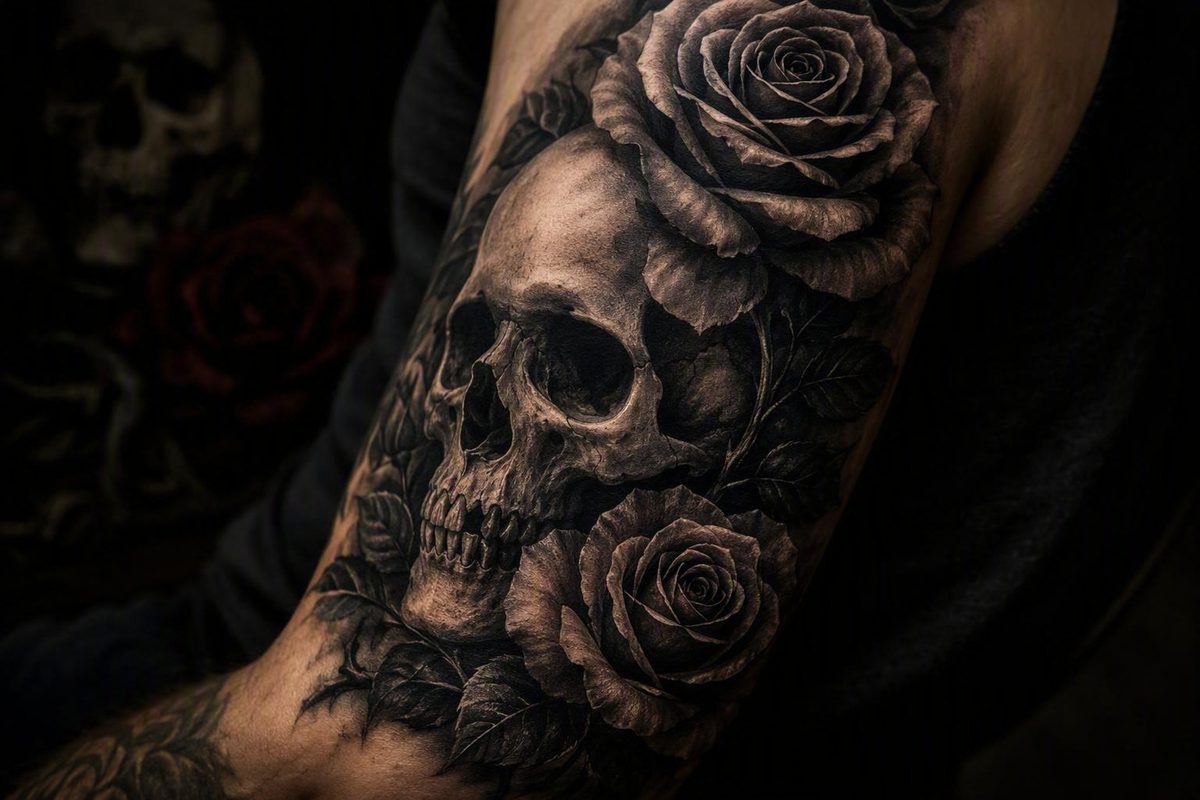
The short answer: what does a skull and rose tattoo mean?
A skull-and-rose tattoo is commonly interpreted as a meeting of opposites: mortality and life, decay and beauty, or loss and love. The skull acknowledges impermanence and death; the rose introduces affection, vitality, remembrance, tenderness, or renewal. Together, they can suggest that beauty and connection remain meaningful even though life does not last forever.
The design can hold darkness and hope at the same time. One wearer might use it to mourn someone while celebrating the relationship that survives in memory. Another might see it as a record of hardship and recovery. For someone else, it may represent accepting mortality, loving despite uncertainty, or finding beauty during a difficult period.
Common personal readings include:
- Love enduring through loss
- Remembrance of a person or period of life
- Resilience after hardship
- The end of one phase and the beginning of another
- Acceptance of mortality and impermanence
- Beauty, hope, or tenderness preserved in dark circumstances
- Defiance in the face of fear or adversity
These are recurring interpretations found in a limited sample of contemporary commercial and tattoo-studio commentary—not a universal symbolic code or documented historical consensus. For example, Sullen Clothing’s discussion of rose-and-skull symbolism emphasizes contrast, balance, and personal interpretation.
That limitation matters. An observer may read the skull as death and the rose as romance, but the wearer may be thinking about recovery, the end of a relationship, a changed identity, a deceased relative, or no specific event at all. Some people choose the pairing for its visual tension and leave its meaning deliberately open.
The clearest answer to “What is the skull and rose tattoo meaning?” is therefore two-part: it commonly contrasts mortality with love, beauty, life, or renewal, but its final meaning depends on the wearer’s story and the way the design is composed.
What the skull and rose can symbolize separately
Understanding each motif separately helps explain why the combination feels layered. Neither image has only one possible meaning, and neither should be reduced to its most familiar stereotype.
A skull can represent:
- Mortality or awareness of death
- The temporary nature of life
- Acceptance of what cannot be avoided
- Survival and resilience
- Personal transformation
- Defiance, independence, or rebellion
A skull is not automatically an emblem of evil, danger, or destructive intent. It can be contemplative rather than threatening. A neutral presentation may support reflection on impermanence, while an aggressive treatment may make the same basic image feel rebellious or ominous. Those impressions come from the complete design, not from a standardized rule attached to every skull.
A rose can represent:
- Love or devotion
- Passion and attraction
- Beauty
- Remembrance
- Growth and renewal
- Tenderness
- The fleeting nature of life
A rose is not limited to romantic love. A wearer can define it as affection for a relative, friend, partner, or another personally significant relationship. In a memorial design, it may support a reading of love and remembrance. In a recovery design, it may stand for retained hope or renewed growth. It can also serve a primarily visual purpose by softening or contrasting with the skull.
Once paired, the motifs affect how each is read. Mortality can make love feel urgent: the skull reminds the viewer that time is limited, while the rose suggests that affection, beauty, and connection remain worth pursuing. Conversely, the rose can make the skull feel less severe by adding tenderness, memory, or renewal.
The combination can preserve conflict instead of resolving it. Chronic Ink’s overview of skull tattoo meanings presents beauty versus ugliness and good versus evil as possible readings of the pairing. Those are interpretations from one tattoo-studio source, not essential meanings of every skull-and-rose tattoo. Other designs may emphasize balance, coexistence, or acceptance instead.
This is why symbolic lookup charts have limited value. A skull engulfing a damaged rose may create an impression of destruction, while healthy roses surrounding a skull may feel more balanced. The symbols provide a vocabulary, but the wearer and artist decide what sentence they form.
Six ways wearers may interpret the pairing
A skull and rose can support several stories without possessing a single fixed definition. The following interpretations are starting points for a design conversation rather than rules for decoding someone else’s tattoo.
1. Memorial and remembrance
In a memorial tattoo, the skull may acknowledge death while the rose represents affection, remembrance, or the continuing importance of the person being honored. The combination can communicate grief without making grief the entire story. It may say, in effect, “This person is gone, but the love remains.”
A memorial intention becomes clearer when the design includes personally significant information. A name, initials, handwriting, short phrase, date, flower, or object associated with the person can distinguish a tribute from a general meditation on mortality.
Without those details, the same image may remain ambiguous. Viewers cannot reliably conclude that its wearer is mourning someone merely because the tattoo contains a skull and rose.
Bounded design scenario: A rose crossing the skull beside a relative’s handwritten initials may function as an explicit memorial. Without the initials, the same arrangement might instead express acceptance of mortality or simply appeal to the wearer aesthetically.
2. Love that endures through mortality or hardship
The pairing can represent love tested by time, separation, conflict, hardship, or death. Here, the skull gives love a finite or difficult setting, while the rose asserts that attachment remains important within it.
This does not have to be a symbol of tragic romance. It could recognize a long relationship that survived adversity, devotion to someone who is absent, or the decision to remain emotionally open after a painful experience. If two roses represent two people, that meaning comes from the wearer rather than from an automatic numerical code.
Bounded design scenario: A rose wrapping around the skull rather than being damaged beneath it may visually suggest affection remaining close to mortality or hardship. That is a compositional reading, not a universal rule.
3. Resilience after a difficult experience
A living flower beside a skull can suggest that hardship did not eliminate the wearer’s capacity for hope, tenderness, or growth. In this reading, the skull may represent a painful period or profound change, while the rose represents what survived or developed afterward.
Resilience does not require the wearer to portray suffering as beneficial, nor does it mean recovery is complete. A tattoo can honor survival while leaving the difficult experience visible. The design works precisely because damage and beauty can occupy the same image without one canceling the other.
Bounded design scenario: A fractured skull with a healthy bloom emerging nearby may support a story of survival without concealing the break. Reversing the condition of the two elements could produce a very different emotional emphasis.
4. Transformation and transition
Because the skull can suggest an ending and the rose can suggest growth or renewal, the combination may mark a transition between phases of life. The “death” can be metaphorical: the end of a relationship, identity, belief, career, habit, or period of life.
Transformation is not always triumphant. A person may grieve what ended while still welcoming what follows. A skull-and-rose tattoo can preserve both sides of that transition rather than reducing it to a simple victory story.
Bounded design scenario: A rose growing through an opening in the bone can depict new life emerging from an ending. The wearer should define what that growth represents rather than relying on an assumed meaning for the flower’s precise stage or shape.
5. Acceptance of mortality
For some wearers, the image is contemplative: death is inevitable, so life, love, and beauty should be appreciated while they are present. The skull does not necessarily threaten; it reminds. The rose does not defeat death; it expresses the value of temporary life.
That reading can feel peaceful, solemn, or confrontational depending on the visual treatment. A balanced arrangement may support acceptance, while dramatic shadows and forceful angles may create a harsher encounter with mortality.
Bounded design scenario: A frontal skull surrounded evenly by open roses may create an impression of equilibrium between life and death. It does not automatically identify the wearer with a particular philosophy or religious belief.
6. Rebellion and defiance
Skulls can carry associations of rebellion, independence, and willingness to confront uncomfortable subjects. In that context, a rose can add passion, elegance, or visual contrast. The tattoo may express refusal to be intimidated by mortality, social expectations, or a difficult past.
Rebellion is only one possible association. A skull does not make every wearer dangerous or anti-authoritarian, and the rose does not impose a romantic meaning.
Bounded design scenario: A dramatically angled skull with heavy contrast and forceful floral movement may feel defiant. A symmetrical skull resting among softer flowers may use the same motifs for remembrance or acceptance.
These six readings can overlap. A memorial may also concern enduring love and transformation; a resilience design may contain grief; an acceptance-of-mortality tattoo may retain a rebellious edge. The pairing is useful when the wearer wants those feelings to remain connected.
How composition changes the story
The physical relationship between the skull and rose often supplies more narrative information than either motif considered alone. Composition determines which element appears primary, whether the motifs coexist or conflict, and whether one seems to emerge from, cover, or restrain the other.
Roses blooming around a skull
Roses surrounding a skull can suggest coexistence between life and death, beauty and mortality, or tenderness and hardship. An even arrangement may feel balanced or ceremonial. A looser arrangement can make the flowers appear to continue growing around what has ended.
A few blooms with ample open space may create a reflective composition. Dense flowers covering much of the bone can make love, life, or remembrance appear more prominent.
A rose growing through bone
A stem or flower emerging through a crack, eye socket, or opening in the skull can suggest renewal, survival, or life continuing after loss. Unlike a simple side-by-side arrangement, this composition creates an action: something living appears to pass through what looks lifeless.
That action does not impose one definition. The flower could be wearer-defined as a person, memory, identity, or form of growth. It might also be intended as a purely visual connection between the two motifs.
When the skull dominates
A large, detailed skull paired with smaller or partially hidden roses may foreground mortality, severity, darkness, or confrontation. The skull appears primary because it carries more visual weight, not because size creates a fixed symbolic meaning.
A dominant skull can still belong to a loving memorial. Its scale may reflect the importance of mortality to the concept, or it may simply suit the chosen area and artistic approach.
When the rose dominates
Large blooms that cover, frame, or soften a smaller skull may bring love, memory, vitality, or renewal forward. The skull then works as an undertone—a reminder that the beauty being celebrated is temporary or connected to loss.
A rose covering the skull’s eyes could appear peaceful, protective, concealing, or unsettling. The wearer’s intention and the rest of the composition determine which reading is most relevant.
The skull’s condition and presentation
An intact skull can feel calm, neutral, or contemplative. Damage, obstruction, dramatic angles, deep shadows, or exaggerated features can make it feel more severe, distressed, private, or ominous. These are possible visual impressions, not established symbolic definitions.
Instead of asking what a damaged skull “always means,” ask what the treatment should contribute to this particular design. Should it communicate an ordeal, create tension, or simply add texture and movement?
Additional details can make the intended story more legible. Text, dates, secondary flowers, background shapes, or personal objects may help distinguish a memorial from a general reflection on mortality. Define the story first, then give each detail a clear visual or personal purpose.
Color and flower details: context matters more than a lookup chart
Color and floral details can affect how a skull-and-rose tattoo is interpreted, but the available evidence does not establish consistent meanings for individual rose colors across cultures, periods, and wearers. A chart claiming that red always means one thing, white another, and black something else creates more certainty than the evidence supports.
A better approach is to make color part of the wearer’s own story. Someone might choose:
- A color associated with a person, place, or memory
- A shade connected to a meaningful object or event
- A muted palette for a restrained mood
- Strong contrast to separate the flower visually from the skull
- Similar tones to make the motifs feel unified
- No color, allowing line, shading, and composition to carry the emotion
Color can also establish visual emphasis. A vivid rose beside a neutral skull may make the flower appear primary. A closely related palette across both motifs may make the design feel more integrated. These are compositional tendencies, not inherited meanings.
The flower’s condition can be approached in the same way. A bud, open bloom, wilted flower, or thorny stem can create different shapes and emotional impressions, but those details should be discussed with the artist rather than treated as universal symbolism. A wearer may define a wilted flower as loss, use a bud to suggest something unfinished, or choose thorns simply because they strengthen the silhouette.
Before selecting those details, write down the intended emotion in plain language. Is the tattoo primarily about remembrance, devotion, recovery, danger, acceptance, anger, or ambiguity? Evaluate each choice against that purpose.
This approach also prevents symbolic clutter. If every petal, thorn, crack, numeral, and background object must carry a separate coded message, the composition can become difficult to read. One strong relationship between the skull and flower may communicate more effectively than a collection of disconnected additions.
Style changes the mood, not necessarily the core meaning
A memorial, romantic, resilience, or transformation concept can be expressed in several styles; what changes is how bold, delicate, solemn, graphic, decorative, or ominous it feels.
American traditional
Those features can make a skull and rose feel direct, iconic, and visually assertive.
The style does not automatically make the tattoo rebellious or assign a special historical meaning to the pairing. It provides a graphic language that can serve memorial, romantic, or purely aesthetic concepts. For more on its broader visual conventions, see our guide to American traditional tattoo style.
Black-and-grey realism
Black-and-grey realism can create a detailed, serious, or solemn presentation.
That mood can suit remembrance or contemplation, but realism is not inherently mournful. Lighting and composition can also make it dramatic, serene, romantic, or unsettling. Solemnity is a tonal possibility, not a symbolic definition.
Neo-traditional
It may make the pairing feel lush, theatrical, ornate, or intense.
This approach can be useful when the rose needs enough visual weight to compete with the skull or when additional ornamental elements must fit within a strong overall silhouette.
Fine-line and minimalist
Fine-line treatments can make the imagery feel restrained, delicate, intimate, or illustrative. A minimalist version might reduce the concept to a skull contour and a single stem, leaving more room for ambiguity.
Visual restraint does not mean limited personal significance. Simplification should be deliberate and discussed with the artist.
Gothic and dark-art
Gothic or dark-art treatments can foreground ominous, macabre, dramatic, or uncanny qualities. Deep shadows, distorted forms, damaged flowers, or dense ornament may make mortality the dominant mood.
That approach can still express love or remembrance. Darkness and affection are not mutually exclusive, particularly when the concept concerns grief, difficult devotion, or survival.
Watercolor and geometric approaches
Neither approach carries an automatic meaning. Watercolor does not guarantee hopefulness, and geometry does not inherently symbolize balance. Their usefulness depends on whether the visual language supports the intended emotion.
A tattoo-studio overview lists American traditional, black-and-grey realism, neo-traditional, minimalist, gothic, and dark-art possibilities, describing traditional work through bold outlines and solid color. Tales of Inkspiration’s skull-and-rose style overview also recommends choosing an artist with relevant experience and discussing the concept in consultation.
When evaluating artists, look for portfolio examples in the style you want and evidence that the artist can combine flowers with anatomical forms. Bring the intended story to the consultation, not merely a finished image to reproduce. An artist can translate ideas such as “quiet remembrance,” “survival without sentimentality,” or “love in the face of mortality” into scale, movement, contrast, line, and negative space.
Placement affects presentation—not a universal symbolic meaning
The supplied evidence does not establish a code in which a skull-and-rose tattoo on the chest means one thing while the same design on the forearm means another. Commercial tattoo sources list the arm or forearm, chest, back, thigh, and leg as possible placements; these are practical options, not fixed symbolic categories. American Skulls’ placement and style overview includes the arm, back, chest, and leg.
Treat placement as a storytelling and design decision involving five questions:
-
How much space does the composition need? A skull, several roses, stems, leaves, text, and background elements need sufficient room to remain visually distinct.
-
How visible should the tattoo be? A forearm tattoo may be easier to display, while a torso or thigh piece may feel more private. That public-versus-private distinction can matter personally, but it is not a universal meaning attached to the body part.
-
Which element should appear primary? Placement affects orientation and viewing distance. A longer area may accommodate a stem passing through the skull, while a broader area may suit flowers arranged around it.
-
How should the image relate to the body? The skull, stems, and blooms need to work with the contours of the selected area.
-
How much detail is essential? If inscriptions, multiple flowers, or subtle damage are central to the concept, ask whether the selected scale provides enough room. If the meaning rests mainly on the interaction between one skull and one rose, a simpler treatment may be more coherent.
Individual anatomy and the artist’s composition determine what works in practice.
Avoid asking an artist to shrink an elaborate reference image without changing it. Decide what is indispensable and allow the composition to be adapted to the body. Removing secondary symbols can make the central relationship between mortality and life clearer rather than less meaningful.
Turn a general symbol into a personal tattoo concept
The most useful way to personalize a skull and rose is to begin with the experience rather than the decoration. Before collecting references, complete this sentence:
This tattoo is about ____.
The answer might be a person, relationship, loss, recovery, transition, belief, or period of life. It could also be “my acceptance that life is temporary” or “the coexistence of beauty and darkness.” If the design is mainly aesthetic, say so. Personal meaning does not need an invented symbolic history.
Next, choose the primary idea:
- Memorial
- Enduring love
- Resilience
- Transformation
- Rebellion
- Acceptance
- Deliberate ambiguity
Secondary ideas can remain, but selecting a primary one gives the artist a clear hierarchy. A tattoo trying to communicate many unrelated messages with equal force can become visually confused.
Then answer four design questions:
-
Which element should dominate? A larger skull may foreground mortality, hardship, or confrontation. Larger roses may foreground devotion, memory, vitality, or renewal. Equal visual weight may support balance.
-
How should the motifs interact? Roses can surround, cover, cross, emerge from, or sit apart from the skull. Each arrangement creates a different visual action.
-
What should the tattoo feel like? Choose emotional language before style labels: quiet, severe, affectionate, defiant, elegant, raw, mournful, hopeful, or ambiguous.
-
How public should it be? Decide whether the tattoo should invite questions, function as a private reminder, or shift between visibility and concealment.
Bring references for separate purposes rather than presenting one tattoo to duplicate. One image might demonstrate mood, another skull anatomy, another floral movement, and another technique. Explain what works in each reference, then ask for an original composition suited to your body and story.
Review portfolios for the selected style and subject matter. An artist may be experienced with fine-line flowers but less familiar with realistic bone, or skilled at dark-art skulls without matching the restrained memorial tone you want. Use the consultation to discuss intent, composition, placement, scale, and technical feasibility.
Keep cultural labels precise as well. The available commercial evidence is not authoritative enough to classify generic skull-and-rose imagery as a sugar skull, calavera, or Día de los Muertos design. Flowers and decoration alone do not provide sufficient evidence for that classification. If the concept is intended to reference a specific tradition, do not assume a general skull-and-rose article can establish the appropriate terminology or cultural context.
A strong concept brief might read:
I want this tattoo to mark the end of a difficult period without pretending the experience was beautiful. The skull should remain visibly damaged, but one rose should grow through it. I want the mood to feel calm rather than triumphant, with the flower slightly more prominent than the bone. I prefer a restrained black-and-grey treatment and a placement that can usually remain private.
That gives an artist more useful direction than “I want a skull and rose because it means life and death.” It defines the emotional purpose while leaving room for original visual problem-solving.
Frequently asked questions
Does a skull and rose tattoo always mean death or grief?
No. Mortality and loss are common associations, but the pairing can also represent love, resilience, transformation, acceptance, beauty amid hardship, or deliberate contrast. Some people choose it primarily for its appearance.
Even when death is part of the imagery, grief may not be the central emotion. The tattoo could be about cherishing life, confronting fear, recognizing impermanence, or expressing defiance. The wearer’s explanation is more reliable than an observer’s assumption.
Can a skull and rose tattoo memorialize a deceased loved one?
Yes. The skull can acknowledge death while the rose expresses love, remembrance, or the continuing importance of the relationship. Personally significant wording, dates, handwriting, or objects can make that intention more explicit.
The imagery alone does not prove that a tattoo is a memorial. An uncaptioned skull and rose may be intentionally ambiguous or represent a different experience.
What does a rose growing through a skull mean?
It may suggest renewal, survival, growth after loss, or life emerging from a difficult ending. The action of the rose passing through bone creates a stronger visual narrative of continuation than simply placing the two motifs side by side.
That interpretation is not compulsory. The rose could represent a particular person, memory, identity, or wearer-defined force that persists.
Is every decorated skull-and-rose tattoo connected to Día de los Muertos?
No such connection can be assumed from decoration or flowers alone. The available commercial tattoo commentary does not provide enough cultural authority to classify every decorated skull as a sugar skull, calavera, or Día de los Muertos image.
If a design is intentionally connected to a particular tradition, research that tradition through appropriate culturally informed sources and communicate the intention clearly to the artist. Avoid treating culturally specific terms as generic labels for any colorful skull.
Which tattoo styles work with a skull-and-rose design?
Possible approaches include American traditional, black-and-grey realism, neo-traditional, fine-line, minimalist, gothic or dark-art, watercolor, and geometric treatments. Each can alter the mood and visual emphasis without imposing a fixed symbolic meaning.
Choose the style according to the emotion you want the tattoo to convey, then find an artist whose portfolio demonstrates experience with that approach. The same story of remembrance, love, resilience, or transformation can appear solemn in realism, bold in traditional work, restrained in fine line, or ominous in dark art.
A skull and rose can hold mortality and vitality, grief and devotion, or hardship and renewal in the same image. Its final meaning does not come from a universal lookup chart. It comes from the wearer’s story and from how deliberately the skull, flower, composition, style, color, and placement express that story. Define the intended emotion first, then work with an artist to turn it into an original design.