
How History and Design Shape a Peony Tattoo’s Meaning
Peony tattoos can signify prosperity, honor and beauty. Learn how Japanese pairings, Victorian flower lore, color and other motifs shape the reading.
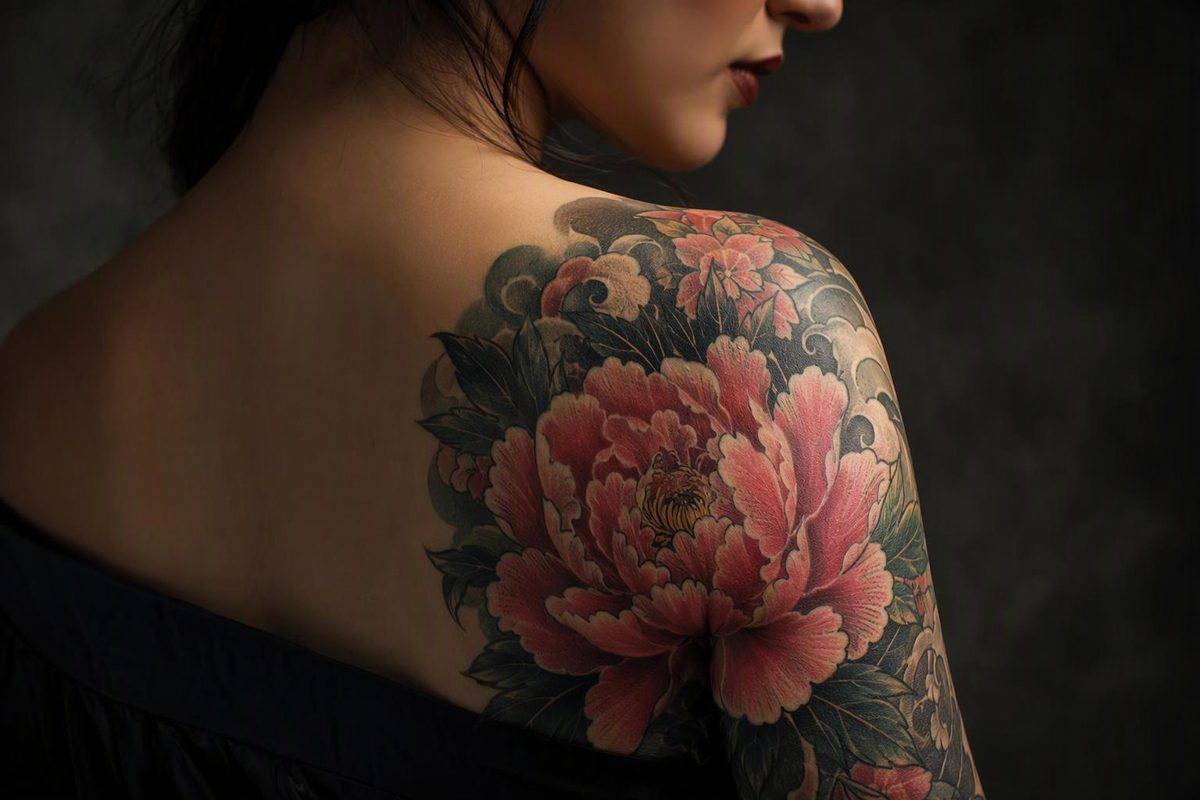
A peony tattoo most defensibly signifies prosperity, honor, status and flourishing beauty. That reading has roots in Chinese art, while Japanese art adds established compositions such as the peony with a guardian lion. Victorian flower language offers a contrasting meaning—bashfulness—but none of these traditions creates a universal tattoo code.
The meaning of a particular tattoo depends on which tradition the design invokes, how the flower is drawn and what appears beside it. A Japanese-style peony and lion does not communicate exactly the same idea as a botanical white peony, a Victorian-inspired flower or a peony wrapped around a skull.
Choose the tradition, companion motif and color treatment closest to your design.
Peony Meaning Finder
Likely reading
Prosperity, honor, status and flourishing beauty.
This is the broad reading with the strongest basis in the cited Chinese art records.
Treat it as a supported interpretation, not a universal tattoo translation.
Sources: Smithsonian National Museum of Asian Art, Kyoto National Museum, Columbia University Libraries, Metropolitan Museum of Art and Smithsonian Gardens. Color and non-lion companion readings are design interpretations, not fixed historical codes.
The Core Meaning Comes From Wealth, Rank and Beauty
A Chinese peony painting in the Smithsonian’s National Museum of Asian Art provides a clear historical basis for connecting the flower with prosperity and status. Its catalog record says the peony was prized at the Tang court and remained a symbol of “status and power.” It also acquired titles translated as “king of flowers” and “flower of wealth and rank” (Smithsonian National Museum of Asian Art).
The Kyoto National Museum likewise describes the peony as a Chinese flower traditionally associated with wealth and honor. It notes that peony paintings and decorative works were brought from China to Japan over many centuries (Kyoto National Museum).
Those records support four closely related ideas:
- Prosperity: abundance, success or the wish for a flourishing life.
- Honor: dignity, esteem or conduct the wearer values.
- Status and power: confidence, achievement or a visible sense of personal worth.
- Flourishing beauty: beauty presented as full, layered and abundant rather than delicate or fleeting.
Prosperity, honor and status have the clearest connection to the art-historical record. “A flourishing life,” romantic fulfillment and good fortune are reasonable personal extensions, but the museum records do not establish them as fixed tattoo definitions.
That distinction matters when explaining the tattoo. Saying that a peony can represent prosperity is supported. Saying that every peony tattoo has always had one precise meaning is not. The flower moved between cultures and art forms, and tattoo wearers continue to give it personal meanings.
Japanese Peonies Work Within a Larger Composition
The Japanese word for peony is botan. In Japanese-style tattooing, the flower is best interpreted as part of the full composition rather than as an isolated symbol. Its rounded petals and flowing outline can visually counterbalance forceful animals, rocks, wind or water.
This means placement and movement contribute to the reading. A peony may soften the visual weight of an animal, fill the transition between larger forms or reinforce the direction of a sleeve or back piece. Those are compositional functions, not separate dictionary definitions, but they affect what the finished tattoo communicates.
A stand-alone botan can still draw on the flower’s associations with wealth, honor and beauty. Once it is paired with another established image, however, the relationship between the motifs often becomes more informative than the flower alone.
The Guardian Lion And Peony Balance Power With Beauty
The most firmly documented Japanese pairing is the peony and Chinese-style guardian lion, known as karajishi-botan. Columbia University’s catalog for an Edo-period print says lions and peonies form a popular motif in Japanese art. The motif was imported from China, and its two elements balance power and beauty (Columbia University Libraries).
The pairing also appears outside prints. An 18th- or 19th-century Japanese sword guard at the Metropolitan Museum of Art depicts a shishi lion with a prominent peony. The museum connects the object to the Noh play Shakkyō, which includes a lion dancing among peonies (Metropolitan Museum of Art).
In a tattoo, karajishi-botan can therefore support readings such as strength balanced by beauty, power paired with elegance or ferocity tempered by grace. These are interpretations of a documented artistic relationship rather than arbitrary meanings assigned to two unrelated images.
Claims that every Japanese peony means “risk and reward” are less secure. A wearer may choose that phrase as a personal explanation, but the cited museum and library records do not establish it as a universal translation of the flower. The documented lion-and-peony relationship offers firmer ground: two contrasting qualities held in balance.
Victorian Flower Lore Gives the Peony a Different Meaning
Nineteenth-century Western flower language assigns the peony a notably different quality. A Smithsonian Gardens guide lists its meaning as “bashfulness” and cautions that floral meanings vary across cultures and change over time (Smithsonian Gardens).
Cornell University Library describes nineteenth-century flower dictionaries as a popular fashion. Their authors connected plants with classical mythology, folklore, heraldry, morality and horticultural information (Cornell University Library).
Bashfulness is therefore a historically grounded interpretation, but it belongs to a specific floriographic tradition. It does not override the Chinese associations with status and wealth, and it should not be applied automatically to Japanese-style work.
A Victorian-inspired peony tattoo might use bashfulness to express reserve, private affection or a contrast between outward beauty and inward shyness. The documented term is “bashfulness”; the more personal emotional readings come from how the wearer applies it.
This is a useful example of why a tattoo’s visual language matters. A design based on a nineteenth-century botanical plate points toward a different context from a large Japanese botan composed with wind, rocks and a guardian lion. Both depict the same flower, but they do not necessarily make the same statement.
Color Changes Emphasis, Not Historical Definition
Color affects the mood and visual emphasis of a peony, but online color charts often present those effects as though they were standardized translations. The museum records support broad associations with wealth, honor, status and power; they do not establish a universal tattoo meaning for every peony color.
Red or deep pink can make the flower feel rich, celebratory, romantic or forceful. Saturated color gives the bloom greater visual weight and can reinforce an abundant or confident reading.
Soft pink can emphasize tenderness and the layered structure of the petals. It may suit a design intended to feel gentle rather than imposing, although softness is a design interpretation rather than a fixed historical code.
White may suit a restrained, memorial or renewal-focused piece. Those meanings should come from the wearer’s stated purpose and the surrounding imagery, not from a claim that all white peonies universally mean remembrance or renewal.
Purple can reinforce a luxurious or regal impression, especially when the intended meaning already concerns status or splendor. It does not independently prove that interpretation.
Black and grey shifts attention away from flower color and toward contrast, movement, shading and form. It can express the same core ideas as a color peony; the absence of color does not remove the flower’s historical associations.
Color is therefore better treated as an adjective than a definition. It tells the viewer whether the peony feels restrained, tender, rich or forceful. The flower’s cultural context and companion images carry more interpretive weight.
Companion Images Can Redirect the Reading
A second motif may reinforce one part of the peony’s meaning or place its beauty in tension with another idea. Only the guardian-lion pairing in this list has the documented historical basis described above. The others are compositional readings rather than inherited definitions.
A Skull Sets Flourishing Life Against Mortality
A skull and peony can contrast abundant life with mortality or decay. The flower does not cancel the skull, and the skull does not turn the peony into a single coded message. Their tension creates the interpretation: beauty and flourishing exist beside the knowledge that life ends.
The balance can change according to visual emphasis. A dominant skull surrounded by smaller flowers may feel more mortality-focused, while a large open bloom overtaking the skull may place greater emphasis on life, growth or beauty.
A Snake Adds Danger Or Transformation
A snake and peony can place beauty in tension with danger or transformation. That reading comes from the complete composition, including the snake’s posture and its relationship to the flower.
A snake moving calmly through the petals will not necessarily communicate the same mood as one striking with an open mouth. It is more accurate to describe the intended relationship than to claim the pairing has one fixed traditional translation.
A Dagger Introduces Pain, Conflict Or Protection
A dagger and peony can suggest tenderness interrupted by pain, conflict or protection. The blade may cut through the flower, sit behind it or be partially concealed by the petals, and each arrangement changes the emphasis.
As with a dagger tattoo, the complete design matters more than a supposed directional code. The angle of the blade alone does not provide enough information to determine what the wearer means.
Names, Dates And Buds Make The Meaning Personal
A name or date can turn the peony toward devotion, remembrance or a personal milestone. In that case, the inscription usually supplies the specific subject while the flower contributes beauty, honor or flourishing.
An open flower shown with buds can become a personal image of maturity, potential or different life stages. These readings are visually coherent, but they are not fixed historical definitions of peony buds. Their meaning should be explained as part of the wearer’s story.
Style Determines Which Tradition Viewers Recognize
The same peony can communicate differently when rendered as a botanical study, a Japanese botan, an ornamental flower or an old-school tattoo. Style signals which visual tradition the wearer intends to reference.
A botanical treatment directs attention to the actual structure of the flower: layered petals, leaves, stems and stages of bloom. It can support a personal reading centered on beauty, growth or close observation without making a strong claim to Japanese or Victorian symbolism.
A Japanese-style treatment places more weight on movement and interaction with other elements. In that setting, the shape of the peony may balance an animal or help organize a larger composition. A guardian lion makes the documented power-and-beauty relationship especially relevant.
An ornamental treatment may prioritize symmetry, repetition and body placement. The peony’s associations remain available, but the tattoo may communicate primarily through decorative structure. Old-school work similarly filters the flower through a distinct drawing vocabulary rather than reproducing a Chinese painting or Victorian botanical illustration.
Before commissioning the piece, decide which of these visual languages best matches the intended meaning. Bring references for petal shape, scale, movement and overall composition instead of asking an artist to copy an existing tattoo. If the concept remains open, broader tattoo ideas can help compare the peony with other motifs by style, size and placement.
The Most Accurate Explanation Includes Context
A short explanation can begin with the broad historical reading: “My peony represents prosperity, honor and flourishing beauty.” If the design uses a guardian lion, it is reasonable to add that the pairing balances power with beauty. If it deliberately draws on Victorian flower lore, bashfulness is the relevant documented term.
Personal interpretations should be stated as personal. A white memorial peony may represent renewal or remembrance to its wearer, but that does not make remembrance the universal historical meaning of every white peony. A skull may create a meditation on life and mortality without establishing an inherited peony-and-skull code.
The most defensible summary is therefore specific but not absolute: a peony tattoo can represent prosperity, honor, status and flourishing beauty; in a Japanese guardian-lion composition, it can balance elegance with power; in Victorian flower lore, it signifies bashfulness.