
Reading Shark Tattoos Without Losing Their Personal Or Cultural Context
Explore shark tattoo meanings through pose, teeth, ocean imagery and Hawaiian context, with a guide to separating personal symbolism from cultural claims.
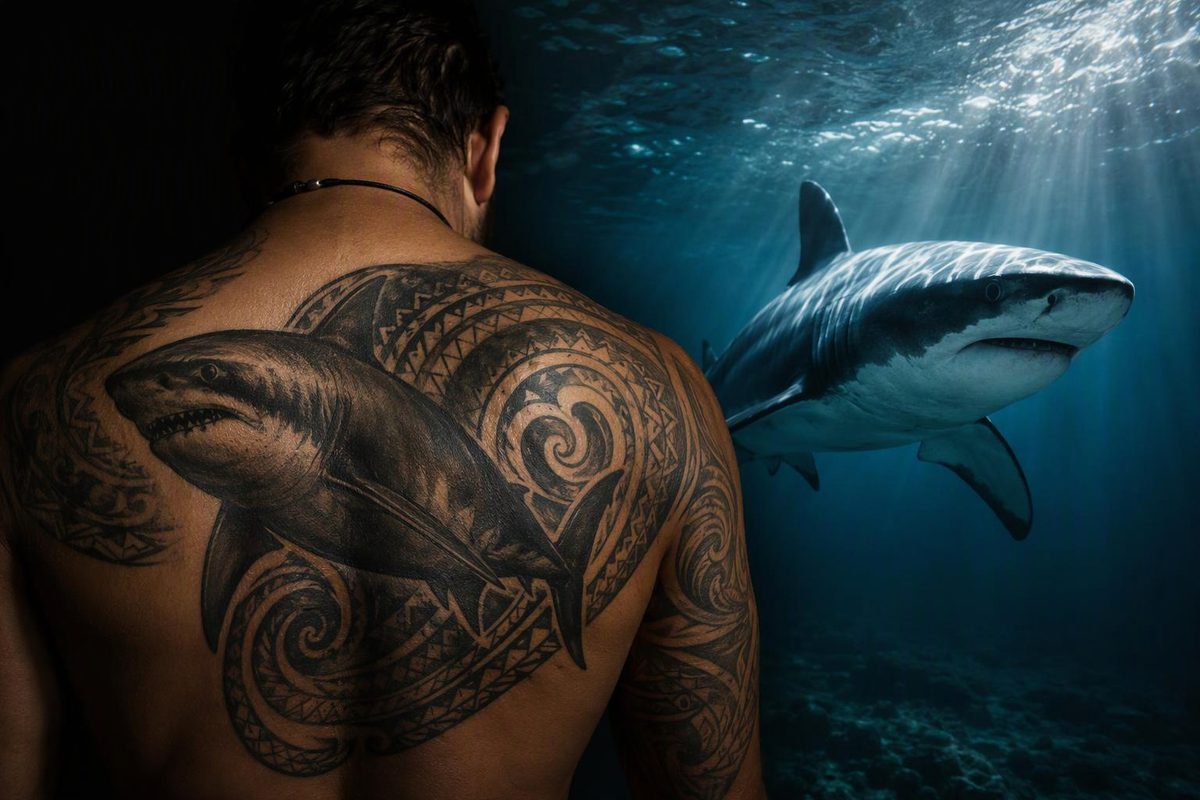
A shark tattoo can mean strength, fearlessness, resilience or protection, or simply a love of the ocean and the animal. Tattooer Chris Toms associates traditional shark designs with power, adaptability and confronting challenges. These are contemporary artist interpretations, not a fixed code that reveals the wearer’s story. (Chris Toms’s shark symbolism guide)
The main distinction is between a picture of a shark and a culturally specific shark motif. An open-jawed shark, a quiet swimming silhouette and a Hawaiian shark-tooth pattern need not communicate the same thing. Pose and surrounding imagery offer clues; the wearer’s explanation and the design’s cultural context carry more weight.
Choose your intended meaning, pose and motif context to see what the design may communicate.
Match The Design To Your Meaning
Ocean Connection: A Compatible Direction
A calm swimming shark can suggest affinity with the sea without making aggression the main subject.
Tell the artist that the ocean connection matters more than a threatening expression.
Limit: Pose suggests a possible reading; it does not establish the wearer's story or a historical meaning.
Sources: Chris Toms’s symbolism guide; Hawaiʻi DLNR and Herb Kawainui Kāne; Naval History and Heritage Command. Design matches are editorial interpretations, not a universal symbol code.
Strength And Fearlessness Are Readings, Not A Universal Code
A shark’s intimidating appearance can make it a useful image for strength or fearlessness. A wearer might choose it to express confronting a challenge, defending a boundary or refusing to be intimidated. Those are possible personal meanings, not facts you can establish by looking at someone’s skin.
There is also a difference between the message a wearer intends and the impression a design creates. Someone may choose a shark to represent resilience, while a viewer notices the teeth and reads aggression. Neither reading establishes the wearer’s personality. A threatening-looking tattoo does not prove that its owner wants to threaten anyone.
Toms’s association with adaptability gives another route into the image: the shark can stand for meeting challenges rather than overpowering other people. If that is your intended meaning, the animal does not have to be attacking. A swimming pose may support your story better than a mouth filled with conspicuous teeth.
Protection is another possible meaning, but it needs more explanation. A contemporary wearer can personally use a shark as a protective symbol. That choice is distinct from claiming a connection to a particular ancestral tradition. The same word—“protection”—can describe very different relationships to the image.
And an animal tattoo does not need to stand for a human virtue. Fascination with sharks, a connection to the sea or affection for a particular species is a complete explanation. Adding a symbolic claim is optional, not a requirement for making the tattoo meaningful.
Pose And Expression Change The Visual Emphasis
Before assigning meaning, look at what the shark is doing. The following are possible visual readings, not established rules or documented meanings shared by all wearers.
| Design Detail | Possible Reading | Limit Of The Reading |
|---|---|---|
| Open jaws and prominent teeth | Danger, force, defiance | Does not prove aggression |
| Calm swimming pose | Confidence, sea connection | Does not establish protection |
| Small, simplified silhouette | Understated animal image | Personal meaning stays open |
| Smiling or cartoon shark | Affection, humor | May still carry a serious story |
| Banner, date or another subject | A more specific narrative | Needs the wearer’s context |
Open Jaws Make Force More Prominent
An open mouth directs attention toward the shark’s capacity to bite. That can suit a design about fearlessness, defiance or defending yourself. If the intention is quiet confidence, however, the same feature may pull the image toward confrontation.
This is a design decision rather than a rule about character. You can like the dramatic shape of an open-jawed shark without identifying with aggression. When reading another person’s tattoo, describe what the image emphasizes before making any claim about what it means to them.
A Swimming Shark Can Keep Aggression Secondary
A shark moving calmly through the composition can convey confidence or affinity with the sea without making attack the main subject. The animal remains recognizable, but teeth do not have to dominate the design.
This can be useful when the story is “I feel at home in the ocean” rather than “I want to look dangerous.” It can also support a personal interpretation of resilience. Neither meaning is guaranteed by the pose; the pose simply gives those intentions room to come through.
Small Or Playful Designs Leave Different Kinds Of Ambiguity
A simplified silhouette offers fewer narrative clues. It may be a personal reminder, an animal portrait or just a shape the wearer likes. Its lack of dramatic detail is not evidence that the tattoo lacks significance.
A smiling or cartoon shark can soften an intimidating animal into something affectionate or humorous. That treatment may be the whole point, or it may make a serious personal subject feel approachable. Visual playfulness and personal importance are not opposites.
Species And Style Do Not Supply A Biography
A great white or hammerhead can be chosen for its appearance or because of a personal encounter. Species alone should not be treated as a dictionary entry for courage, wisdom or loyalty. Without the wearer’s explanation, those assignments are guesses.
For someone planning a tattoo, species is more useful as a question of recognition and attachment: which shark do you actually want to depict, and why that one? If a particular outline or encounter matters, communicate that to the artist rather than replacing it with an unsupported symbolic label.
Likewise, the bold rendering of an American traditional tattoo describes its visual style, not the wearer’s biography. A traditional-style shark can carry a private story, an ocean connection or a preference for the design itself. The style does not automatically make it evidence of naval service.
Surrounding elements can narrow the possibilities. A banner may state an intention outright; a date may point toward a personal event; another subject may change the relationship between the shark and the rest of the image. Still, a date alone does not explain what happened, and a phrase does not necessarily explain every part of the tattoo.
Read the whole composition rather than isolating one tooth, species or stylistic feature. When choosing your own design, the surrounding details should support your intended meaning, not force the viewer to decode a collection of unrelated symbols.
Hawaiian Protection Meanings Have A Specific Context
Protection has a particular cultural context in Hawaiʻi. In a paper hosted by Hawaiʻi’s Department of Land and Natural Resources, artist-historian Herb Kawainui Kāne explains that some families understood an ancestor’s spirit, or ʻaumakua, as able to appear through a shark—for example, to guide a lost canoe to safety. He distinguishes this from treating every shark as an ancestral spirit. (Kāne’s account of Hawaiian ancestral spirits)
That distinction changes how the symbolism should be described. The account concerns particular family relationships with ancestral spirits, not a general claim that every shark image means protection. It also does not establish that every person with a shark tattoo is representing an ʻaumakua.
The department recounts a Hawaiian legend in which a woman escapes a shark by identifying it as her ʻaumakua. The shark says it will recognize her by the tooth marks left on her ankle. The account connects this story with some Hawaiian people tattooing their ankles to indicate that their ʻaumakua is a shark. This is a reported legend and cultural association, not a claim that tattoos prevent shark attacks. (Hawaiʻi DLNR’s account of tooth-mark tattoos)
The specific elements matter: the ancestral relationship, the recognition through tooth marks and the account’s connection to ankle tattoos. Reducing that to “shark teeth mean protection” removes the context that gives the association its meaning.
Shark-Tooth Patterns Need More Than A Shape Match
A triangular motif does not carry one meaning everywhere. Seeing tooth-like shapes is not enough to identify a tradition, a family connection or the intended significance of a complete composition.
If you want a design drawn from Hawaiian or another Pacific tattoo tradition, identify the tradition and discuss the pattern with an artist knowledgeable about it. A useful conversation starts with the particular design and its context, not the broad request for a “tribal shark tattoo.”
Ask what the artist can explain about the composition you are considering and whether it includes family-linked elements. Do not copy someone’s family-linked composition as generic decoration. If your goal is simply to express affection for sharks, an animal depiction can communicate that without requiring you to borrow a cultural claim.
A general shark illustration and a culturally specific motif can both be meaningful, but they call for different explanations. Personal symbolism should be presented as personal symbolism; cultural attribution needs a basis beyond visual resemblance.
A Shark Alone Does Not Establish Sailor Status
A shark tattoo does not necessarily mean the wearer is a sailor. Toms’s guide repeats a protective interpretation associated with sailors, but that is not enough to establish a universal historical meaning for shark tattoos.
The Naval History and Heritage Command documents specific maritime associations, including a shellback turtle for crossing the equator and a full-rigged ship for rounding Cape Horn. A shark alone should not be used to infer an equivalent achievement or naval service. (Naval History and Heritage Command’s tattoo history)
The distinction is between an ocean-related subject and a documented association with a particular maritime experience. A shark is an ocean animal, but that fact does not tell you whether the wearer worked at sea, served in a navy or completed a voyage.
Even when a shark appears alongside maritime imagery, the composition still needs context. A wearer may be referencing a personal history, enjoying a visual theme or combining subjects for another reason. The surrounding imagery can invite a maritime reading without proving a service record.
If your own tattoo concerns time spent at sea, you can make that connection explicit in the brief to your artist. You do not need to present the shark as an established badge of an achievement that the cited history does not assign to it.
Give The Artist A Sentence, Not A List Of Virtues
For your own shark tattoo, start with the message you want the design to carry. “Strength, courage, resilience, protection” leaves several competing directions open. A sentence such as “I want this to feel protective, not threatening” gives the artist a clearer problem to solve.
For an ocean connection, “This is about feeling at home in the sea” makes the priority different from a design centered on teeth. For fascination with the animal, “I want the shark itself to be the subject” prevents added symbolism from taking over. These are design briefs, not historical claims.
Then consider whether the proposed pose and expression support that sentence. If the sketch feels more aggressive than you intended, discuss the mouth and posture. If the shark is meant to be affectionate or humorous, a playful expression may suit it. If a personal event matters, decide whether a banner, date or accompanying subject clarifies the story or distracts from the animal.
Separate cultural questions from visual preferences. Wanting tooth shapes for their appearance is not the same as seeking a Hawaiian ancestral association. If the latter is your intention, a general symbolism guide cannot establish whether a particular composition is appropriate; that discussion belongs with an artist knowledgeable about the tradition.
When interpreting someone else’s tattoo, keep the same distinction. You can say that open jaws emphasize danger or that a swimming silhouette feels calm. To know why the wearer chose it, ask them. The design suggests a reading; the wearer’s story establishes the personal meaning.