
What Does a Turtle Signify in a Tattoo?
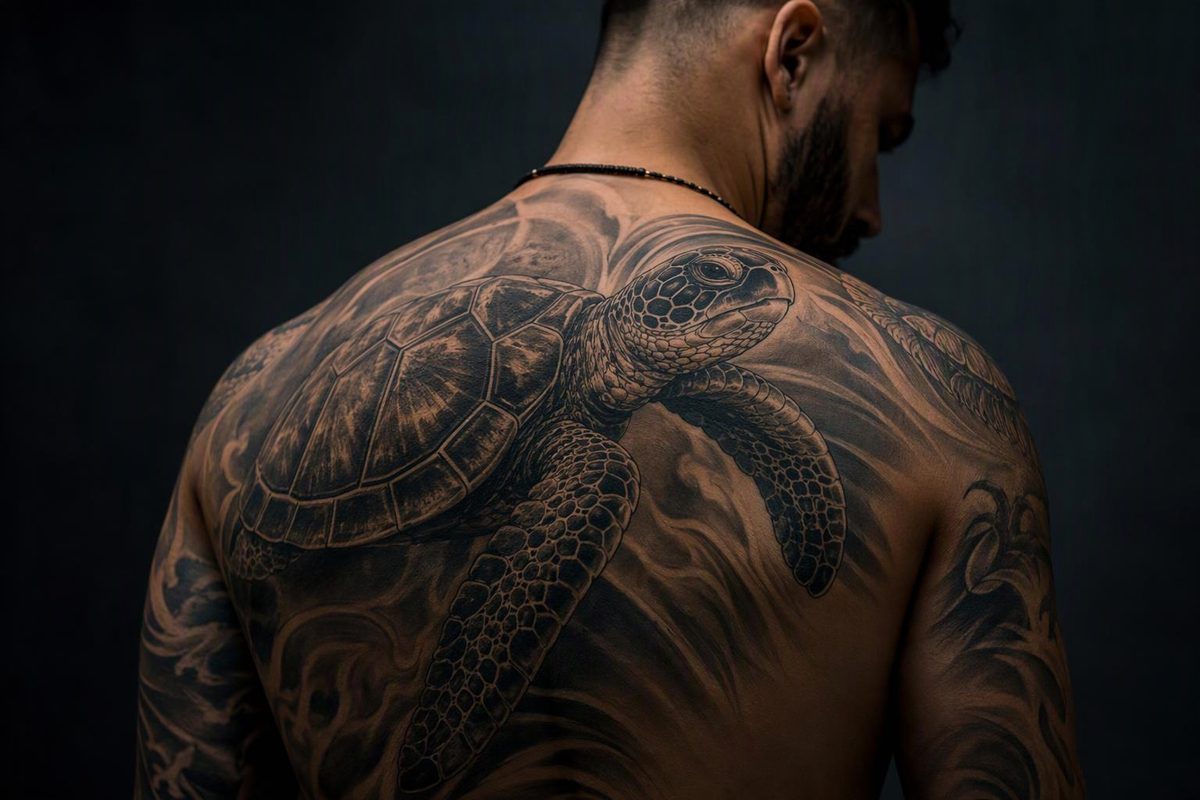
A turtle tattoo can signify longevity, protection, perseverance or a calm, steady approach to life. A sea turtle can also evoke navigation, travel and returning home. These are starting points, not a universal code: species, pose, accompanying symbols and cultural tradition all change the reading.
Some meanings come from documented cultural imagery. Others are modern interpretations of the animal’s body and behavior. It helps to know which is which before treating any meaning as traditional.
Common turtle tattoo meanings
- Longevity: Many turtles live for decades, although lifespan varies greatly by species. Sea turtles can reach at least 60 to 70 years, while some giant tortoises live beyond a century (Encyclopaedia Britannica). Long life is also a documented meaning in Japanese turtle imagery.
- Protection: The shell makes an immediate visual metaphor for safety, boundaries or carrying refuge with you. This is a contemporary design reading, not one meaning shared by every culture.
- Patience and perseverance: A walking turtle can represent deliberate progress—continuing without being hurried by someone else’s pace.
- Navigation and homecoming: Female sea turtles may migrate thousands of miles to nest at or near their birth beach. They use Earth’s magnetic field to orient themselves, along with cues that may include the beach’s smell (Smithsonian Ocean). A sea-turtle tattoo can turn that behavior into a personal symbol of finding the way home.
- Creation or stability: World-on-turtle stories appear in several distinct traditions. In one Haudenosaunee (Iroquois) creation account, land is formed on Great Turtle’s back after Sky Woman falls from the sky. The Smithsonian also records separate Moche, Seri and Hindu accounts involving a turtle and the world (Smithsonian Ocean). These traditions are not interchangeable.
Cultural context changes the meaning
Calling the turtle a universal symbol of “wisdom” or “Mother Earth” can erase important differences. Identify a design by its actual source rather than calling any patterned turtle “tribal.”
Japanese turtle imagery
In Japanese art, turtles can signify longevity and immortality. The Metropolitan Museum of Art describes a naturalistic Meiji-period turtle as part of that tradition and connects the animal with Mount Hōrai, the mythical island of immortality (The Met). LACMA likewise notes that the minogame—a mythical long-tailed turtle said to live for a thousand years—appears in designs wishing someone a long life (LACMA).
A Japanese-style turtle can therefore suit a tattoo about long life or an enduring bond. A minogame, crane or Mount Hōrai reference makes that reading more specific; a naturalistic turtle alone does not automatically announce a Japanese meaning.
Hawaiian honu
Honu is the Hawaiian name for the green sea turtle. Hawai‘i’s Division of Aquatic Resources says many Hawaiians view green sea turtles as ‘aumakua—family or personal deities that warrant protection and care (Hawai‘i Division of Aquatic Resources). That relationship should not be flattened into a generic claim that every honu means “guardian.”
One account of Kauila tells of a magical turtle who took the form of a girl to watch over children at Punaluʻu Beach (University of Hawaiʻi Maui College). It is a named story connected to a place, not a free-floating definition for all turtle art.
If a tattoo uses recognizably Hawaiian or other Polynesian pattern systems, ask an artist grounded in the relevant tradition about the pattern’s source and whether the composition is appropriate for you. A generic sea-turtle silhouette and a culturally specific patterned honu are not the same design.
The sailor’s shellback turtle
In U.S. naval tattoo tradition, a shellback turtle records an equator crossing. The Naval History and Heritage Command lists it among earned voyage markers, alongside other “crossing the line” imagery such as King Neptune and coordinates (Naval History and Heritage Command).
A traditional turtle with a “Shellback” banner, nautical imagery or an equator-crossing date may therefore read as a service record rather than a general love of the ocean. If that is not your history, omit the earned title and invented crossing details. For more on the visual grammar behind bold nautical flash, see what defines American traditional tattooing.
How the design changes the message
Pose supplies much of the personal reading. A turtle inside its shell can emphasize retreat, privacy or self-protection. A turtle moving forward suggests persistence. A swimming sea turtle can lean toward freedom, migration or homecoming. A hatchling heading toward the water may mark a vulnerable beginning or a new stage of life.
Surrounding elements can narrow the idea:
- Waves or a compass: travel, direction or homecoming
- Flowers: a gentler composition plus the flower’s own symbolism
- A cracked or repaired shell: survival after injury or hardship
- A family of turtles: parenthood, lineage or bonds across generations
- A world carried on the shell: creation, responsibility or cosmic stability—without claiming a named tradition unless the design genuinely comes from it
Color is not a fixed cipher. Blue can strengthen an oceanic mood, green can make the animal more naturalistic, and blackwork can emphasize the shell’s geometry. Meaning comes from the complete composition and the wearer’s intent, not a color chart.
Before the appointment, state the idea in one sentence: “a sea turtle returning home after a long journey” gives an artist more direction than “a turtle that means everything.” Bring references for species, pose and style, then let the artist build an original composition. If you are still comparing motifs, browse these tattoo ideas organized by meaning and style.